Tag: End Game Bonuses

Andromeda’s Edge 🟠

Behold, Andromeda’s Edge: A dazzling, uncharted region of space on the edge of the Andromeda Galaxy. Littered with the modular debris of the precursor civilization, patrolled by malicious extragalactic raiders, and bordered by dense nebulae, The Edge is a last resort for the brave and foolhardy who seek a new life beyond the oppressive reach of the Lords of Unity.

In this game, you lead a desperate faction seeking to build a new civilization on Andromeda’s Edge. You begin with only a space station, a few ships, and a handful of resources. By carefully placing your ships, you will gather resources, claim moons, acquire modules to add to your station, populate planets and build developments on them. You will battle opponents and compete with others to ascend the progress tracks: Science, Industry, Commerce, Civilization and Supremacy.

On your turn, you either launch a starship or return your ships to your station. Launching sends one of your starships to a region of Andromeda, either collecting resources from planetary systems or taking actions at Alliance Bases. If the region is occupied by your opponents or fearsome raiders, face off in a dice battle, with Supremacy on the line but where strategic manipulation can turn a loss into a reward. Returning to your station allows you to activate your engine, using the modules you’ve acquired to generate energy, gain resources and carry out actions.

Throughout the game you will build up your unique faction, building developments (Observatories, Factories, Spaceports, Cities and Obelisks) and gaining station modules which move you up the progress tracks. Advancement on the tracks is rewarded both during mid-game events and at the conclusion, and is the key to victory.

Age of Innovation 🔴

Age of Innovation is a standalone game set in the world of Terra Mystica.

Twelve factions, each with unique characteristics, populate this world of varying terrains. Here you will compete to erect buildings and merge them into cities. Each game allows you to create new combinations of factions, homelands, and abilities so that each game isn’t the same as another.

You control one of these factions and will terraform the game map’s terrain into your homelands where you can erect your buildings. Proximity to other factions may limit your expansion, but it also gains you significant advantages in the game. This tension adds to the appeal of the Terra Mystica series.

Upgrade your buildings to gain valuable resources such as tools, scholars, money, and power. Build schools to advance in different sciences and collect books, which you can use to make innovations. Build your palace to gain a powerful new ability or build workshops, guilds, and universities to complete your culture.

Carnegie

Carnegie was inspired by the life of Andrew Carnegie who was born in Scotland in 1835. Andrew Carnegie and his parents emigrated to the United States in 1848. Although he started his career as a telegraphist, his role as one of the major players in the rise of the United States’ steel industry made him one of the richest men in the world and an icon of the American dream.

Andrew Carnegie was also a benefactor and philanthropist; upon his death in 1919, more than $350 million of his wealth was bequeathed to various foundations, with another $30 million going to various charities. His endowments created nearly 2,500 free public libraries that bear his name: the Carnegie Libraries.

During the game you will recruit and manage employees, expand your business, invest in real estate, produce and sell goods, and create transport chains across the United States; you may even work with important personalities of the era. Perhaps you will even become an illustrious benefactor who contributes to the greatness of his country through deeds and generosity!

The game takes place over 20 rounds; players will each have one turn per round. On each turn, the active player will choose one of four actions, which the other players may follow.

The goal of the game is to build the most prestigious company, as symbolized by victory points.

Game Mechanics:

  • Area Movement
  • End Game Bonuses
  • Income
  • Network and Route Building
  • Solo / Solitaire Game
  • Tech Trees / Tech Tracks
  • Variable Phase Order
  • Worker Placement

Game Specifications:

  • 1 – 4 Players
  • 90 – 120 Minutes
  • Difficulty Weight 3.81

Ark Nova

In Ark Nova, you will plan and design a modern, scientifically managed zoo. With the ultimate goal of owning the most successful zoological establishment, you will build enclosures, accommodate animals, and support conservation projects all over the world. Specialists and unique buildings will help you in achieving this goal.

Each player has a set of five action cards to manage their gameplay, and the power of an action is determined by the slot the card currently occupies. The cards in question are:

  • CARDS: Allows you to gain new zoo cards (animals, sponsors, and conservation project cards).
  • BUILD: Allows you to build standard or special enclosures, kiosks, and pavilions.
  • ANIMALS: Allows you to accommodate animals in your zoo.
  • ASSOCIATION: Allows your association workers to carry out different tasks.
  • SPONSORS: Allows you to play a sponsor card in your zoo or to raise money.

255 cards featuring animals, specialists, special enclosures, and conservation projects, each with a special ability, are at the heart of Ark Nova. Use them to increase the appeal and scientific reputation of your zoo and collect conservation points.

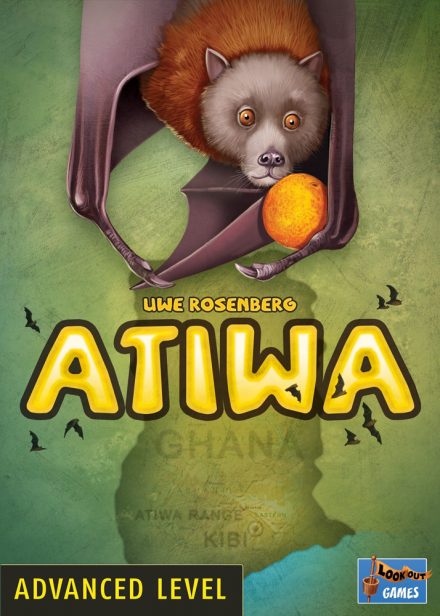
Atiwa

The Atiwa Range is a region of southeastern Ghana in Africa consisting of steep-sided hills with rather flat summits. A large portion of the range comprises an evergreen forest reserve, which is home to many endangered species. However, logging and hunting for bushmeat, as well as mining for gold and bauxite, are putting the reserve under a lot of pressure.

Meanwhile, in the nearby town of Kibi, the mayor is causing a stir by giving shelter to a large number of fruit bats in his own garden. This man has recognized the great value the animals have in deforested regions of our planet: Fruit bats sleep during the day and take off at sunset in search of food, looking for suitable fruit trees up to sixty miles away. They excrete the seeds of the consumed fruit, disseminating them across large areas as they fly home. A single colony of 150,000 fruit bats can reforest an area of up to two thousand acres a year.

Just like that mayor, in Atiwa, you know that fruit bats — once scorned and hunted as mere fruit thieves — are in fact incredibly useful animals, spreading seeds over large areas of the country. By doing so, they help to reforest fallow land and, in the medium term, improve harvests. This realization has led to a symbiotic co-operation between fruit bats and fruit farmers. The animals are kept as “pets” to increase the size of fruit farms more quickly. Tall trees are left as roosts, providing shelter for them rather than hunting them for their scant meat. However, if you have a lot of fruit bats, you need a lot of space…

In the game, you will develop a small community near the Atiwa Range, creating housing for new families and sharing your newly gained knowledge on the negative effects of mining and the importance that the fruit bats have for the environment. You must acquire new land, manage your animals and resources, and make your community prosper. The player who best balances the needs of their community and the environment wins.

Anno 1800: The Board Game 🟡

In Anno 1800, a board game based on the popular PC game from Ubisoft, you continuously build up your own industry to develop your home island.

Ship fleets allow for lively trade and the development of new islands in the Old and New World. You have to fulfill the wishes of your own population. While the inhabitants are initially satisfied with bread and clothing, they soon demand valuable luxury goods. You must plan production chains sensibly and keep an eye on the specialization of your population. The goal: A wise distribution of farmers, workers, craftsmen, engineers, and investors — but the competition never sleeps and can snatch the new achievements from under your nose at any time! Who can create the most prosperous island?

Aquatica

Aquatica is a deep, but easy to learn family engine builder about underwater kingdoms.

In the game you will become one of the mighty ocean kings, struggling to bring glory to his realm. To win the game, you need to capture and buy locations, recruit new characters, and complete goals; each of these actions gives you victory points at the end of the game. To do so, you need to play cards from your hand (each with a unique set of actions) and combine them. Don’t think it’s simple! With a good strategy during your turn, you can take up to ten actions in a row.

You will encounter plenty of mysterious ocean creatures and take them to your hand. With their help you will explore the unknown locations and raise found resources from the ocean depths to your kingdom. Mechanically this is represented with the help of three-layered player board and the unique mechanism of card-rising.

Acquire 🟢

In Acquire, each player strategically invests in businesses, trying to retain a majority of stock. As the businesses grow with tile placements, they also start merging, giving the majority stockholders of the acquired business sizable bonuses, which can then be used to reinvest into other chains. All of the investors in the acquired company can then cash in their stocks for current value or trade them 2-for-1 for shares of the newer, larger business. The game is a race to acquire the greatest wealth.

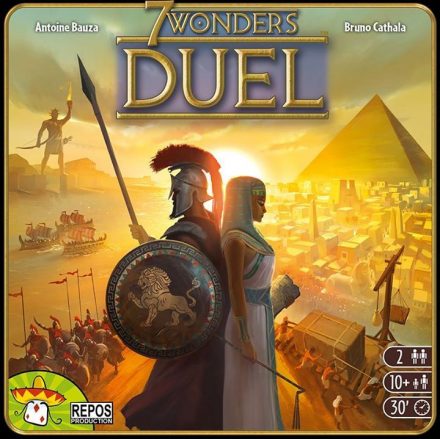
7 Wonders Duel 🟢

In many ways 7 Wonders Duel resembles its parent game 7 Wonders as over three ages players acquire cards that provide resources or advance their military or scientific development in order to develop a civilization and complete wonders.

What’s different about 7 Wonders Duel is that, as the title suggests, the game is solely for two players, with the players not drafting cards simultaneously from hands of cards, but from a display of face-down and face-up cards arranged at the start of a round. A player can take a card only if it’s not covered by any others, so timing comes into play as well as bonus moves that allow you to take a second card immediately. As in the original game, each card that you acquire can be built, discarded for coins, or used to construct a wonder.

Each player starts with four wonder cards, and the construction of a wonder provides its owner with a special ability. Only seven wonders can be built, though, so one player will end up short.

Players can purchase resources at any time from the bank, or they can gain cards during the game that provide them with resources for future building; as you acquire resources, the cost for those particular resources increases for your opponent, representing your dominance in this area.

A player can win 7 Wonders Duel in one of three ways: each time you acquire a military card, you advance the military marker toward your opponent’s capital, giving you a bonus at certain positions; if you reach the opponent’s capital, you win the game immediately; similarly, if you acquire any six of seven different scientific symbols, you achieve scientific dominance and win immediately; if none of these situations occurs, then the player with the most points at the end of the game wins.

7 Wonders 🟢

You are the leader of one of the 7 great cities of the Ancient World. Gather resources, develop commercial routes, and affirm your military supremacy. Build your city and erect an architectural wonder which will transcend future times.

7 Wonders lasts three ages. In each age, players receive seven cards from a particular deck, choose one of those cards, then pass the remainder to an adjacent player. Players reveal their cards simultaneously, paying resources if needed or collecting resources or interacting with other players in various ways. (Players have individual boards with special powers on which to organize their cards, and the boards are double-sided). Each player then chooses another card from the deck they were passed, and the process repeats until players have six cards in play from that age. After three ages, the game ends.

In essence, 7 Wonders is a card development game. Some cards have immediate effects, while others provide bonuses or upgrades later in the game. Some cards provide discounts on future purchases. Some provide military strength to overpower your neighbors and others give nothing but victory points. Each card is played immediately after being drafted, so you’ll know which cards your neighbor is receiving and how her choices might affect what you’ve already built up. Cards are passed left-right-left over the three ages, so you need to keep an eye on the neighbors in both directions.