Tag: Hand Management

Hand Management is a game mechanic in which players are rewarded for playing cards in a specific order. This mechanic often encourages players to hold cards for later turns.

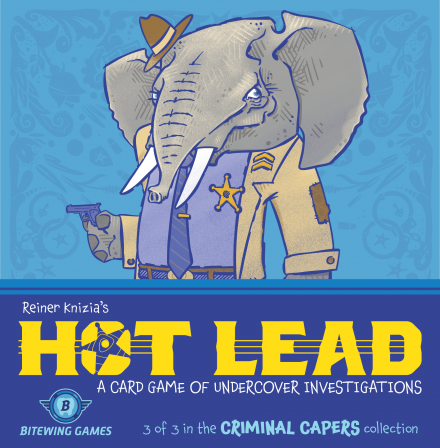
Hot Lead

Lead the undercover investigation against five criminal groups to gather enough evidence to convict them. However, if you investigate too aggressively, the criminals will smell a rat and go dark!

In each round of Hot Lead, criminal cards are displayed in a column equal to the number of players. Players then make their bid by simultaneously revealing an investigator card from their hand. The highest investigator bid takes the criminal card closest to the deck, the second highest takes the second closest, and so on. These cards are worth points equal to their face value (0-5).

Gather enough evidence on one criminal organization to convict them when the game concludes after ten rounds; in game terms, by having exactly three of a suit, you earn 10 bonus points. Ten bonus points are also awarded to those who acquire criminal cards of all five suits. If you investigate too aggressively and grab the fourth card of a suit, those criminals will sense a rat and you’ll scare them underground, thereby losing all of those cards. The player with the most points at the end of the game wins.

—description from publisher

Game Specifications:

  • 2 – 5 Players
  • 15 Minutes
  • Difficulty Weight 1.25

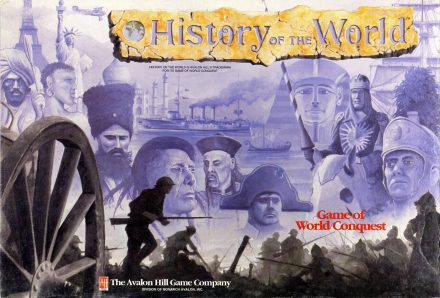
History of the World

History of the World works under the assumptions that all empires eventually fade and that the only things differentiating great empires from lesser ones is how much territory they conquer and how long it takes for their civilizations to disappear. The game is played out over 7 epochs or rounds, from the ancient 3000 B.C. Sumerians to the pre-WW1 Germany, with every player controlling a new rising empire from history. Some empires are stronger than others (like the Romans), but the game’s clever mechanisms can help balance that out. At the end of each epoch, players score points for all units of their color (from both the current and any previous empires) remaining on the board.

Before the start of their turn a player may play up to two Event cards from their hand. The Events played are resolved before the player starts his Empire’s actions. If the player’s active Empire has navigation a ship token is placed in each sea or ocean listed (if an ocean is listed all adjacent seas to the ocean have ship markers put into them). A Reallocation Greater Event allows an Empire with Navigation to exchange Fleets in seas and oceans for Coins that can be used to buy back defeated troops (1 coin per troop). If the active Empire has a capitol it is taken and placed in the Empire’s starting land with one unit of the Empire’s available troops. Since each land space may only contain one troop the player begins expanding from their starting land by placing troops in any adjacent land space that they wish to occupy or conquer. To conquer a land the attacker moves one unit into the land space either from adjacent land or through a sea with a ship in it. Then dice are rolled, the attacker gets 2 dice and the defender only one, unless the attacker traveled across a strait or the defender’s land has either a forest, the great wall of China, or mountains on the border of the land that the attacker came from. In this case the defender receives 2 dice as well. If the attack comes from the sea the defender gets 3 dice for defense. Highest score wins with ties killing off both the defender and attacker. In this case the attacker can merely place the next troop, if he has any left, in the now-empty land space.

At any time the active Empire player may exchange an unplaced troop for a fort. On later turns, a fort gives the player a +1 to defensive rolls in that land. Also, if the defender in a fort loses or ties with an attacker only the fort is removed and the battle continues. Whenever an army conquers a land with a capitol the capitol mini is flipped reducing it to a city (if it was a city to begin with it is removed from board when conquered). After the active player’s Empire is finished with it’s actions check to see if it conquered to land spaces with resource symbols, if so it can build a monument.

Then scoring takes place. Each area (Middle-East, Northern Europe, Eurasia, etc…) has a tile with 3 values for the current Epoch. One value is for having a presence in the area (at least one land). Another value is for having Dominance in the area (at least 2 lands and more than any other player in area). The last value is for having Control of an area (at least 3 lands and no other player has any in area). These values vary from Epoch to Epoch and Area to Area (Middle-East is more valuable in early Epochs and fades in later Epochs, for example). Total the scores from each area for all pieces of the player’s color from all Empires controlled that remain on board. Then add 2 points for each capitol controlled, 1 point per city and one point for each monument controlled. After all areas are scored the next Empire called takes its turn.

After all players have taken their turns and scored, for the first Epoch, the player with the highest score gets to take a pre-eminence marker and places it in front of him. These are secret bonus points (worth somewhere from 3 to 6) for the end of the game and may not be examined till then. This bonus to leader helps balance the Empire-draw mechanic and makes it valuable to score maximal points even early in the game, rather than tanking to get a better draw later. Then drawing begins for the next Epoch with the player having the lowest score drawing first on up to the person with the highest score drawing last (and likely being given a less than optimal Empire by another player).

After the last player has scored for Epoch 7 and the leader has drawn a pre-eminence marker, all players reveal their pre-eminence markers and add them to their scores. The player with the highest score wins.

Game Specifications:

  • 3 – 6 Players
  • 135 – 270 Minutes
  • Difficulty Weight 2.77

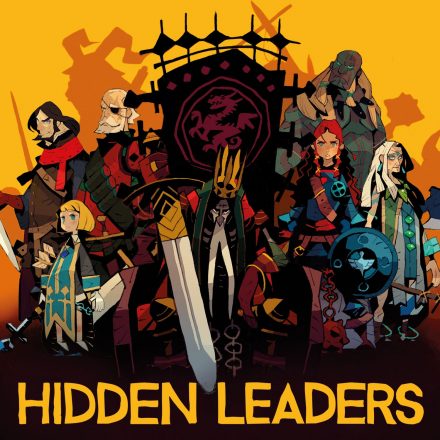
Hidden Leaders

The island of Oshra is in turmoil. Following the death of the Emperor, the conflict between the Hill Tribes and the Imperial Army escalated. While the Water People try to maintain balance between the old rivals, the Undead aim to escalate the war. All hope rests on the six children of the Emperor: Who of them will claim the throne?

In Hidden Leaders, you take the role of one of six secret leaders, each of them is allied with two of the four factions/colors. By playing heroes into your tableau, either openly or secretly, you influence the outcome of the conflict.

At the end of the game, one of the four factions will win:
Red leading > Red victory
Green leading > Green victory
Tie between Red & Green > Blue victory
Red & Green in War Zone > Black victory
Each player who is aligned with the winning faction can claim the victory. However, they must have more heroes of this color than any competitor.

Hidden Leaders is a quick, light strategy card game with direct player interaction. It combines tableau building and deduction elements with its unique winning mechanism. This is a game of great tension with no-down time, that’s fast to learn. Its distinctive artwork and character names will make you smile.

—description from designer

Game Specifications:

  • 2 – 6 Players
  • 20 – 40 Minutes
  • Difficulty Weight 1.82

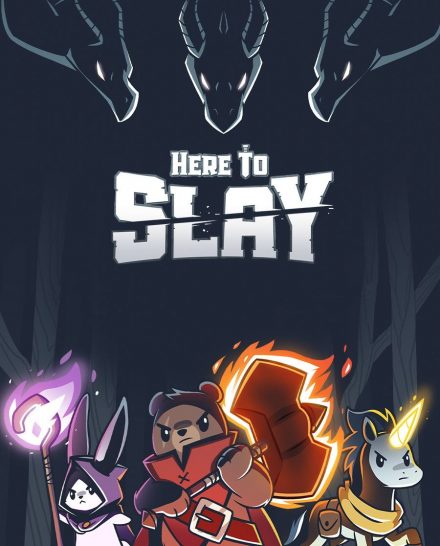
Here to Slay

Here to Slay is a competitive role-playing fantasy strategy card game that’s all about assembling a party of Heroes and slaying monsters (and sometimes sabotaging your friends too) from the creators of Unstable Unicorns.

In this game, you’ll assemble a full party of heroes to slay dangerous monsters while working to avoid the sabotage of your foes. The game also includes items you can equip to your heroes, 1V1 challenge cards, and roll modifiers to tip the odds in your favor.

The first person to successfully slay three monsters, or build a full party with six classes, wins the game!

Every player gets to choose a party leader character to represent them throughout the game. Each party leader card has a class and a skill that gives you an edge over your opponents. Whether you enjoy fighters, bards, wizards, or thieves, you’ll find a party leader that’s right for your play style – but choose wisely, because you only get one party leader for the whole game!

Your heroes are brave adventurers, ready to attack monsters and go head to head with your foes! The game includes over 40 unique heroes. Each hero card has a class and an effect, and each hero’s effect has a roll requirement. In order to use a hero’s effect, you must roll two dice and score equal to or higher than that effect’s roll requirement. Heroes take advantage of items, magic and modifiers to increase their chances of making their dice rolls.
In order to slay that monster, you must roll two dice and score equal to or higher than that monster’s roll requirement. Be warned: Each monster has a roll range in which they’ll fight back, and if you score within that range, your party might be in grave danger…

Don’t like what your opponent just played? Throw down a challenge! Challenge cards can be played instantly to try to stop another player from playing a hero, item, or magic card. Playing a challenge card initiates a 1V1 challenge in which you and another player both have to roll the dice. If they win the challenge, they still get to play their card, but if you win the challenge, you get to send their card directly to the discard pile!

— description from the publisher

Game Specifications:

  • 2 – 6 Players
  • 30 – 60 Minutes
  • Difficulty Weight 1.68

Hegemony: Lead Your Class to Victory

The Nation is in disarray and a war is waging between the classes. The working class faces a dismantled welfare system, the capitalists are losing their hard-earned profits, the middle class is gradually fading and the state is sinking into a deep deficit. Amidst all this chaos, the only person who can provide guidance is… you. Will you take the side of the working class and fight for social reforms? Or will you stand with the corporations and the free market? Will you help the government try to keep it all together, or will you try to enforce your agenda no matter the cost to the country?

Hegemony is an asymmetric politico-economic card-driven board game for 2-4 players that puts you in the role of one of the socio-economic groups in a fictional state: The Working Class, the Middle Class, the Capitalist Class and the State itself.

The Working class controls the workers. The Capitalist class controls the companies. The Middle class combines elements from both the Working class and the Capitalist. It has workers who can work in the Capitalist’s companies but it can also build companies of its own, yet smaller. Finally the State is trying to keep everyone happy, providing benefits and subsidies when needed but trying also to maintain a steady income through taxes to avoid going into debt.

While players have their own separate goals, they are all limited by a series of policies that affect most of their actions, like Taxation, Labor Market, Foreign Trade etc. Voting on those policies and using their influence to change them is also very important. Through careful planning, strategic actions and political maneuvering, you will do your best to increase the power of your class and carry out your agenda. Will you be the one to lead your class to victory?

Hegemony is heavily based on actual academic principles such as Social-Democracy, Neoliberalism, Nationalism and Globalism, and allows players to see their real world applications through engaging gameplay. There are many ways to achieve hegemony- which one will you take?

—description from the publisher
Game Specifications:

  • 2 – 4 Players
  • 90 – 180 Minutes
  • Difficulty Weight 4.26

Heart of Crown

They were tough times, the days when swords and magic still ruled the world. A long, destructive war had ended, and the entire continent had been unified. Before the empire’s subjects had even come to know peace, however, their great emperor fell victim to disease, having never declared a successor…

We must not return to that war-torn world! Thankfully you are an influential figure in the empire. Quickly lay claim to the throne and ensure the rock-solid unity and peace of the continent. Though the emperor had no son, there are seven candidates for succession, starting with the two lineal princesses. Now, let’s get your favorite princess on the emperor’s throne! Garner support from all over the country, clash with rival candidates and depend on your special skill!

Heart of Crown is a deck-building card game. Each player starts with the same deck, strengthens that deck with strategic cards, and finally one player will declare victory by throning the princess he controls. Each player’s deck starts with seven “Rural” territory cards and three “Apprentice Handmaid” succession cards (an unreliable subject). Using the currency (coins) generated by your “Rural” territory cards, you incorporate cards from the market into your deck according to your own strategy.

Each player’s main goal is to give the princess he’s fielded the throne. First, collect stronger territory cards such as “City” and “Metropolis” to increase your coins, and declare fielding a princess using these coins. There are five princesses and one set of twin princesses, totaling six princess cards. Each princess has special support abilities, but with only one of each, you need to be quick to field the right princess and get the support you need!

For your princess to take the throne, you must collect Succession Points, which represent the support of your loyal subjects and influential figures in the empire. Once you control 20 Succession Points, you may declare a coronation. Your opponents get one more turn to interrupt your coronation, but if your points remain at or above 20 by your next turn, the coronation succeeds and your princess takes the throne!

Game Specifications:

  • 2 – 4 Players
  • 30 – 60 Minutes
  • Difficulty Weight 2.50

Hare & the Tortoise, the (Tales & Games)

The Hare & the Tortoise, originally published as Royal Turtle, is a card-driven betting game about animal racing loosely based on one of Aesop’s Fables.

At the start of a race, each player secretly bets on up to two of five animals: turtle, rabbit, lamb, wolf and fox. One animal is chosen at random for each player, then after receiving a hand of seven cards, each player places one of his cards face-down (possibly the same animal) as an additional bet. Players then take turns laying down 1-4 cards, with all cards needing to show the same animal, then refilling the hand to five cards. As soon as eight total cards have been played or four cards of any one animal, the animals move (maybe).

Each animal has a distinct characteristic that players can use to their advantage. The turtle always moves one space, but it moves two if four of its cards were played. The rabbit always moves two spaces as long as cards are played. — unless four cards are played and it’s at the head of the pack, in which case it sleeps and doesn’t move. The fox moves as many spaces as the number of cards played. The lamb moves one more space than the number of cards played — but if it reaches water, it stops moving to take a drink. The wolf moves 1 space if one to two cards are played, and one less space than the number of cards if more are played. The wolf also has 3 cards with a howl, if one of these is played no one but the wolf moves.(The track consists of eleven road cards, two covered with water.)

After the animals move, players start a new round of card-playing. A round ends when three of the five animals reach the goal, after which each player scores points based on the ranking of the animals and how they bet. After three rounds, the player with the most points wins.

The original title of Royal Turtle is a homage to Reiner Knizia’s Royal Turf, another betting game about animals racing (albeit horses in that game).

Game Specifications:

  • 2 – 5 Players
  • 15 – 20 Minutes
  • Difficulty Weight 1.37

Hanamikoji: Geisha’s Road

“Yoko… What lies ahead for us?” asked her friend Tomoyo.
Yoko stared out into the sea, calm and serene. “Today we are just maiko. But one day, we will complete our training and become known as geisha.”
“Yes, artists of the highest order. But then what?”
“Okaasan said that one day, perhaps some of us may be lucky to inherit the teahouse… if fortune favors us and our hard work.”

Welcome back to Hanamikoji! In Hanamikoji: Geisha’s Road is a two-player based on “Hanamikoji” with a new Geisha movement and roundel system added to the game design to make the strategy more diversified. It’s competitive strategy game full of implicit intentions, veiled messages, and hidden actions, players represent rival but friendly patrons supporting Yoko, Tomoyo, and others along their journey from apprentice (maiko) to full geisha (artist) and perhaps even the owner (okaasan) of their own establishment.

To do so, players help their favored geisha advance and build prestige through performing their art at different teahouses. Geisha start as apprentices (maiko) but become full geisha and score prestige points after accruing the necessary patronage to return to their original teahouse (ochaya) for the graduation ceremony (erikae). Some geisha may continue their path further and eventually inherit the teahouse (upon a second return) to become the new okaasan, recognized with more prestige points.

At the end of the game, the player who provides the most support to each geisha is recognized. The player who has supported the most prestigious group of geisha wins the game.

Game Specifications:

  • 2 Players
  • 25 Minutes
  • Difficulty Weight 2.18

Hanabi

Hanabi—named for the Japanese word for “fireworks”—is a cooperative game in which players try to create the perfect fireworks show by placing the cards on the table in the right order. (In Japanese, hanabi is written as 花火; these are the ideograms flower and fire, respectively.)

The card deck consists of five different colors of cards, numbered 1–5 in each color. For each color, the players try to place a row in the correct order from 1–5. Sounds easy, right? Well, not quite, as in this game you hold your cards so that they’re visible only to other players. To assist other players in playing a card, you must give them hints regarding the numbers or the colors of their cards. Players must act as a team to avoid errors and to finish the fireworks display before they run out of cards.

An extra suit of cards, rainbow colored, is also provided for advanced or variant play.

Hanabi was originally published as part of Hanabi & Ikebana.

Game Specifications:

  • 2 – 5 Players
  • 25 Minutes
  • Difficulty Weight 1.69

Guillotine

The French Revolution is famous in part for the use of the guillotine to put nobles to death, and this is the macabre subject of this light card game. As executioners pandering to the masses, the players are trying to behead the most popular nobles. Each day the nobles are lined up and players take turns killing the ones at the front of the line until all the nobles are gone. However, players are given cards which will manipulate the line order right before ‘harvesting’ heads, which is what makes the game interesting. After three days of chopping, the highest total carries the day.

Game Specifications:

  • 2 – 5 Players
  • 30 Minutes
  • Difficulty Weight 1.27