Tag: Civilization

Civilization board games have mechanics similar to the actual game Civilization, in which players would acquire prestige by marrying nobility and holding noble titles.

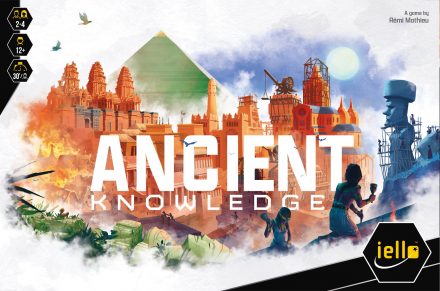
Ancient Knowledge

Heirs to an exceptional knowledge that has survived the ages, it is now up to you to preserve the vestige of your civilization.

Ancient Knowledge is a strategic card game in which you erect monuments and build artefacts to pass on your knowledge. Time will make your constructions ephemeral,so make the right decision and combine the many cards at your disposal, because all knowledge is doomed to disappear…

It’s up to you to find the best synergy so that you can pass down knowledge before the decline of the emblematic monuments you have constructed, monuments we still find nowadays in the four corners of the globe. From Mexican pyramids to the Sphinx of Giza, passing through the famous cities of Tiwanaku and Babylon, only the cleverest builder will shine through the ages and seize victory. In this game, your only enemy is time.

Prove to your opponents that you are the worthy representative of your Legacy!
Will your monuments withstand the trial of time?

Game Specifications:

  • 2 – 4 Players
  • ~75 Minutes
  • Difficulty Weight 2.72

Antiquity Quest 🔵

Your goal in Antiquity Quest is to have the highest score a the end of the game. You can choose to play either a single round for a quick game (20-30 min) or a complete game in which you’ll tally scores over three rounds (60-90 min)

Each player is dealt two sets of 10 cards at the start of a round. You’ll pick up one set, this is called a hand. The second set, called a cache, remains face down on the table until you’ve played all of the cards from your hand.

You’ll take turns drawing, playing, and discarding cards as you work on creating your own collections and sabotaging the collections that belong to other players.

Collections consist of Antiquity and Treasure cards. The six suits of Antiquity cards represent six ancient civilizations. Treasures are their own suit and are more rare and valuable. The more challenging a collection is to create. the more it’s worth.

A round ends once a player has completed at least five collections and played through all of the cards in their hand and cache. That player earns a bonus for going out first. Every other player takes on last turn and then scores are tallied.

Your score at the end of each round is the combination of bonus points from going out first, points for completing collections ,and points for the cards you play. The player with the highest score at the end of the game wins.

Here’s what to expect in this bold and exciting set collection game:

You’ll strive to create collections of Antiquities and Treasures.

The more challenging a collection is to create, the more it’s worth.

Beware! Your competitors can, and will seek to sabotage your efforts.

Careful planning, brilliant strategy, and a stroke of luck will bring you success!

Game Specifications:

  • 2 – 8 Players
  • 30 – 90 Minutes
  • Difficulty Weight 1.20

Age of Innovation 🔴

Age of Innovation is a standalone game set in the world of Terra Mystica.

Twelve factions, each with unique characteristics, populate this world of varying terrains. Here you will compete to erect buildings and merge them into cities. Each game allows you to create new combinations of factions, homelands, and abilities so that each game isn’t the same as another.

You control one of these factions and will terraform the game map’s terrain into your homelands where you can erect your buildings. Proximity to other factions may limit your expansion, but it also gains you significant advantages in the game. This tension adds to the appeal of the Terra Mystica series.

Upgrade your buildings to gain valuable resources such as tools, scholars, money, and power. Build schools to advance in different sciences and collect books, which you can use to make innovations. Build your palace to gain a powerful new ability or build workshops, guilds, and universities to complete your culture.

Twilight Imperium: Fourth Edition

Twilight Imperium: Fourth Edition

Twilight Imperium: Fourth Edition

Twilight Imperium (Fourth Edition) is a game of galactic conquest in which three to six players take on the role of one of seventeen factions vying for galactic domination through military might, political maneuvering, and economic bargaining. Every faction offers a completely different play experience, from the wormhole-hopping Ghosts of Creuss to the Emirates of Hacan, masters of trade and economics. These seventeen races are offered many paths to victory, but only one may sit upon the throne of Mecatol Rex as the new masters of the galaxy.

No two games of Twilight Imperium are ever identical. At the start of each galactic age, the game board is uniquely and strategically constructed using 51 galaxy tiles that feature everything from lush new planets and supernovas to asteroid fields and gravity rifts. Players are dealt a hand of these tiles and take turns creating the galaxy around Mecatol Rex, the capital planet seated in the center of the board. An ion storm may block your race from progressing through the galaxy while a fortuitously placed gravity rift may protect you from your closest foes. The galaxy is yours to both craft and dominate.

A round of Twilight Imperium begins with players selecting one of eight strategy cards that both determine player order and give their owner a unique strategic action for that round. These may do anything from providing additional command tokens to allowing a player to control trade throughout the galaxy. After these roles are selected, players take turns moving their fleets from system to system, claiming new planets for their empire, and engaging in warfare and trade with other factions. At the end of a turn, players gather in a grand council to pass new laws and agendas, shaking up the game in unpredictable ways.

After every player has passed their turn, players move up the victory track by checking to see whether they have completed any objectives throughout the turn and scoring them. Objectives are determined by setting up ten public objective cards at the start of each game, then gradually revealing them with every round. Every player also chooses between two random secret objectives at the start of the game, providing victory points achievable only by the holder of that objective. These objectives can be anything from researching new technologies to taking your neighbor’s home system. At the end of every turn, a player can claim one public objective and one secret objective. As play continues, more of these objectives are revealed and more secret objectives are dealt out, giving players dynamically changing goals throughout the game. Play continues until a player reaches ten victory points.

Game Mechanics:

  • Action Drafting
  • Civilization
  • Dice Rolling
  • Economic
  • Grid Movement
  • Negotiation
  • Racing
  • Trading
  • Wargame

Game Specifications:

  • 3 – 6 Players
  • 240 – 480 Minutes
  • Difficulty Weight 4.27

Underwater Cities

Underwater Cities

Underwater Cities

In Underwater Cities, which takes about 30-45 minutes per player, players represent the most powerful brains in the world, brains nominated due to the overpopulation of Earth to establish the best and most livable underwater areas possible.

The main principle of the game is card placement. Three colored cards are placed along the edge of the main board into 3 x 5 slots, which are also colored. Ideally players can place cards into slots of the same color. Then they can take both actions and advantages: the action depicted in the slot on the main board and also the advantage of the card. Actions and advantages can allow players to intake raw materials; to build and upgrade city domes, tunnels and production buildings such as farms, desalination devices and laboratories in their personal underwater area; to move their marker on the initiative track (which is important for player order in the next turn); to activate the player’s “A-cards”; and to collect cards, both special ones and basic ones that allow for better decision possibilities during gameplay.

All of the nearly 220 cards — whether special or basic — are divided into five types according to the way and time of use. Underwater areas are planned to be double-sided, giving players many opportunities to achieve VPs and finally win.

Game Mechanics:

  • City Building
  • Civilization
  • Hand Management
  • Network Building
  • Tableau Building
  • Worker Placement

Game Specifications:

  • 1 – 4 Players
  • 80 – 150 Minutes
  • Difficulty Weight 3.60

Tzolk’in

Tzolk'in

Tzolk'in

Tzolkin: The Mayan Calendar presents a new game mechanism: dynamic worker placement. Players representing different Mayan tribes place their workers on giant connected gears, and as the gears rotate they take the workers to different action spots.

During a turn, players can either (a) place one or more workers on the lowest visible spot of the gears or (b) pick up one or more workers. When placing workers, they must pay corn, which is used as a currency in the game. When they pick up a worker, they perform certain actions depending on the position of the worker. Actions located “later” on the gears are more valuable, so it’s wise to let the time work for you – but players cannot skip their turn; if they have all their workers on the gears, they have to pick some up. 

The game ends after one full revolution of the central Tzolkin gear. There are many paths to victory. Pleasing the gods by placing crystal skulls in deep caves or building many temples are just two of those many paths…

Game Mechanics:

  • Civilization
  • Economic
  • Worker Placement

Game Specifications:

  • 2 – 4 Players
  • ~90 Minutes
  • Difficulty Weight 3.67

Tigris & Euphrates

Tigris & Euphrates

Tigris & Euphrates

Regarded by many as Reiner Knizia’s masterpiece, Tigris & Euphrates is set in the ancient fertile crescent with players building civilizations through tile placement. Players are given four different leaders: farming, trading, religion, and government. The leaders are used to collect victory points in these same categories. However, your score at the end of the game is the number of points in your weakest category, which encourages players not to get overly specialized. Conflict arises when civilizations connect on the board, i.e., external conflicts, with only one leader of each type surviving such a conflict. Leaders can also be replaced within a civilization through internal conflicts.

Starting in the Mayfair edition from 2008, Tigris & Euphrates included a double-sided game board and extra components for playing an advanced version of the game. This “ziggurat expansion”, initially released as a separate item in Germany for those who already owned the base game, is a special monument that extends across five spaces of the board. The monument can be built if a player has a cross of five civilization tokens of the same color by discarding those five tokens and replacing them with the ziggurat markers, placing a ziggurat tower upon the middle tile. The five ziggurat markers cannot be destroyed. All rules regarding monuments apply to the ziggurat monument as well. If your king is inside the kingdom of the ziggurat, you will get one victory point in a color of your choice at the end of your turn.

Game Mechanics:

  • Abstract Strategy
  • Area Control
  • Civilization
  • Hand Management
  • Set Collection
  • Tile Placement

Game Specifications:

  • 2 – 4 Players
  • ~90 Minutes
  • Difficulty Weight 3.50

Through the Ages

Through the Ages

Through the Ages

Through the Ages is a civilization building game. Each player attempts to build the best civilization through careful resource management, discovering new technologies, electing the right leaders, building wonders and maintaining a strong military. Weakness in any area can be exploited by your opponents. The game takes place throughout the ages beginning in the age of antiquity and ending in the modern age.

One of the primary mechanisms in TTA is card drafting. Technologies, wonders, and leaders come into play and become easier to draft the longer they are in play. In order to use a technology you will need enough science to discover it, enough food to create a population to man it and enough resources (ore) to build the building to use it. While balancing the resources needed to advance your technology you also need to build a military. Military is built in the same way as civilian buildings. Players that have a weak military will be preyed upon by other players. There is no map in the game so you cannot lose territory, but players with higher military will steal resources, science, kill leaders, take population or culture. It is very difficult to win with a large military, but it is very easy to lose because of a weak one.

Victory is achieved by the player whose nation has the most culture at the end of the modern age.

Game Mechanics:

  • Action Points
  • Auction/Bidding
  • Civilization
  • Economic
  • Hand Management
  • Open Drafting
  • Tableau Building

Game Specifications:

  • 2 – 4 Players
  • ~120 Minutes
  • Difficulty Weight 4.17

Terra Mystica

Terra Mystica

Terra Mystica

In the land of Terra Mystica dwell 14 different peoples in seven landscapes, and each group is bound to its own home environment, so to develop and grow, they must terraform neighboring landscapes into their home environments in competition with the other groups.

Terra Mystica is a full information game, without any luck, that rewards strategic planning. Each player governs one of the 14 groups. With subtlety and craft, the player must attempt to rule as great an area as possible and to develop that group’s skills. There are also four religious cults in which you can progress. To do all that, each group has special skills and abilities.

Taking turns, the players execute their actions on the resources they have at their disposal. Different buildings allow players to develop different resources. Dwellings allow for more workers. Trading houses allow players to make money. Strongholds unlock a group’s special ability, and temples allow you to develop religion and your terraforming and seafaring skills. Buildings can be upgraded: Dwellings can be developed into trading houses; trading houses can be developed into strongholds or temples; one temple can be upgraded to become a sanctuary. Each group must also develop its terraforming skill and its skill with boats to use the rivers. The groups in question, along with their home landscape, are:

  • Desert (Fakirs, Nomads)
  • Plains (Halflings, Cultists)
  • Swamp (Alchemists, Darklings)
  • Lake (Mermaids, Swarmlings)
  • Forest (Witches, Auren)
  • Mountain (Dwarves, Engineers)
  • Wasteland (Giants, Chaos Magicians)

Proximity to other groups is a double-edged sword in Terra Mystica. Being close to other groups gives you extra power, but it also means that expanding is more difficult…

Game Mechanics:

  • Civilization
  • Economic
  • Network Building
  • Tableau Building

Game Specifications:

  • 2 – 5 Players
  • 60 – 150 Minutes
  • Difficulty Weight 3.97

Tawantinsuyu

Tawantinsuyu

Tawantinsuyu

The great Sapa Inca Pachacuti turned to his offspring and ordered them to worship Inti, the Sun God, and to expand the Inca Empire as far as the llamas roam. With Chinchaysuyu, Antisuyu, Qullasuyu, and Kuntisuyu — the four regions of the new empire — now ripe for conquest, the time has come for Pachacuti’s true successor to arise.

Gather your people from the villages below and use their unique abilities to strategically place them where they can perform the greatest tasks for you. Climb the steps of the Sun Temple, reaping the rewards of your piety. Build structures that both nourish your people and provide you with benefits no other has at their disposal. Muster an army and conquer villages in the four realms of Tawantinsuyu. Prove yourself a worthy successor to Pachacuti and lead the Inca to glory!

During Tawantinsuyu: The Inca Empire, players place workers onto various locations on the game board, performing actions, collecting resources (potatoes, corn, stone, and gold), constructing buildings and stairs, sculpt statues, expanding their military strength, and collecting weavings.

The game board features a hill located within the old Inca capital of Cusco, the sides of which are terraced and divided into five sections. Atop the hill sits the Coricancha, The Golden Temple, the most important temple of the Inca Empire. Within the Coricancha, each player has a High Priest. On the terraced sections below exist a variety of worker placement locations, interconnected by paths and individually marked by symbols. On your turn, you must either place a worker onto a location outside the Coricancha OR choose two of the following:

  • Recruit one worker.
  • Take two god cards.
  • Draw two army cards and keep one of them.
  • Move your High Priest one or two steps clockwise within the Coricancha.

When placing a worker, you must first discard a god card with a matching symbol or pay one gold. Once placed, the worker remains on the game board for the rest of the game! Each worker placement location is connected to exactly three action spaces. You must always perform at least one of these actions. However, for each adjacent worker (i.e., connected to your worker’s location via direct path through one of the action spaces) that matches the type of worker just placed, you receive one additional action!

While some locations will result in you being able to perform multiple actions, other actions and placements may be more desirable, especially since each of the five types of workers has a unique ability:

  • Warrior: Remove one of the adjacent workers, placing it in your player area.
  • Craftsman: Gain +1 action if placed onto a craftsman space.
  • Architect: Gain +1 action if placed onto an architect space.
  • Courier: Decreased placement cost; +1 action if it’s the first worker placed within a given area.
  • Priest: Take one god card; you may pay one potato to gain +1 action.

All god cards feature one of the different symbols found on the worker placement locations. Before placing a worker, you must either discard a god card with a matching symbol or pay valuable gold resources. God cards also depict special abilities that can be activated only if you have previously built a matching statue!

Army cards allow you to send one or more units to conquer villages in nearby regions. You must compete against the other players for control of each region as well as for valuable rewards that can be gained as a result of military conquest.

The position of your High Priest within the Coricancha has a significant impact on your overall strategy, affecting your access to powerful actions and determining any potential resource costs when placing your workers. More specifically, when placing a worker, you must pay additional resources the farther your worker is from your High Priest, from nothing all the way up to eight potatoes or corn!

Additionally, when moving your High Priest, you can activate powerful actions available only within the Coricancha:

  • Produce: Gain all rewards from your production buildings.
  • Worship: Sacrifice previously sculpted statues to gain permanent temple advancements.
  • Offering: Pay resources to gain temple advancements.
  • Conquer: Engage in military conquest of nearby villages.
  • Rejuvenate: Refresh previously activated buildings and military units.

Throughout the game, you score victory points whenever you construct stairs or sculpt statues. Gain bonus victory points whenever another player makes use of the stairs you have constructed. Score victory points from temple advancements and control of the four regions.

The game ends when the worker pool has become exhausted, symbolizing the full incorporation of nearby regions and villages into the newly risen Inca Empire. You then score bonus victory points from reaching the top of the temple, from your woven tapestries, and from various buildings and resources you have accumulated.

Game Mechanics:

  • Action Points
  • Area Control
  • Civilization
  • Economic
  • Hand Management
  • Open Drafting
  • Pattern Building
  • Rondel
  • Set Collection
  • Worker Placement

Game Specifications:

  • 1 – 4 Players
  • 60 – 120 Minutes
  • Difficulty Weight 4.07