Tag: Economic

Economic games encourage players to produce, distribute, and trade various resources.

Gallerist, The

This age of art and capitalism has created a need for a new occupation – The Gallerist.

Combining the elements of an Art dealer, museum curator, and Artists’ manager, you are about to take on that job! You will promote and nurture Artists; buy, display, and sell their Art; and build and exert your international reputation. As a result, you will achieve the respect needed to draw visitors to your Gallery from all over the world.

There’s a lot of work to be done, but don’t worry, you can hire assistants to help you achieve your goals. Build your fortune by running the most lucrative Gallery and secure your reputation as a world-class Gallerist!

Maximize your money and thus win the game by:

  • having visitors in your gallery;
  • exhibiting and selling works of art;
  • investing in artists’ promotion to increase art value;
  • achieving trends and reputation as well as curator and dealer goals.

Game Specifications:

  • 1 – 4 Players
  • 60 – 150 Minutes
  • Difficulty Weight 4.21

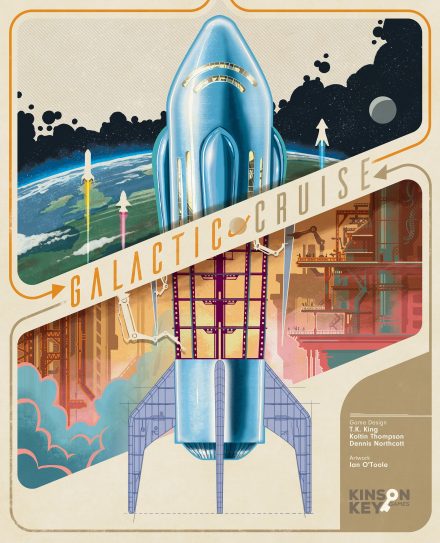
Galactic Cruise

Hello, and welcome to Galactic Cruise. Here, we offer our guests something special: the comfort of a luxury cruise with the innovation of space travel. As the first company to offer extended-stay space vacations, we are excited to have you working for us! As a supervisor of this company, you’ll be expected to not only build these ships and satisfy our guests, but also to help the company thrive by enhancing our company network, inventing new technologies, and growing our workforce. We are a united company, and you’ll often find that what another supervisor does will make your job easier. Let me be clear, though, this is a competition. Our current CEO will be stepping down in three years, and the supervisor who comes out on top will take his place.

On your turn, you will either place a worker to take two actions in the ever-expanding network, launch a ship and send one of your workers to space as a pilot, or recall all your earthbound workers to collect funding bonuses. Actions include acquiring blueprints, constructing ships, attracting guests, and building developments–connections between locations that increase action selection throughout the game. You will also be affecting resource markets that ebb and flow with the actions of all the players.

Throughout the game, you will also be competing with your fellow supervisors to complete company goals, which will earn you progress cubes throughout the game. Progress cubes are also placed when you launch ships, and when a certain number of cubes are placed onto the company’s progress track, the game ends, and the player with the most Victory Points becomes the new CEO of Galactic Cruise.

Do you still think you have what it takes to work for us? You do? Great. Let’s get started.

Game Specifications:

  • 1- 4 Players
  • 90 – 150 Minutes
  • Difficulty Weight 3.99

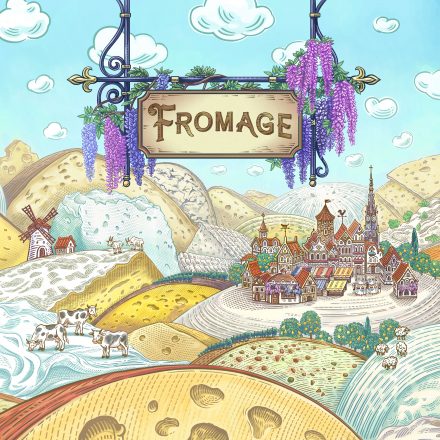
Fromage

You are a French cheesemaker in the early 20th century making, aging, and selling your artisanal cheeses. Become the most prestigious cheesemaker in all of France by running a highly successful creamery and crafting exceptional cheese.

Fromage is a simultaneous worker-placement game where players place Workers to make cheese and gather resources from the quadrant of the board facing them. Once all players have placed their Workers, the board rotates, aging any cheese that was made, and presenting each player with a new quadrant to place Workers into. Score Prestige Points by selling cheese to the four locations, and by efficiently managing and upgrading your creamery.

Game Specifications:

  • 1 – 4 Players
  • 30 – 45 Minutes
  • Difficulty Weight 2.38

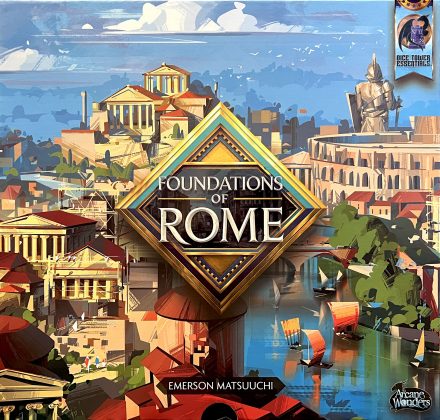
Foundations of Rome

The city-building board game Foundations of Rome puts you into the role of an architect competing to own land and build magnificent structures! Build domūs and insulae, fountains, foundries, and more to increase your renown – gaining glory for yourself and the empire! With 96 wonderfully detailed miniatures in the base game, Foundations of Rome is a testament to the glory of Rome that you can bring to the table.

Foundations of Rome is the next, and biggest game to date, in the Dice Tower Essentials line and is designed by famed designer Emerson Matsuuchi. With a quick setup time and easy to learn to rules you will be on your way to achieving glory within Rome in no time!

On a player’s turn they select from purchasing a new lot, building a new building in the shared city of Rome, or collecting income!

Players collect Glory Points at the end of each round based on the population and commerce they have brought to the city as well as gaining glory for civic buildings that score not only based on their own buildings, but those of their opponents!

Game Specifications:

  • 1 – 5 Players
  • 30 – 60 Minutes
  • Difficulty Weight 1.99

For Sale

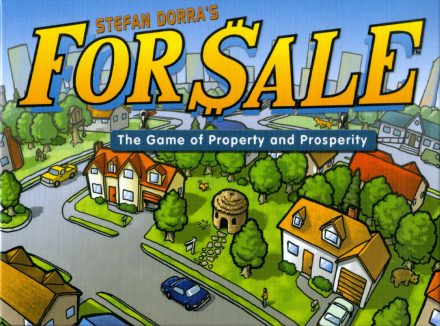
For Sale is a quick, fun game nominally about buying and selling real estate. During the game’s two distinct phases, players first bid for several buildings then, after all buildings have been bought, sell the buildings for the greatest profit possible.

Rounding rule

The rounding rule preferred by the designer Stefan Dorra is that players get back half of their bid rounded DOWN (not UP), as confirmed in correspondence with him here and here. A history of how the rounding rule has changed in different editions is documented here.

Game Specifications:

  • 3 – 6 Players
  • 30 Minutes
  • Difficulty Weight 1.25

Food Chain Magnate

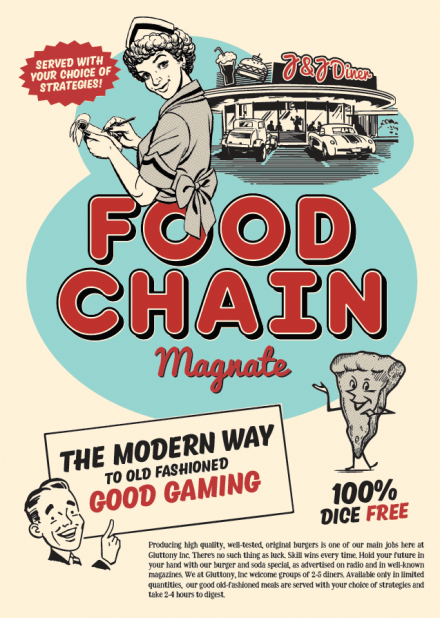
“Lemonade? They want lemonade? What is the world coming to? I want commercials for burgers on all channels, every 15 minutes. We are the Home of the Original Burger, not a hippie health haven. And place a billboard next to that new house on the corner. I want them craving beer every second they sit in their posh new garden.” The new management trainee trembles in front of the CEO and tries to politely point out that… “How do you mean, we don’t have enough staff? The HR director reports to you. Hire more people! Train them! But whatever you do, don’t pay them any real wages. I did not go into business to become poor. And fire that discount manager, she is only costing me money. From now on, we’ll sell gourmet burgers. Same crap, double the price. Get my marketing director in here!”

Food Chain Magnate is a heavy strategy game about building a fast food chain. The focus is on building your company using a card-driven (human) resource management system. Players compete on a variable city map through purchasing, marketing and sales, and on a job market for key staff members. The game can be played by 2-5 serious gamers in 2-4 hours.

Game Specifications:

  • 2- 5 Players
  • 120 – 240 Minutes
  • Difficulty Weight 4.19

Finca

The gameboard of Finca shows the mediterranean island of Mallorca. Players try to crop and deliver the fruits of Mallorca (such as oranges, lemons, almonds, grapes etc.) by means of moving workers on a traditional windmill. Object of the game is to distribute your crop as effectively as possible in order to deliver faster than your opponents.

From the Box: Mallorca, Island of the Wind. A place of golden beaches and a light-blue sea. The almond harvest is at hand, in addition, juicy oranges, lemons, and figs are ready to be picked and taken to the market. Olive trees bewitch the country with their curled branches and sumptuous vineyards invite passers-by to walk among their warm earth. In the midst of this landscape, your centuries-old natural stone farmhouse provides a home and supports your large windmill: your FINCA.
Listen to the wind, which propels your windmill! Then take in the course of the yearly harvest the sweetest and most valuable fruits from the land. Load them on your old donkey cart and travel around the island, selling them everywhere. If you manage this quickly, you will soon be the richest farmer on the island.

Game Specifications:

  • 2 – 5 Players
  • ~45 Minutes
  • Difficulty Weight 2.07

East India Companies

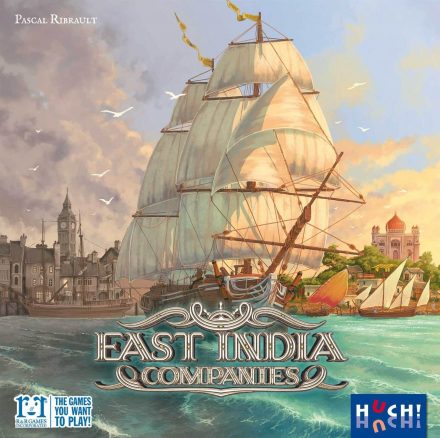
In the 18th and 19th centuries, shipping companies aimed to strengthen the trade between the West and the Far East that had begun in previous centuries. Tea, spices, coffee, and silk are commodities much consumed in Europe, and their buying and selling prices depend closely on supply and demand. Fortunes can be made and gambled depending on circumstances.

In East India Companies, players manage a large shipping company that trades with far flung trading posts in India. They must manage their ships and invest in buying shares of their own company or those of their competitors. Most importantly, players have to keep an eye on the constantly fluctuating market prices! Is it better to invest your money in the stock market or in buying goods? Do they prefer to use fast ships with low tonnage or slower ships with larger holds? Whatever the players choose, their strategies will influence those of their opponents.

Game Specifications:

  • 2 – 4 Players
  • 90 – 120 Minutes
  • Difficulty Weight 3.00

Anachrony 🟠

It is the late 26th century. Earth is recovering from a catastrophic explosion that exterminated the majority of the population centuries ago and made most of the surface uninhabitable due to unearthly weather conditions. The surviving humans organized along four radically different ideologies, called Paths, to rebuild the world as they see fit: Harmony, Dominance, Progress, and Salvation. Followers of the four Paths live in a fragile peace, but in almost complete isolation next to each other. Their only meeting point is the last major city on Earth, now just known as the Capital.

By powering up the mysterious Time Rifts that opened in the wake of the cataclysm, each Path is able to reach back to specific moments in their past. Doing so can greatly speed up their progress, but too much meddling may endanger the time-space continuum. But progress is more important than ever before: if the mysterious message arriving through the Time Rift is to be believed, an even more terrible cataclysm is looming on the horizon: an asteroid bearing the mysterious substance called Neutronium is heading towards Earth. Even stranger, the scientists show that the energy signature of the asteroid matches the explosion centuries ago…

Anachrony features a unique two-tiered worker placement system. To travel to the Capital or venture out to the devastated areas for resources, players need not only various specialists (Engineers, Scientists, Administrators, and Geniuses) but also Exosuits to protect and enhance them — and both are in short supply.

The game is played in 4-7 turns, depending on the time when the looming cataclysm occurs — unless, of course, it is averted! The elapsed turns are measured on a dynamic timeline. By powering up the Time Rifts, players can reach back to earlier turns to supply their past “self” with resources. Each Path has a vastly different objective that rewards it with a massive amount of victory points when achieved. The Paths’ settlements will survive the impact, but the Capital will not. Whichever Path manages to collect most points will be the new seat for the Capital, thus the most important force left on the planet…

Game Specifications:

  • 1 – 4 Players
  • 30 – 120 Minutes
  • Difficulty Weight 4.01

Twilight Imperium: Fourth Edition

Twilight Imperium: Fourth Edition

Twilight Imperium: Fourth Edition

Twilight Imperium (Fourth Edition) is a game of galactic conquest in which three to six players take on the role of one of seventeen factions vying for galactic domination through military might, political maneuvering, and economic bargaining. Every faction offers a completely different play experience, from the wormhole-hopping Ghosts of Creuss to the Emirates of Hacan, masters of trade and economics. These seventeen races are offered many paths to victory, but only one may sit upon the throne of Mecatol Rex as the new masters of the galaxy.

No two games of Twilight Imperium are ever identical. At the start of each galactic age, the game board is uniquely and strategically constructed using 51 galaxy tiles that feature everything from lush new planets and supernovas to asteroid fields and gravity rifts. Players are dealt a hand of these tiles and take turns creating the galaxy around Mecatol Rex, the capital planet seated in the center of the board. An ion storm may block your race from progressing through the galaxy while a fortuitously placed gravity rift may protect you from your closest foes. The galaxy is yours to both craft and dominate.

A round of Twilight Imperium begins with players selecting one of eight strategy cards that both determine player order and give their owner a unique strategic action for that round. These may do anything from providing additional command tokens to allowing a player to control trade throughout the galaxy. After these roles are selected, players take turns moving their fleets from system to system, claiming new planets for their empire, and engaging in warfare and trade with other factions. At the end of a turn, players gather in a grand council to pass new laws and agendas, shaking up the game in unpredictable ways.

After every player has passed their turn, players move up the victory track by checking to see whether they have completed any objectives throughout the turn and scoring them. Objectives are determined by setting up ten public objective cards at the start of each game, then gradually revealing them with every round. Every player also chooses between two random secret objectives at the start of the game, providing victory points achievable only by the holder of that objective. These objectives can be anything from researching new technologies to taking your neighbor’s home system. At the end of every turn, a player can claim one public objective and one secret objective. As play continues, more of these objectives are revealed and more secret objectives are dealt out, giving players dynamically changing goals throughout the game. Play continues until a player reaches ten victory points.

Game Mechanics:

  • Action Drafting
  • Civilization
  • Dice Rolling
  • Economic
  • Grid Movement
  • Negotiation
  • Racing
  • Trading
  • Wargame

Game Specifications:

  • 3 – 6 Players
  • 240 – 480 Minutes
  • Difficulty Weight 4.27