Category: Competitive Games

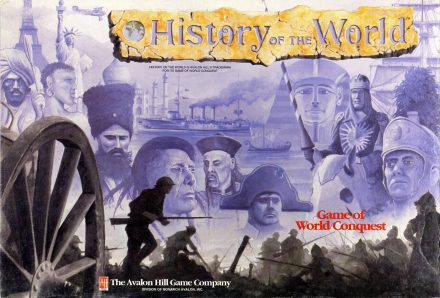
History of the World

History of the World works under the assumptions that all empires eventually fade and that the only things differentiating great empires from lesser ones is how much territory they conquer and how long it takes for their civilizations to disappear. The game is played out over 7 epochs or rounds, from the ancient 3000 B.C. Sumerians to the pre-WW1 Germany, with every player controlling a new rising empire from history. Some empires are stronger than others (like the Romans), but the game’s clever mechanisms can help balance that out. At the end of each epoch, players score points for all units of their color (from both the current and any previous empires) remaining on the board.

Before the start of their turn a player may play up to two Event cards from their hand. The Events played are resolved before the player starts his Empire’s actions. If the player’s active Empire has navigation a ship token is placed in each sea or ocean listed (if an ocean is listed all adjacent seas to the ocean have ship markers put into them). A Reallocation Greater Event allows an Empire with Navigation to exchange Fleets in seas and oceans for Coins that can be used to buy back defeated troops (1 coin per troop). If the active Empire has a capitol it is taken and placed in the Empire’s starting land with one unit of the Empire’s available troops. Since each land space may only contain one troop the player begins expanding from their starting land by placing troops in any adjacent land space that they wish to occupy or conquer. To conquer a land the attacker moves one unit into the land space either from adjacent land or through a sea with a ship in it. Then dice are rolled, the attacker gets 2 dice and the defender only one, unless the attacker traveled across a strait or the defender’s land has either a forest, the great wall of China, or mountains on the border of the land that the attacker came from. In this case the defender receives 2 dice as well. If the attack comes from the sea the defender gets 3 dice for defense. Highest score wins with ties killing off both the defender and attacker. In this case the attacker can merely place the next troop, if he has any left, in the now-empty land space.

At any time the active Empire player may exchange an unplaced troop for a fort. On later turns, a fort gives the player a +1 to defensive rolls in that land. Also, if the defender in a fort loses or ties with an attacker only the fort is removed and the battle continues. Whenever an army conquers a land with a capitol the capitol mini is flipped reducing it to a city (if it was a city to begin with it is removed from board when conquered). After the active player’s Empire is finished with it’s actions check to see if it conquered to land spaces with resource symbols, if so it can build a monument.

Then scoring takes place. Each area (Middle-East, Northern Europe, Eurasia, etc…) has a tile with 3 values for the current Epoch. One value is for having a presence in the area (at least one land). Another value is for having Dominance in the area (at least 2 lands and more than any other player in area). The last value is for having Control of an area (at least 3 lands and no other player has any in area). These values vary from Epoch to Epoch and Area to Area (Middle-East is more valuable in early Epochs and fades in later Epochs, for example). Total the scores from each area for all pieces of the player’s color from all Empires controlled that remain on board. Then add 2 points for each capitol controlled, 1 point per city and one point for each monument controlled. After all areas are scored the next Empire called takes its turn.

After all players have taken their turns and scored, for the first Epoch, the player with the highest score gets to take a pre-eminence marker and places it in front of him. These are secret bonus points (worth somewhere from 3 to 6) for the end of the game and may not be examined till then. This bonus to leader helps balance the Empire-draw mechanic and makes it valuable to score maximal points even early in the game, rather than tanking to get a better draw later. Then drawing begins for the next Epoch with the player having the lowest score drawing first on up to the person with the highest score drawing last (and likely being given a less than optimal Empire by another player).

After the last player has scored for Epoch 7 and the leader has drawn a pre-eminence marker, all players reveal their pre-eminence markers and add them to their scores. The player with the highest score wins.

Game Specifications:

  • 3 – 6 Players
  • 135 – 270 Minutes
  • Difficulty Weight 2.77

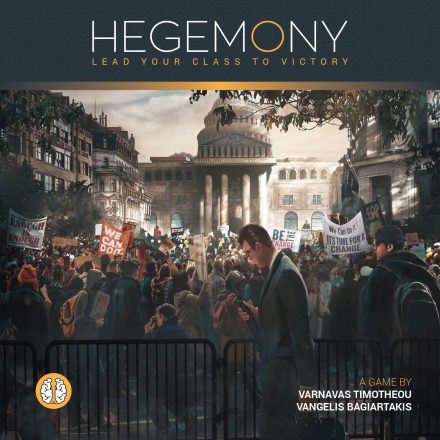
Hegemony: Lead Your Class to Victory

The Nation is in disarray and a war is waging between the classes. The working class faces a dismantled welfare system, the capitalists are losing their hard-earned profits, the middle class is gradually fading and the state is sinking into a deep deficit. Amidst all this chaos, the only person who can provide guidance is… you. Will you take the side of the working class and fight for social reforms? Or will you stand with the corporations and the free market? Will you help the government try to keep it all together, or will you try to enforce your agenda no matter the cost to the country?

Hegemony is an asymmetric politico-economic card-driven board game for 2-4 players that puts you in the role of one of the socio-economic groups in a fictional state: The Working Class, the Middle Class, the Capitalist Class and the State itself.

The Working class controls the workers. The Capitalist class controls the companies. The Middle class combines elements from both the Working class and the Capitalist. It has workers who can work in the Capitalist’s companies but it can also build companies of its own, yet smaller. Finally the State is trying to keep everyone happy, providing benefits and subsidies when needed but trying also to maintain a steady income through taxes to avoid going into debt.

While players have their own separate goals, they are all limited by a series of policies that affect most of their actions, like Taxation, Labor Market, Foreign Trade etc. Voting on those policies and using their influence to change them is also very important. Through careful planning, strategic actions and political maneuvering, you will do your best to increase the power of your class and carry out your agenda. Will you be the one to lead your class to victory?

Hegemony is heavily based on actual academic principles such as Social-Democracy, Neoliberalism, Nationalism and Globalism, and allows players to see their real world applications through engaging gameplay. There are many ways to achieve hegemony- which one will you take?

—description from the publisher

Game Specifications:

  • 2 – 4 Players
  • 90 – 180 Minutes
  • Difficulty Weight 4.26

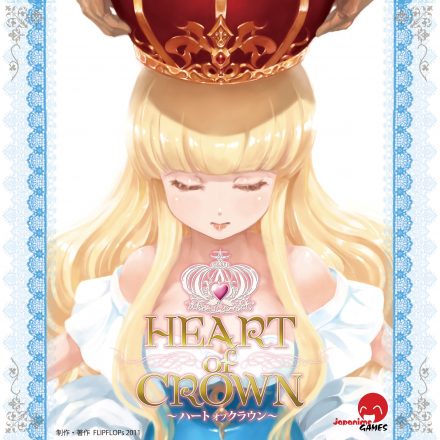
Heart of Crown

They were tough times, the days when swords and magic still ruled the world. A long, destructive war had ended, and the entire continent had been unified. Before the empire’s subjects had even come to know peace, however, their great emperor fell victim to disease, having never declared a successor…

We must not return to that war-torn world! Thankfully you are an influential figure in the empire. Quickly lay claim to the throne and ensure the rock-solid unity and peace of the continent. Though the emperor had no son, there are seven candidates for succession, starting with the two lineal princesses. Now, let’s get your favorite princess on the emperor’s throne! Garner support from all over the country, clash with rival candidates and depend on your special skill!

Heart of Crown is a deck-building card game. Each player starts with the same deck, strengthens that deck with strategic cards, and finally one player will declare victory by throning the princess he controls. Each player’s deck starts with seven “Rural” territory cards and three “Apprentice Handmaid” succession cards (an unreliable subject). Using the currency (coins) generated by your “Rural” territory cards, you incorporate cards from the market into your deck according to your own strategy.

Each player’s main goal is to give the princess he’s fielded the throne. First, collect stronger territory cards such as “City” and “Metropolis” to increase your coins, and declare fielding a princess using these coins. There are five princesses and one set of twin princesses, totaling six princess cards. Each princess has special support abilities, but with only one of each, you need to be quick to field the right princess and get the support you need!

For your princess to take the throne, you must collect Succession Points, which represent the support of your loyal subjects and influential figures in the empire. Once you control 20 Succession Points, you may declare a coronation. Your opponents get one more turn to interrupt your coronation, but if your points remain at or above 20 by your next turn, the coronation succeeds and your princess takes the throne!

Game Specifications:

  • 2 – 4 Players
  • 30 – 60 Minutes
  • Difficulty Weight 2.50

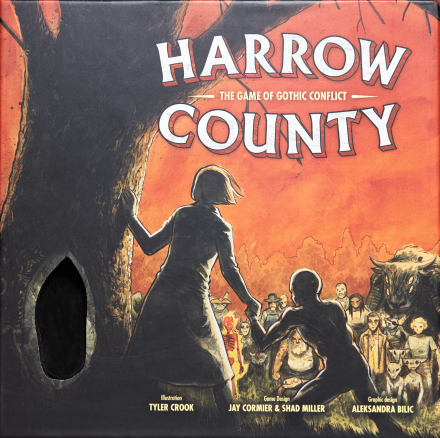
Harrow County: The Game of Gothic Conflict

A witch named Hester was hung, burned, and buried under a tree. Some time later, the family of Hester came to Harrow County to destroy it, but standing in their way is eighteen-year-old Emmy who mysteriously has powers of her own.

In the asymmetric combat game Harrow County: The Game of Gothic Conflict, players can play as one of the Protectors, trying to rescue townsfolk, or as one of the family, trying to destroy Harrow County. You can instead play as a third faction that originates from the surprise return of Emmy’s twin sister, Kammi, who wants to rule Harrow County. Players activate mason jars to move their haints (undead creatures) around the hex-based board as they try to accomplish their missions. Combat is resolved using a never-before-seen cube tower that’s built into the actual box.

Finally, a third player can enter the game: Hester, the dead witch buried under the tree. She controls the roots of the tree and using the cube tower, Hester can infect haints on her roots, which causes a snake to be placed into its ear. That player can still control this haint, but now so can Hester. If Hester comes back to life, then she needs to eat the other legends to gain all her power back to win.

In short, Harrow County is a thematic, tactical game of territory control and enemy elimination to determine the fate of Harrow County.

—description from the publisher

Guildhall Fantasy: Box of Holding

Guildhall Fantasy: Box of Holding contains 4 Guildhall Fantasy games all in one spot! Feel free to mix and match the different sets for new experiences each time you play!

Guildhall Fantasy: Fellowship

Do you have a thirst for adventure? Is your middle name danger? Do you just like treasure? Form a party of adventurers to help you be victorious! The more members of each class you have, the greater the bonus they’ll give you – but be careful; your opponents might try to poach your party members!

In Guildhall Fantasy: Fellowship, 2-4 players compete to create the perfect party by recruiting adventurers into their guildhall chapters. Collect sets of cards with unique abilities to control the table, and complete a full chapter to claim victory cards. Will you go for points quickly, or build up your special powers? Which will lead to ultimate victory? Only you and the gamemaster know!

Guildhall Fantasy: Alliance

In Guildhall Fantasy: Alliance, each profession grants you special abilities, and these abilities grow stronger the more of that profession that you collect. When you cash in that profession set for victory points, however, you lose the ability until you can build it up again.

Guildhall Fantasy: Coalition

In Guildhall Fantasy: Coalition, each profession grants you special abilities, and these abilities grow stronger the more of that profession that you collect. When you cash in that profession set for victory points, however, you lose the ability until you can build it up again.

Advanced Guildhall Fantasy: The Gathering

There can be only… Wait! There is another!

Guildhall Fantasy: The Gathering is a standalone game in the Guildhall series, featuring six never before seen professions. Additionally, this set contains two mini expansions: “The Chapter Masters” and “The Master Houses”.

Game Specifications:

  • 2 – 4 Players
  • 30 – 45 Minutes
  • Difficulty Weight 2.00

Guild of Merchant Explorers, the

In The Guild of Merchant Explorers, each player starts with one city on their personal map board.

Shuffle the deck of terrain cards, then reveal most of these cards one by one. Based on the terrain revealed, each player places on their board cubes that are connected to their starting city or other cubes. You want to complete areas on your board, cross the seas to new land, and establish new cities on the board. You can explore capsized ships for treasure — which gives you special placement capabilities — and create linked connections between locations to score bonus points. Common objectives can be completed by all players, with those who complete it first scoring more points.

At the end of a round, all cubes are removed from each board, leaving only the cities behind, so if you don’t establish new cities, you’ll be stuck in the same places.

The Guild of Merchant Explorers contains multiple copies of four different maps, and the game is designed so that you can play remotely with one or more copies.

Game Specifications:

  • 1 – 4 Players
  • 45 Minutes
  • Difficulty Weight 2.05

Guild Academies of Valeria

You and your fellow Headmasters are trying to build out your academies, recruit the best students, hire talented guildmasters, and influence important council ministers. Only select graduates can be tasked to fulfill quests ordered by the King, while the so-so graduates are sent to the capital city to make their own way.

GAOV uses action selection, dice drafting and dice manipulation (Students), tile drafting, resource management and engine building (Academies), contract fulfillment (Quests), and a unique system where players choose which game aspects they want to score (Council Ministers) to bring a new aspect of the Valeria Universe to life.

—description from the publisher

Game Specifications:

  • 1 – 4 Players
  • 90 – 120 Minutes
  • Difficulty Weight 2.94

Grimm Forest, the

Welcome to The Grimm Forest, where family members of the legendary Three Little Pigs are having an epic house building competition. But this is no ordinary competition as all the most famous Fairy Tale characters will be looking on and occasionally lending a hand.

Who will benefit most from the cunning of Robin Hood, the beauty of Snow White, the bountiful gifts of the Golden Goose or the dark witchcraft of the Evil Queen?

Using only their wits, a handful of sharp steel tools, and a few stacks of resources gathered at great risk from fields, brickyards, and even the dark and deadly Grimm Forest itself, each player must compete to be the first to build 3 Houses and gain the title of Royal Builder.

Players are encouraged to use any of the devious tricks they have read about in the many books of Fables found throughout the land. Some will have their plans wrecked by that villain of old, the Big Bad Wolf, while others will gain bricks, straw, and wood by the cart load.

Who will brave the dangers, avoid foul monsters, and bring home the victory? There is only one way to find out… get ready to venture into …The Grimm Forest!

Grimm Forest is a 2-4 player strategic game of Hidden Movement, Resource Gathering, and House Building. It is a medium weight game that plays in approximately 45-60 minutes.

During the game, players will play cards secretly to move to various Location boards where they attempt to gather resources. Using their deduction skills and a hand full of Fable cards, players attempt to guess each other’s plans and make the most of their actions while disrupting the other player’s plans.

After resources are collected during the Gather Phase, players will enter a Building Phase where they can use those resources to build Wood, Straw, or Brick Houses. Whenever a player builds a Wall Section on one of their houses, a helpful Friend from the nearby forest comes to lend a hand. Players may choose to accept the help of that Friend, but occasionally it makes more sense to send that Friend to a different player, sometimes discarding their current Friend in the process.

With 16 unique Fable cards and 12 powerful Friend cards, gathering resources in the Grimm Forest can be a difficult and challenging endeavor.

Work hard, deduce correctly, avoid the treachery of the other builders and the sharp teeth of the lurking monsters, and you just might have a chance!

Game Specifications:

  • 2 – 4 Players
  • 45 – 60 Minutes
  • Difficulty Weight 1.93

Great Western Trail: New Zealand

Kia ora, and welcome to Great Western Trail New Zealand!

Towards the end of the 19th century, you established yourself as a runholder (owner of a sheep station) on the South Island of New Zealand. Recent years have seen your family farm prosper by diversifying your breeds of sheep and increasing the value of your wool.

With the dawn of the new century, difficult challenges have arisen. You must acquire improved and valuable breeds of sheep to ensure the prosperity of your family business and the labourers who work for you. Decide whether to focus on your past strengths or to diversify into new ventures. Will the beginning of the 20th century be as rewarding as earlier years, or will the efforts of others surpass your strategy? Good luck, and kia kaha!

In Great Western Trail New Zealand, you move your runholder along a trail that winds and forks from the lower left corner of the game board to Wellington in the upper right. Along your path, you perform actions that provide you with various ways to earn victory points.

Each time your runholder reaches Wellington, you deliver sheep to a local or foreign trading post, which may also be worth victory points. Afterwards, your runholder continues its movement again.

Game Specifications:

  • 1 – 4 Players
  • 75 – 150 Minutes
  • Difficulty Weight 4.01

Great Western Trail: El Paso

El Paso at the end of the 19th century: Five railroad companies have connected the Sun City to their network and made it a major hub for the cattle trade. Ranchers from the surrounding parts of Texas and Mexico drive their cattle into the city to send them on their long journey to the north, east, and west of the United States.

In Great Western Trail: El Paso, you take on the role of the ranchers of that time and bring your best cattle to El Paso to earn money and victory points. Hire more cowboys, builders, and engineers to get closer to your goals:

Buy cattle to increase the value of your herd!
Construct buildings to unlock more actions!
Participate in the expansion of the railroad and secure the most attractive contracts!
El Paso is mechanically based on its predecessors in the Great Western Trail trilogy. It can serve as an introduction to the series and is the perfect game for game nights when there is not enough time for its big brothers!

—description from the publisher

Game Specifications:

  • 1 – 4 Players
  • 60 – 90 Minutes
  • Difficulty Weight 2.84