Tag: Voting

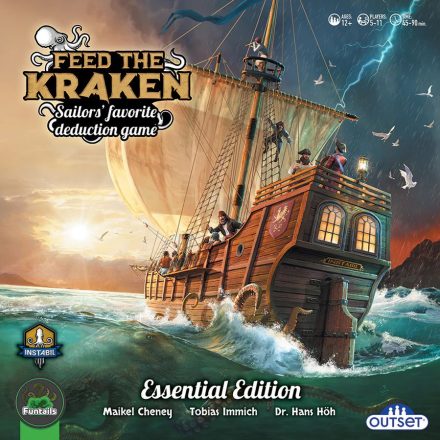
Feed the Kraken

Feed the Kraken is a hidden role deduction game, with three asymmetric factions. All players may be sitting in the same boat, but they want to navigate in different directions! The loyal sailors must bring the ship safely to mainland, whereas the pirates crave to secretly maneuver the ship into the Bermuda Triangle. Meanwhile a crazy cultist is busy convincing parts of the crew to help him summon their dark lord —the Kraken— from the depth of the sea to save them all.

The goal of the game is to navigate the ship towards your final destination, which would be easy if only players weren’t divided into three different factions. Each secret faction wants to reach a different area of the board. Every turn the ship will sail in one of the three possible directions —but which one will it be? The current captain and their chosen lieutenant will study ancient sea maps and pass their often conflicting orders onto the chosen navigator, who has to make the final decision. Meanwhile the rest of the crew is busy drinking rum, gambling and telling each other tales of ancient sea monsters.

After each navigation, the lieutenant and navigator go off duty, and the captain has to find somebody sober enough to take their spot instead. Everyone can discuss, how well that last navigation went, who is to blame for the current course, and who should be in charge in the future instead. Convince your enemies that it is in their best interest to make you the next lieutenant, or navigator! You can even draw your guns and become the new captain in open mutiny! But for how long will you be able to keep the trust of your crew? The next mutiny might already be waiting for you if your decisions don’t please your fellow sailors.

Game Specifications:

  • 5 – 11 Players
  • 45 – 90 Minutes
  • Difficulty Weight 2.17

GoodCritters

It’s the most anticipated moment of any heist: time to split the loot. Of course, everybody trusts the boss to divide everything evenly, right? But will the boss be even-handed and make sure that every “made critter” gets a piece? Maybe the boss will pay off only some of them and keep the rest of it…

GoodCritters is a game for 4-8 criminal critters who are pulling off heists and fighting over the loot! Whoever is chosen as the boss can distribute the loot from the heist however they desire, but it’s the crew that has the final say. If the crew doesn’t like the split, they might just tell the boss to take a hike and put some other critter in charge! In the end, the critter that collects the most valuable stash of loot wins!

Game Mechanics:

Game Specifications:

  • 4 – 8 Players
  • 30 – 45 Minutes
  • Difficulty Weight 1.44

Burn the Witch

Step back into a dark period in our past, when frenzy and paranoia dominated peoples’ perception of ‘the other’, driving communities across Europe to take the most extreme measures against their fellow man… or woman, as history would have it.

Burn the Witch is a game of social deduction where players are divided into two factions (zealots and sympathizers), which are pitted against each other in a bid for survival. Players represent houses, comprised of two to four villagers, one or more of whom may be a witch. The zealots win by uncovering the identity of all witches in play—a discovery made only through fire. The sympathizers win by keeping the witches’ identities hidden. With witches forming a small minority, the sympathizers’ only chance for success depends on their ability to employ cunning and misdirection as they seek to outwit the other players by turning the zealots’ xenophobia and pyromania back onto themselves.

The game typically goes for 45-75 minutes and concludes when either every witch in the village has been uncovered or enough innocents have been wrongly condemned that the witch hunt is called off, and the sympathizers win.

Game Mechanics:

  • Hidden Roles
  • Player Judge
  • Roles with Asymmetric Information
  • Traitor Game
  • Voting

Game Specifications:

  • 5 – 15 Players
  • 45 – 75 Minutes
  • Difficulty Weight 2.75

Blood on the Clocktower

In the quiet village of Ravenswood Bluff, ‌a demon walks amongst you…

During a hellish thunderstorm, on the stroke of midnight, there echoes a bone-chilling scream. The townsfolk rush to investigate and find the town storyteller murdered, their body impaled on the hands of the clocktower, blood dripping onto the cobblestones below. A Demon is on the loose, murdering by night and disguised in human form by day. Some have scraps of information. Others have abilities that fight the evil or protect the innocent. But the Demon and its evil minions are spreading lies to confuse and breed suspicion. Will the good townsfolk put the puzzle together in time to execute the true demon and save themselves? Or will evil overrun this once peaceful village?

Blood on the Clocktower is a bluffing game enjoyed by 5 to 20 players on opposing teams of Good and Evil, overseen by a Storyteller player who conducts the action and makes crucial decisions. The goal of the game is to successfully deduce and execute the demons before they outnumber the townfolk.

During a ‘day’ phase players socialize openly and whisper privately to trade knowledge or spread lies, culminating in a player’s execution if a majority suspects them of being Evil. Of a ‘night’ time, players close their eyes and are woken one at a time by the Storyteller to gather information, spread mischief, or kill.

The Storyteller uses the game’s intricate playing pieces to guide each game, leaving others free to play without a table or board. Players stay in the thick of the action to the very end even if their characters are killed, haunting Ravenswood Bluff as ghosts trying to win from beyond the grave.

If you arrive late to a game, you can enter after it’s started as a powerful Traveller character with unusual talents and questionable allegiances. Each character comes with their own special ability and no two players in a game are ever the same character.

Game Mechanics:

  • Bluffing
  • Deduction
  • Hidden Roles
  • Negotiation
  • Team-Based Game
  • Variable Player Powers
  • Voting

Game Specifications:

  • 6 – 21 Players
  • 30 – 120 Minutes
  • Difficulty Weight 3.03

Dixit

Each turn in Dixit, one player is the storyteller, chooses one of the six cards in their hand, then makes up a sentence based on that card’s image and says it out loud without showing the card to the other players. Each other player then selects the card in their hand that best matches the sentence and gives the selected card to the storyteller, without showing it to anyone else.

The storyteller shuffles their card with all of the received cards, then reveals all of these cards. Each player other than the storyteller then secretly guesses which card belongs to the storyteller. If nobody or everybody guesses the correct card, the storyteller scores 0 points, and each other player scores 2 points. Otherwise, the storyteller and whoever found the correct answer score 3 points. Additionally, the non-storyteller players score 1 point for every vote received by their card.

The game ends when the deck is empty or if a player has scored at least 30 points. In either case, the player with the most points wins.

Game Mechanics:

  • Race
  • Singing
  • Storytelling
  • Targeted Clues
  • Voting

Game Specifications:

  • 3 – 6 Players
  • ~30 Minutes
  • Difficulty Weight 1.19