Tag: Betting and Bluffing

Human Punishment: Social Deduction 2.0

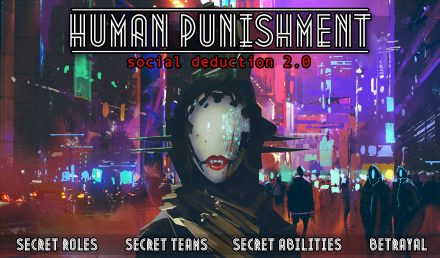
Human Punishment is a combination of social deduction, social experiment, and party game for 4-16 players. Each player takes on the role of a human, a machine, or an outlaw in a distant future. Players must investigate others to figure out who is on their side, grab one of the four different weapons, and eliminate the enemies. Stay focused because hidden enemies may be on your team! Find your team, trust no one!

The traitor mechanism in Human Punishment transforms the table into a social experiment…

Game Specifications:

  • 4 – 16 Players
  • 15 – 90 Minutes
  • Difficulty Weight 2.57

Hot Streak

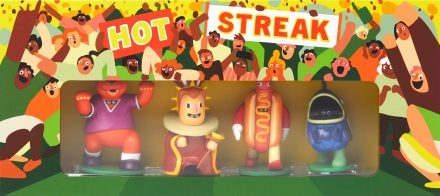
Hot Streak is a game for hard luck gamblers who love to bet on and scream at the racers, who in this case happen to be mascots who may (or may not) keep running in the right direction.

At the start of the game, set up the racing deck with one card for each mascot and a number of random cards based on the player count. Reveal these cards to all players, after which players draft a betting ticket from those on display, then in reverse order draft a second bet. For each bet, you can play it safe — or flip it to the risky side, which might pay out more – or cost you money if you lose. After betting, each player chooses one of three cards in their hand to secretly add to the racing deck.

Shuffle the deck, burn three cards, then reveal cards one by one from the deck, moving the mascots along the track, with them sometimes swerving into another lane and knocking over another racer, sometimes turning around, sometimes all moving at once, and sometimes just going backwards! If a racer runs off the track or would be knocked over while already fallen, they’re disqualified. If needed, shuffle all cards in the deck, burn three cards again, and keep racing until all four spots on the box podium are filled. Pay out bets based on these results.

For races #2-3, first deal each player a random card from the deck, then place bets again, then have each player contribute a card from their hand to the deck. After race #3, everyone tallies their money.

Game Specifications:

  • 2 – 8 Players
  • 20 Minutes
  • Difficulty Weight 1.22

Hidden Leaders

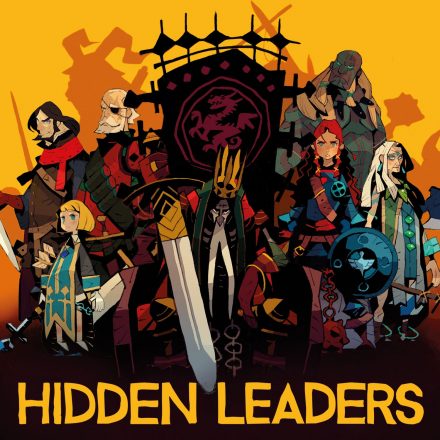
The island of Oshra is in turmoil. Following the death of the Emperor, the conflict between the Hill Tribes and the Imperial Army escalated. While the Water People try to maintain balance between the old rivals, the Undead aim to escalate the war. All hope rests on the six children of the Emperor: Who of them will claim the throne?

In Hidden Leaders, you take the role of one of six secret leaders, each of them is allied with two of the four factions/colors. By playing heroes into your tableau, either openly or secretly, you influence the outcome of the conflict.

At the end of the game, one of the four factions will win:
Red leading > Red victory
Green leading > Green victory
Tie between Red & Green > Blue victory
Red & Green in War Zone > Black victory
Each player who is aligned with the winning faction can claim the victory. However, they must have more heroes of this color than any competitor.

Hidden Leaders is a quick, light strategy card game with direct player interaction. It combines tableau building and deduction elements with its unique winning mechanism. This is a game of great tension with no-down time, that’s fast to learn. Its distinctive artwork and character names will make you smile.

—description from designer

Game Specifications:

  • 2 – 6 Players
  • 20 – 40 Minutes
  • Difficulty Weight 1.82

Hare & the Tortoise, the (Tales & Games)

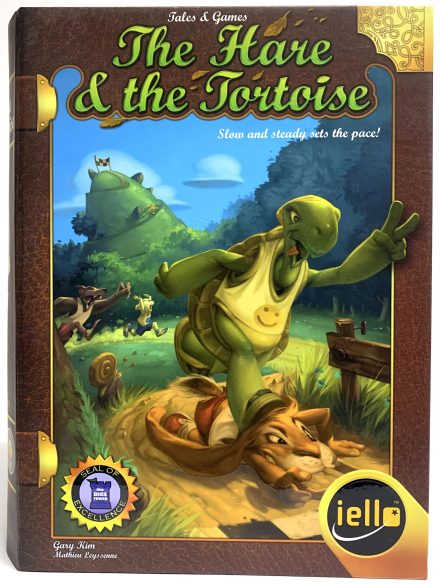
The Hare & the Tortoise, originally published as Royal Turtle, is a card-driven betting game about animal racing loosely based on one of Aesop’s Fables.

At the start of a race, each player secretly bets on up to two of five animals: turtle, rabbit, lamb, wolf and fox. One animal is chosen at random for each player, then after receiving a hand of seven cards, each player places one of his cards face-down (possibly the same animal) as an additional bet. Players then take turns laying down 1-4 cards, with all cards needing to show the same animal, then refilling the hand to five cards. As soon as eight total cards have been played or four cards of any one animal, the animals move (maybe).

Each animal has a distinct characteristic that players can use to their advantage. The turtle always moves one space, but it moves two if four of its cards were played. The rabbit always moves two spaces as long as cards are played. — unless four cards are played and it’s at the head of the pack, in which case it sleeps and doesn’t move. The fox moves as many spaces as the number of cards played. The lamb moves one more space than the number of cards played — but if it reaches water, it stops moving to take a drink. The wolf moves 1 space if one to two cards are played, and one less space than the number of cards if more are played. The wolf also has 3 cards with a howl, if one of these is played no one but the wolf moves.(The track consists of eleven road cards, two covered with water.)

After the animals move, players start a new round of card-playing. A round ends when three of the five animals reach the goal, after which each player scores points based on the ranking of the animals and how they bet. After three rounds, the player with the most points wins.

The original title of Royal Turtle is a homage to Reiner Knizia’s Royal Turf, another betting game about animals racing (albeit horses in that game).

Game Specifications:

  • 2 – 5 Players
  • 15 – 20 Minutes
  • Difficulty Weight 1.37

Gladius

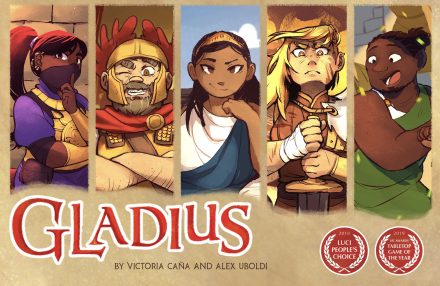
In Gladius, play as cunning Roman spectators trying to make the most money by betting on gladiators competing in the gladiatorial games. Through the skillful use of underhanded tactics, players can help and hinder teams to alter the outcome of each battle. Can you outwit your opponents to turn a profit, or will you be left empty-handed?

Game Specifications:

  • 2 – 5 Players
  • 20 – 30 Minutes
  • Difficulty Weight 1.71

Feed the Kraken

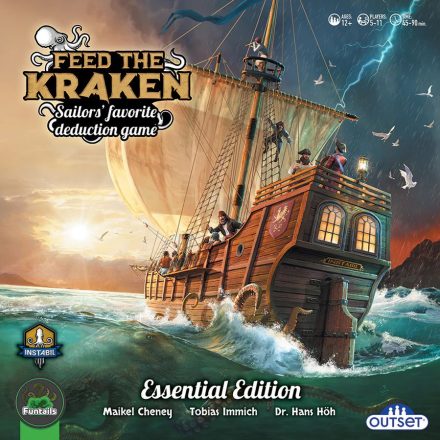
Feed the Kraken is a hidden role deduction game, with three asymmetric factions. All players may be sitting in the same boat, but they want to navigate in different directions! The loyal sailors must bring the ship safely to mainland, whereas the pirates crave to secretly maneuver the ship into the Bermuda Triangle. Meanwhile a crazy cultist is busy convincing parts of the crew to help him summon their dark lord —the Kraken— from the depth of the sea to save them all.

The goal of the game is to navigate the ship towards your final destination, which would be easy if only players weren’t divided into three different factions. Each secret faction wants to reach a different area of the board. Every turn the ship will sail in one of the three possible directions —but which one will it be? The current captain and their chosen lieutenant will study ancient sea maps and pass their often conflicting orders onto the chosen navigator, who has to make the final decision. Meanwhile the rest of the crew is busy drinking rum, gambling and telling each other tales of ancient sea monsters.

After each navigation, the lieutenant and navigator go off duty, and the captain has to find somebody sober enough to take their spot instead. Everyone can discuss, how well that last navigation went, who is to blame for the current course, and who should be in charge in the future instead. Convince your enemies that it is in their best interest to make you the next lieutenant, or navigator! You can even draw your guns and become the new captain in open mutiny! But for how long will you be able to keep the trust of your crew? The next mutiny might already be waiting for you if your decisions don’t please your fellow sailors.

Game Specifications:

  • 5 – 11 Players
  • 45 – 90 Minutes
  • Difficulty Weight 2.17

Fairy

Every round, reveal a new card. Simultaneously, all players choose a hand gesture to guess how the card relates to the previous one (☝️ for higher value, ? for lower value, ? for same suit, or ✊ to guess a fairy).

Guess the correct value relation and get two points. Guess same suit correctly and get four points. Call one of the three fairies in the deck? That’s seven points!

Any wrong guess loses you a point. First player to fifteen wins!

Game Specifications:

  • 2 – 10 Players
  • 5 – 10 Minutes
  • Difficulty Weight 1.00

Divinity Derby

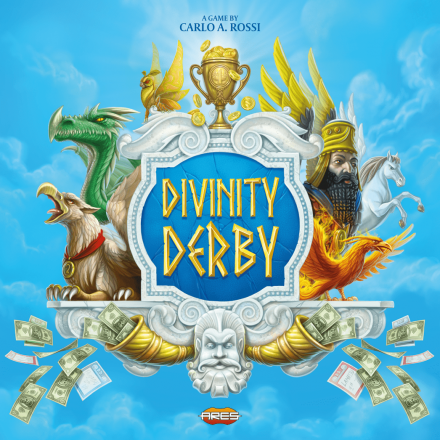
Zeus has invited a bunch of divine friends, including a couple of new ones, from all around the Multiverse for a little get-together on Mount Olympus…and you are one of them! After a few rounds of ambrosia, soon the racing and betting begins, with the Olympic “All-father” as the ultimate judge.

Divinity Derby is a fun and fast betting and racing game for 3 to 6 players, with a clever “shared hand” card mechanism. Players, as god-like beings betting on the race of six flying creatures, share a cardholder with each neighbor, and every turn they play one card from each shared card holder. Are you able to guess what your neighbor’s intentions and secret bets are and make the best use of the shared knowledge to win your bets?

With beautiful components, colorful art, and simple but engaging gameplay, Divinity Derby is suitable for players of all ages and skill levels.

Game Mechanics:

  • Betting and Bluffing
  • Open Drafting
  • Variable Player Powers

Game Specifications:

  • 3 – 6 Players
  • 45 – 90 Minutes
  • Difficulty Weight 1.92

Coyote

One day Coyote crossed the river with his friends, but he was carrying too many things and almost drowned before Bear pulled him out of the water. Poor Coyote had lost everything.

They sat down by a fire to dry off and rest. Coyote became jealous of the other animals because they still had all their things, so he challenged them to a bluffing game to win their belongings. The other animals agreed to the challenge as they thought Coyote would never win. After all, he is known to never tell the truth — but in this game everybody has to lie because no one knows the truth…

In the bluffing game Coyote, you always see the cards of the other players, but never your own. When it’s your turn, you must announce a number that is less than the total of all the cards in the game, yet higher than the previous number given. Alternatively, you can challenge the number previously announced. Finally, when all the cards are revealed, you’ll see who has the cunning Coyote on their side.

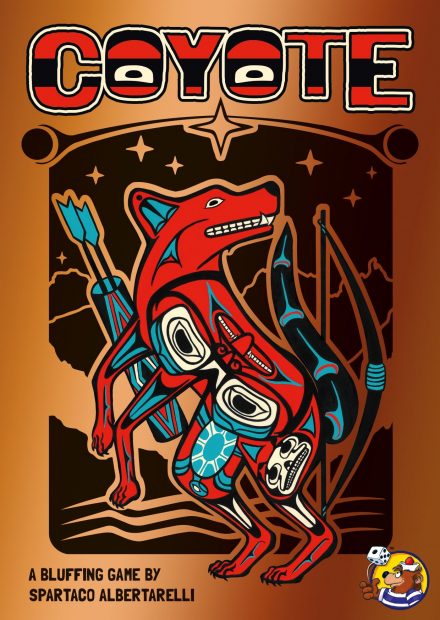
Coyote is in the same game line as Spicy, with the game box and card backs being decorated with a special metallic print in copper. As in the tradition of the Northwest Coast Tribes, copper is a symbol of prosperity and cultural wealth.

The artist Zona Evon Shroyer (Yupik Alaskan Native) is a master of the traditional Northwest Coastal art, whose richness of detail and complexity requires years of study and practice. For the cover illustration of Coyote, she designed a modern silhouette for the coyote, which she then filled in a classical manner with other animal motifs: turtle, beaver, and bear — the animals that he is sitting around the fire with and playing a game, in our little story.

Game Mechanics:

  • Betting & Bluffing
  • Player Elimination

Game Specifications:

  • 3 – 6 Players
  • 15 – 25 Minutes
  • Difficulty Weight 1.27

Catch Me!

Catch Me! is a variant of the public domain game, Buttons.

A game involving rubber mice, dice, cheese tokens, and a miniature toilet plunger. There are several different Catch Me! editions which have substantially different components, but similar gameplay. The 2004 edition, for example, has a plastic cat shaped capture device that doesn’t resemble a toilet plunger.

A player rolls the dice and depending on their roll either tries to plunge the mice or not. Players holding the mice must pull their mice away before they are captured.

Game Mechanics:

  • Betting and Bluffing
  • Dice Rolling
  • Pattern Recognition 

Game Specifications:

  • 2 – 7 Players
  • ~15 Minutes
  • Difficulty Weight 1.02