Tag: Square Grid

Grand Carnival, The

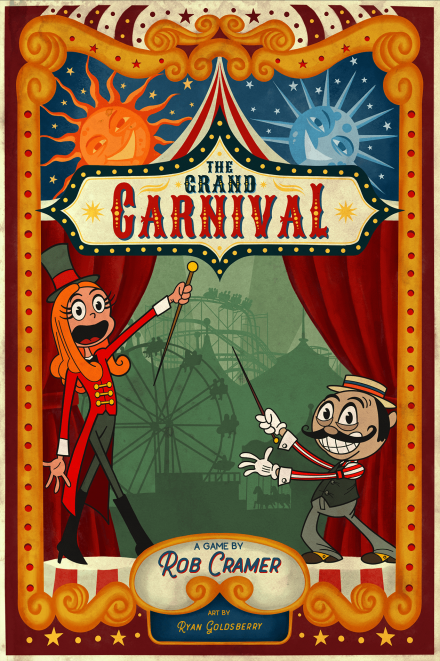
Ladies and gentlemen, step right up — the carnival is coming to town! In The Grand Carnival, players compete to create the most impressive carnival this town has ever seen. You’ll need to carefully plan your carnival’s layout, build attractions, hire staff, and manage the crowds, all while learning a few tricks of the trade.

Each turn, players cover a number on their player board, then select an action. The covered number determines the effectiveness of their action — and won’t become available again until the next round — so players need to think carefully about which number to use. Possible actions include:

• Place a Foundation Tile: Select a foundation tile to place on your fairground. The higher the number you cover, the more tile options you have. Each tile is a 2×2 grid and is made up of construction sites and walkways. Attractions can be placed only on construction sites, whereas guests can move only on walkways, so place your tiles carefully.

• Build an Attraction: Select a polyomino attraction and place it on the construction sites on your fairground. The size of the attraction you can select depends on the number you cover. Larger attractions can collect more tickets (and can be worth more points), but can be difficult for guests to move around.

• Move a Guest: Select a guest token and move it along the walkways on your fairground. The distance a guest can move depends on the number you cover. If a guest moves next to an attraction, place a ticket token on that attraction. If you move enough guests, you can hire a carnival barker; barkers help guests move quickly through your carnival, but take up precious space in your fairground.

After taking your action, see whether you qualify for any of the three “Tricks of the Trade” cards. Each trick has a requirement that must be met before you unlock its unique ability. Once a player unlocks a trick, each of their opponents has one turn to meet the same requirement or lose access to that trick for the rest of the game.

After seven rounds, the game ends. Players earn points from sets of the same size attractions, sets of each size of attraction, carnival barkers, guests that move all the way through your park, and their tickets. The player with the most points wins!

—description from the designer

Game Specifications:

  • 1 – 4 Players
  • 45 – 60 Minutes
  • Difficulty Weight 2.21

Go

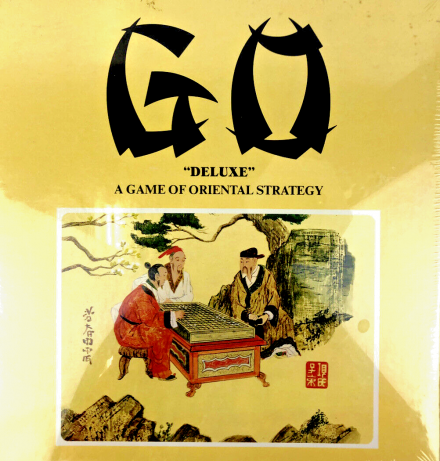
In Go, players alternately place stones on the empty intersections of a 19×19 grid. The goal: to enclose territory behind stone perimeters and, secondarily, to tightly surround and capture enemy stones. After both players pass, they add up their territory and deduct the number of captives lost, higher score wins.

As you see, the concept is simple, yet the challenge can enrich a lifetime. In truth many lifetimes, for Go has been played for thousands of years. With that long of a lineage and a worldwide following, it has come to be known by different names (Weiqi, Igo, Baduk) and to be played by slightly differing rules, but those differences seldom affect play.

So welcome to this masterpiece that is the game of Go, the race for geographical control of an unclaimed land. Experience running battles and swift reversals, bold invasions and painful sacrifices, each sally, each setback playing out to the dulcet tap of stone on wood.

Game Specifications:

  • 2 Players
  • 30 – 180 Minutes
  • Difficulty Weight 3.91

Cathedral

In Cathedral, each player has a set of pieces of a different color. The pieces are in the shapes of buildings, covering from one to five square units. The first player takes the single neutral Cathedral piece and places it onto the board. Players then alternate placing one of their buildings onto the board until neither player can place another building. Players capture territory by surrounding areas that are occupied by at most one opponent or neutral building. A captured piece is removed and captured territory becomes off-limits to the opponent. The player with the fewest ‘square units’ of buildings that can’t be placed wins.

Game Specifications:

  • 2 Players
  • ~20 Minutes
  • Difficulty Weight 1.79

Arboretum

Arboretum is a strategy card game for 2-4 players, aged 10 and up, that combines set collection, tile-laying and hand management while playing in about 25 minutes. Players try to have the most points at the end of the game by creating beautiful garden paths for their visitors.

The deck has 80 cards in ten different colors, with each color featuring a different species of tree; each color has cards numbered 1 through 8, and the number of colors used depends on the number of players. Players start with a hand of seven cards. On each turn, a player draws two cards (from the deck or one or more of the discard piles), lays a card on the table as part of her arboretum, then discards a card to her personal discard pile.

When the deck is exhausted, players compare the cards that remain in their hands to determine who can score each color. For each color, the player(s) with the highest value of cards in hand of that color scores for a path of trees in her arboretum that begins and ends with that color; a path is a orthogonally adjacent chain of cards with increasing values. For each card in a path that scores, the player earns one point; if the path consists solely of trees of the color being scored, the player scores two points per card. If a player doesn’t have the most value for a color, she scores zero points for a path that begins and ends with that color. Whoever has the most points wins.

Game Specifications:

  • 2 – 4 Players
  • ~30 Minutes
  • Difficulty Weight 2.13

Arcadia Quest

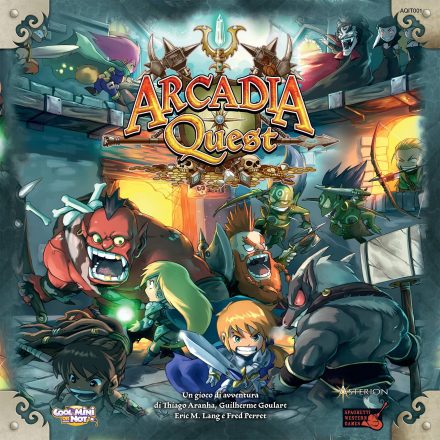
In Arcadia Quest, players lead guilds of intrepid heroes on an epic campaign to dethrone the vampire lord and reclaim the mighty Arcadia for their own. But only one guild may lead in the end, so players must battle against each other as well as against the monstrous occupying forces.

Arcadia Quest is a campaign-based game for 2 to 4 players, where each player controls a guild of three unique heroes, facing off against the other players and the various monsters controlled by the game. Players need to accomplish a series of quests in order to win each scenario and choose where to go next in the campaign.

Players are able to choose the path their campaign takes, navigating through six out of eleven available scenarios, so each time the campaign is played it can have a different configuration of scenarios. As the campaign progresses, the heroes are able to acquire new weapons, equipment and abilities that give them powerful options to tackle the obstacles ahead. Furthermore, by fulfilling specific quests in a scenario, players unlock exclusive features in subsequent scenarios.

Acquire 🟢

In Acquire, each player strategically invests in businesses, trying to retain a majority of stock. As the businesses grow with tile placements, they also start merging, giving the majority stockholders of the acquired business sizable bonuses, which can then be used to reinvest into other chains. All of the investors in the acquired company can then cash in their stocks for current value or trade them 2-for-1 for shares of the newer, larger business. The game is a race to acquire the greatest wealth.

Azul

Introduced by the Moors, azuleijos (originally white and blue ceramic tiles) were fully embraced by the Portuguese when their king Manuel I, on a visit to the Alhambra palace in Southern Spain, was mesmerized by the stunning beauty of the Moorish decorative tiles. The king, awestruck by the interior beauty of the Alhambra, immediately ordered that his own palace in Portugal be decorated with similar wall tiles. As a tile-laying artist, you have been challenged to embellish the walls of the Royal Palace of Evora.

In the game Azul, players take turns drafting colored tiles from suppliers to their player board. Later in the round, players score points based on how they’ve placed their tiles to decorate the palace. Extra points are scored for specific patterns and completing sets; wasted supplies harm the player’s score. The player with the most points at the end of the game wins.