Tag: Chaining

Harmonies

In Harmonies, build landscapes by placing colored tokens and create habitats for your animals. To earn the most points and win the game, incorporate the habitats in your landscapes wisely and have as many animals as you can settle there.

Starting with the first player and proceeding clockwise, each player will choose a set of 3 terrain tokens from the central area to place on their personal board. They may optionally choose an Animal card from the 5 displayed and/or place an Animal cube from their Animal card(s) on any completed patterns on their board that match their personal Animal cards. There is a 4-card limit per player. After their turn, refill with a new set of 3 tokens and a new Animal card if needed.

Placement of the terrain tokens will depend on the personal Animal card goals, and scoring rules for the various terrain types (mountain, field, forest, etc). For example, mountain tiles score based on how high they are (1 tile scores 1, while 3 tiles stacked score 7), but the mountain scores zero if it is not adjacent to at least one other mountain. If all the cubes on a given Animal card have been placed, the card is set aside and a new card can be drawn. The cards are scored at game end based on the highest number that isn’t covered by a cube.

The games ends when there are no tokens left in the bag to refill the central area, or at least one players has 2 or fewer empty spaces on their player board. Play continues until all players have had an equal turn that round. The player with the highest points is the winner.

Optionally, you can use Nature’s Spirit cards for richer gameplay. During setup, each player chooses 1 of 2 spirit cards and places a Spirit cube on the card. They follow the same placement rules as Animal cards, but tend to have an ongoing effect once completed. The spirit card does count towards the 4-card hand limit.

—description from the publisher

Game Specifications:

  • 1 – 4 Players
  • 30 – 45 Minutes
  • Difficulty Weight 2.01

Guild of Merchant Explorers, the

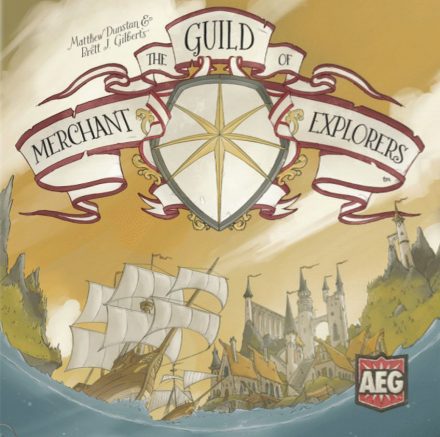
In The Guild of Merchant Explorers, each player starts with one city on their personal map board.

Shuffle the deck of terrain cards, then reveal most of these cards one by one. Based on the terrain revealed, each player places on their board cubes that are connected to their starting city or other cubes. You want to complete areas on your board, cross the seas to new land, and establish new cities on the board. You can explore capsized ships for treasure — which gives you special placement capabilities — and create linked connections between locations to score bonus points. Common objectives can be completed by all players, with those who complete it first scoring more points.

At the end of a round, all cubes are removed from each board, leaving only the cities behind, so if you don’t establish new cities, you’ll be stuck in the same places.

The Guild of Merchant Explorers contains multiple copies of four different maps, and the game is designed so that you can play remotely with one or more copies.

Game Specifications:

  • 1 – 4 Players
  • 45 Minutes
  • Difficulty Weight 2.05

Go

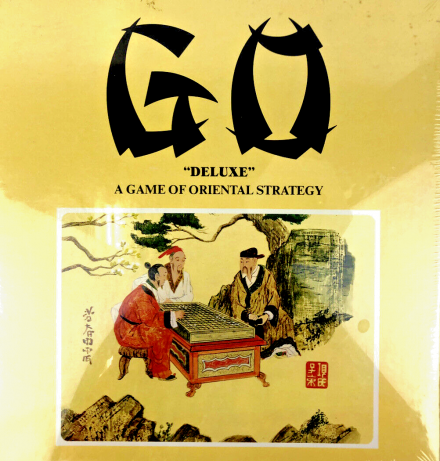
In Go, players alternately place stones on the empty intersections of a 19×19 grid. The goal: to enclose territory behind stone perimeters and, secondarily, to tightly surround and capture enemy stones. After both players pass, they add up their territory and deduct the number of captives lost, higher score wins.

As you see, the concept is simple, yet the challenge can enrich a lifetime. In truth many lifetimes, for Go has been played for thousands of years. With that long of a lineage and a worldwide following, it has come to be known by different names (Weiqi, Igo, Baduk) and to be played by slightly differing rules, but those differences seldom affect play.

So welcome to this masterpiece that is the game of Go, the race for geographical control of an unclaimed land. Experience running battles and swift reversals, bold invasions and painful sacrifices, each sally, each setback playing out to the dulcet tap of stone on wood.

Game Specifications:

  • 2 Players
  • 30 – 180 Minutes
  • Difficulty Weight 3.91

Anarchy, The 🟠

At the end of 1135, Henry I, King of England, died unexpectedly leaving no male heir to reign in his stead. Henry’s daughter, Empress Matilda, believed she should rule by succession. However, the late king’s favorite nephew, Stephen de Blois (“blue-a”), was quicker to the throne, and with the help of his brother, the Bishop of Winchester, was crowned king.

Those loyal to the empress were enraged by Stephen’s coronation and would not accept him as their new ruler. Over the next eighteen years, England saw a breakdown in law and order as civil war spread throughout the country. This conflict came to be known as “The Anarchy”…

In The Anarchy, players take on the role of English nobles loyal to King Stephen. Over five rounds, players must build their domain, defend their castle from attacks by the approaching Angevin armies, and storm strongholds loyal to Matilda with their own crafted siege weapons. The player who can accumulate the most bravery, loyalty, influence and might — while avoiding discontent — will prove to King Stephen they are his most loyal ally, thereby earning his largest earldom.

Cascadero

The kingdom is shattered, its towns are divided, and its people are distrusting. The newly crowned ruler, El Cascadero, seeks to reunite the land, but he can’t do it alone. Thus, he appoints four ministers to visit the people and restore civil harmony. While the ministers are obligated to bring prosperity to the entire land, each of them also has one dedicated responsibility: Farming, Crafting, Mining, and Markets. El Cascadero also records in his book the successes of his ministers…

Cascadero is the next epic tile placement strategy game from acclaimed designer Reiner Knizia. Ministers visit towns by placing their envoys adjacent to them; but towns are distrusting of single envoys, so newly placed envoys will only trigger town scoring when they are part of an established group or carry an official seal from El Cascadero himself. Towns with Royal Messengers at them or a history of envoy visits are even more valuable, as they willingly collaborate for even greater successes.

Players must decide between two competing strategies: build long chains of their envoys to achieve synergies and objectives, or establish smaller, separate groups of envoys to trigger timely town scoring. Both will award victory points, yet your victory points will mean nothing if you don’t also reach the end of your appointed success column.

By triggering town scoring, you’ll advance along that town’s matching success column, gaining bonuses as you pass over them. Bonuses include earning victory points, advancing further on any success column, claiming an official seal, repositioning an envoy, or even acquiring an additional turn. Through careful timing and clever plans, players can trigger a cascading combo of exciting bonuses that swing momentum in their favor.

Cascadero provides a wealth of replayability through emergent player interaction, variable board and tile setups, and an advanced player mode featuring traveling heralds. Yet the game will always end in one of two ways: when one player reaches fifty victory points or must place a tile but has no tiles left. The players who reached the end of their appointed success column qualify for victory, and whoever among them has the most victory points wins.

Game Mechanics:

  • Chaining
  • Connections
  • Network and Route Building
  • Tile Placement
  • Track Movement

Game Specifications:

  • 2 – 4 Players
  • 45 – 60 Minutes
  • Difficulty Weight 2.58

Azul

Introduced by the Moors, azuleijos (originally white and blue ceramic tiles) were fully embraced by the Portuguese when their king Manuel I, on a visit to the Alhambra palace in Southern Spain, was mesmerized by the stunning beauty of the Moorish decorative tiles. The king, awestruck by the interior beauty of the Alhambra, immediately ordered that his own palace in Portugal be decorated with similar wall tiles. As a tile-laying artist, you have been challenged to embellish the walls of the Royal Palace of Evora.

In the game Azul, players take turns drafting colored tiles from suppliers to their player board. Later in the round, players score points based on how they’ve placed their tiles to decorate the palace. Extra points are scored for specific patterns and completing sets; wasted supplies harm the player’s score. The player with the most points at the end of the game wins.