Tag: Pattern Building

In Pattern Building games players place various game components in specific patterns to achieve various results.

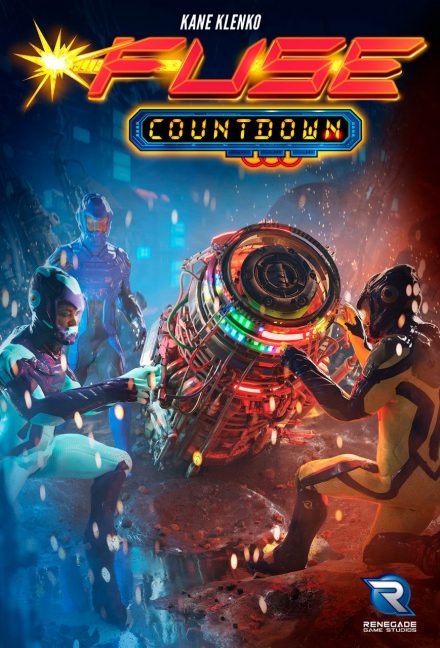
FUSE Countdown

FUSE Countdown is a new entry in the FUSE family, one that’s playable both standalone or as an expansion for the original FUSE!

Originally launched in 2015 as one of Renegade’s very first games, Kane Klenko’s FUSE brought the tense action of bomb defusal to the tabletop, in a quick and simple, but extraordinarily challenging cooperative game! Taking just ten minutes to play and minutes to teach, FUSE has appeal for all types of gamers!

Veteran FUSE bomb-disposal techs may think they have the original game down to a science, but FUSE Countdown will throw some new obstacles in their way while also providing some great new tools! Multi-colored dice, Spark cards, new configurations, and Roles all add new elements to the game! Multi-colored dice can fill spots of either color, allowing a new level of flexibility AND challenge!

FUSE Countdown Includes:

  • Multi-colored Dice – can fulfill either color
  • Spark Cards – When you can’t place a die, instead of rolling it and removing a related die, you draw a Spark card. They work like a mini-bomb card for you to fulfill. You cannot win the game unless all active Spark cards are resolved.
  • Roles – Each player has a special player power.
  • New Cards! New bomb cards using some of the new features/icons. *New Fuse cards featuring multiple colors/numbers

Game Specifications:

  • 1 – 4 Players
  • ~10 Minutes
  • Difficulty Weight 2.14

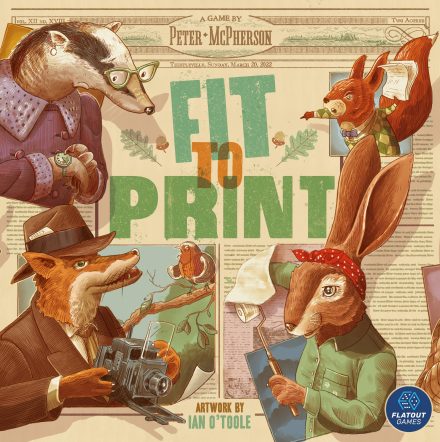
Fit to Print

Fit to Print is a puzzly tile-laying game about breaking news, designed by Peter McPherson and set in a charming woodland world created by Ian O’Toole!

Thistleville is the world’s most bustling little town — it’s a challenge to keep up with everything going on, from who took home first prize for their baked goods at the community fair to who has been digging in Mrs. Brambleberry’s carrot patch.

As an editor at one of the local newspapers, your job is to tell their stories!

The front page is due in just a few hours and you have no time for perfection. Grab the big stories before the other papers get a chance, and make sure you get the right photos too. A newspaper is a business, so the money has to come from somewhere — don’t forget the ads! After you’ve picked out a combination of stories, photos, and ads, it’s time to lay out the front page. Did you take enough tiles to fill the paper, but not so many that things have to be cut? Over the course of three hectic days, your skills will be tested as you compete to be the most newsworthy editor!

Fit To Print is a tile-laying game for the whole family. Players simultaneously collect newspaper tiles, stacking them on their desks until they think they have what they need to make the perfect front page. Then, they will yell “Layout!” and begin to lay out the page by carefully considering the placement of centerpieces, articles, photographs, and advertisements. When everything is just right, they yell “Print” to be the first off the press and gain their choice of centerpiece for the next round! This hectic spatial puzzle features over 100 unique newspaper tiles, 6 characters with their own special abilities, as well as 3 decks of Breaking News cards — so that each and every time you play you will be solving a new puzzle!

If real-time games aren’t your style, Fit to Print has a number of alternative modes to satisfy every type of puzzle gamer. In Slo-Mode players take turns drafting tiles from a shared market and arranging them on their front pages. In Puzzle Mode, take a specific set of tiles and piece together the highest-scoring arrangements. Whether you enjoy relaxing solo puzzles on your own, or frenetic action for up to 6 players, you will have a blast helping the critters of Thistleville tell their stories!

Game Specifications:

  • 1 – 6 Players
  • 15 – 30 Minutes
  • Difficulty Weight 2.12

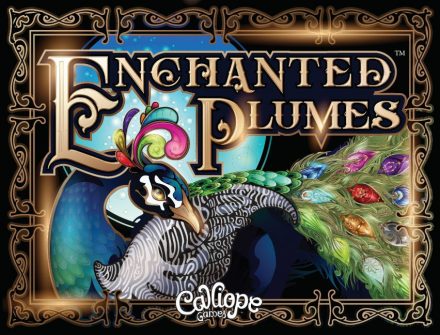
Enchanted Plumes

In Enchanted Plumes, players strive to complete magical peacocks by assembling plumes in sparkling rows from top to bottom.

Skillfully placing feather cards of the same color from row to row is key, as the top row value will count against your score, while all lower rows count as positive values.

Once the peahen card is revealed, the player with the most valuable plumes wins the game and is bestowed with the luck of the peacock!

Game Specifications:

  • 2 – 6 Players
  • 20 – 40 Minutes
  • Difficulty Weight 1.38

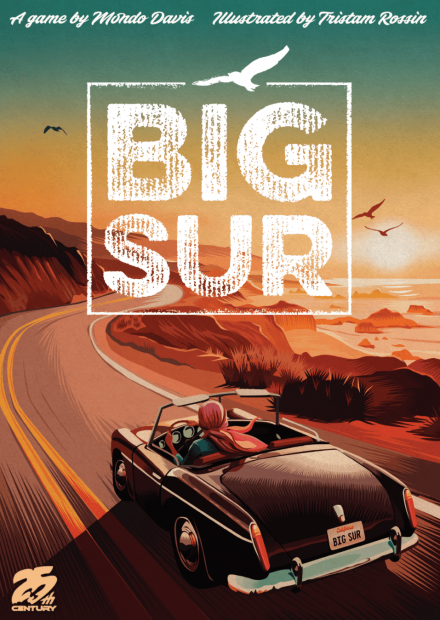
Big Sur

Cruise along California’s State Route 1 on the Big Sur Coast Highway to check out the views and landmarks along the most scenic driving route in the world — or rather, invite others to cruise on the highway that you build over the course of play.

In Big Sur, players draft cards to use them either as resources to build new road sections or as the road sections themselves. Your linear path of cards will score for connecting terrain types and meeting other conditions. You can also add notable landmarks to your highway for other unique scoring conditions; these landmarks are based on actual scenic lookouts and locations on Big Sur.

Game Mechanics:

  • Multi-Use Cards
  • Pattern Building

Game Specifications:

  • 2 – 4 Players
  • 15 – 30 Minutes
  • Difficulty Weight 2.00

Cities

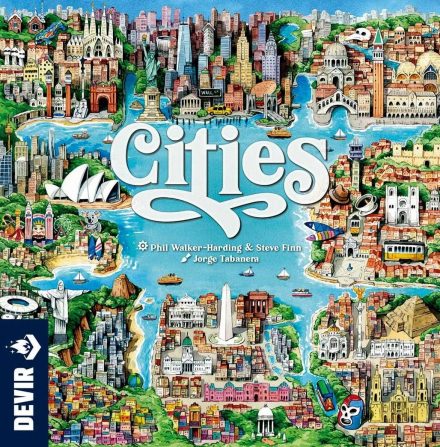
You’ve been tasked by the city council to put together a plan to transform a whole neighborhood in the city. You have the opportunity to build new housing, office buildings, parks, and leisure areas near the waterfront. It is in your hands to make the city a better place.

Cities is a city-building game in which you draft the best projects and arrange them in your own playing area. With action and resource draft mechanisms, it will give you the opportunity to visit the cities of Sydney, Venice, New York, Barcelona, Rio de Janeiro, Lisbon, Mexico City, and Buenos Aires. Can you design the most magnificent neighborhood?

The game is played over eight rounds (or four rounds in a two-player game). Each round, players use their workers to collect 1 scoring card, 1 city tile, 1-2 feature tiles, and 2-4 building pieces. City tiles are made up of park spaces, water spaces, and building spaces. Building pieces are placed on building spaces of the same color to form buildings, which can be 1-4 stories high. Whenever a player fulfills an achievement, they place one of their discs on the achievement board. At the end of the game, players add up the points they have gained from all of their scoring cards and achievements.

Game Mechanics:

  • Contracts
  • Pattern Building
  • Set Collection
  • Tile Placement
  • Variable Set-up
  • Worker Placement

Game Specifications:

  • 2 – 4 Players
  • ~45 Minutes
  • Difficulty Weight 1.92

Codex Naturalis

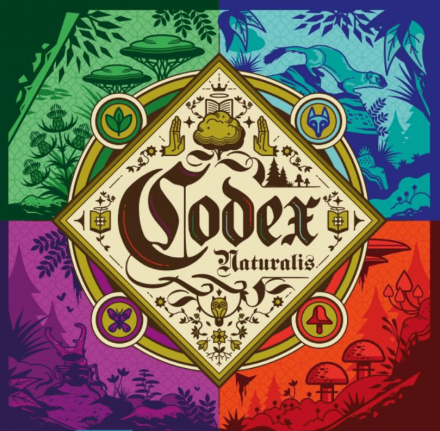
In Codex Naturalis, you are competing with your opponents to create the best manuscript of living species in primary forests. You’ll do this by placing down cards, overlapping them to assemble an overall manuscript, providing yourself with resources or points! You’ll have to plan carefully to maximize your points, and you’ll have to be willing to make sacrifices to get the best possible outcome.

Game Mechanics:

  • Hand Management
  • Layering
  • Open Drafting
  • Pattern Building

Game Specifications:

  • 1 – 4 Players
  • 20 – 30 Minutes
  • Difficulty Weight 1.76

Civolution

Hello, student beings! The cosmic faculty of the Technical Academy of Creation is delighted to welcome you to your Civolution, the final exam in Civilization Design!

For this occasion, we prepared a humanoid scenario on an isolated continent. Here, each of you holds the rank of a local deity which is closely linked to its very own civilization and must lead it to success over the other civilizations. Your developmental possibilities are endless and reach from cultural and technical progress to evolutional adaptations. For example, what would you consider more beneficial to your tribes: inventing the wheel or growing wings? Demonstrate your ability to operate your civilization console and show us how well you can adjust to changeable environmental conditions and mild creational chaos.

When the exam ceases after four eras, whoever managed to gather the most success points will not only pass the exam but will become a full member of the Technical Academy of Creation and garner the opportunity to be promoted to the next instance.

Civolution is a medium heavy to heavy euro-style game that utilizes a dice selection mechanism to trigger actions on a tech tree-like structure. As you figure out how to best use your dice and put your unique cards into play, tons of strategies and paths to victory emerge, though each time you play, you will only explore a fraction of the possibilities that the game’s system and many cards provide.

Game Mechanics:

  • Events
  • Modular Board
  • Open Drafting
  • Pattern Building
  • Tech Trees / Tech Tracks
  • Variable Set-up

Game Specifications:

  • 1 – 4 Players
  • 90 – 180 Minutes
  • Difficulty Weight 4.22

Chomp

The era of the dinosaurs is here! Your goal in Chomp is to form herds of dinos and make sure they are all fed. Herbivores and carnivores both need food sources, but if the carnies are not properly fed, they don’t mind chomping an herbie to fill their bellies!

Gameplay involves dual rows of goal tiles and dino tiles, and each turn players select one tile to add to their personal arrangement. Goal tiles stay off to the side for endgame scoring, and dino tiles are arranged in front of each player. Dino tiles include three sizes each of herbivores and carnivores. Each tile must overlap previous ones, either on top of a quarter tile, half tile, or even a whole tile, ensuring that any covered dinos are completely hidden.

Adjacent dinos of the same species form herds, which will eat together if connected to a single food source — or die together if they are unfed, adjacent to a tar pit, or next to an otherwise unfed carnivore!

At the end of the game, each living and fed dino scores 1-3 points depending on its size, and the player with the highest score wins.

Game Mechanics:

  • Open Drafting
  • Pattern Building
  • Tile Placement

Game Specifications:

  • 1 – 4 Players
  • ~20 Minutes
  • Difficulty Weight 1.56

Bloomchasers

30-min light strategy game for adults – grow your flowers and outwit opponents on a stunning 3D tree, either solo, as a team, or competitively.

Each turn, players — affectionately called “Bloomchasers” — place a new branch onto the tree, along with a “bud” of your color. Your goal is to place your buds in certain shapes so when a Bloom card is drawn, you’re set up to grow flowers (and your opponents aren’t!). Your ability to read and predict the weather will help you bloom faster and make sure you’re growing the most valuable flowers to win.

Game Mechanics:

  • Cooperative Game
  • Pattern Building
  • Solo / Solitaire Game
  • Three Dimensional Movement

Game Specifications:

  • 1 – 6 Players
  • 20 – 45 Minutes
  • Difficulty Weight 1.75

Cartographers Heroes

The expedition to the Western Lands is the kind of honor that comes once in a lifetime for a royal cartographer. But these are dangerous times. War ravages the land, and you are sure to encounter Dragul forces determined to thwart Queen Gimnax’s plans for western expansion.

Fortunately, brave heroes have risen to the defense of Nalos. Chart their deeds alongside the queen’s edicts and secure your place in history.

Cartographers Heroes is the sequel to the critically acclaimed map-drawing game Cartographers. It includes all-new map sheets, scoring cards, explore cards, and ambush cards with unique abilities.

Cartographers Heroes can be played on its own or mixed with components from the original game for a greater variety of gameplay possibilities.

Game Mechanics:

  • Paper-and-Pencil
  • Pattern Building
  • Solo / Solitaire Game
  • Take That
  • Variable Set-up

Game Specifications:

  • 1 – 100 Players
  • 30 – 45 Minutes
  • Difficulty Weight 2.00