Tag: Multi-Use Cards

Games with Multi-Use Cards give players cards that have a variety of uses, but typically only allow the player to select one use.

Big Sur

Cruise along California’s State Route 1 on the Big Sur Coast Highway to check out the views and landmarks along the most scenic driving route in the world — or rather, invite others to cruise on the highway that you build over the course of play.

In Big Sur, players draft cards to use them either as resources to build new road sections or as the road sections themselves. Your linear path of cards will score for connecting terrain types and meeting other conditions. You can also add notable landmarks to your highway for other unique scoring conditions; these landmarks are based on actual scenic lookouts and locations on Big Sur.

Game Mechanics:

  • Multi-Use Cards
  • Pattern Building

Game Specifications:

  • 2 – 4 Players
  • 15 – 30 Minutes
  • Difficulty Weight 2.00

Apiary 🟡

In a far-distant future, humans no longer inhabit Earth. The cause of their disappearance (or perhaps their demise) is unknown, but their absence left a void ready to be filled by another sentient species.

Over the span of untold generations, one species of the humble honeybee evolved to fill that void. They grew in size and intelligence to become a highly advanced society. They call themselves Mellifera, and they have made substantial technological advances in addition to the technology they adapted from human ruins, up to and including space travel.

In Apiary, each player controls one of twenty unique factions. Your faction starts the game with a hive, a few resources, and worker bees. A worker-placement, hive-building challenge awaits you: explore planets, gather resources, develop technologies, and create carvings to demonstrate your faction’s strengths (measured in victory points) over one year’s Flow. However, the Dearth quickly approaches, and your workers can take only a few actions before they must hibernate! Can you thrive or merely survive?

Game Specifications:

  • 1 – 5 Players
  • 60 – 90 Minutes
  • Difficulty Weight 2.97

1961 🟢

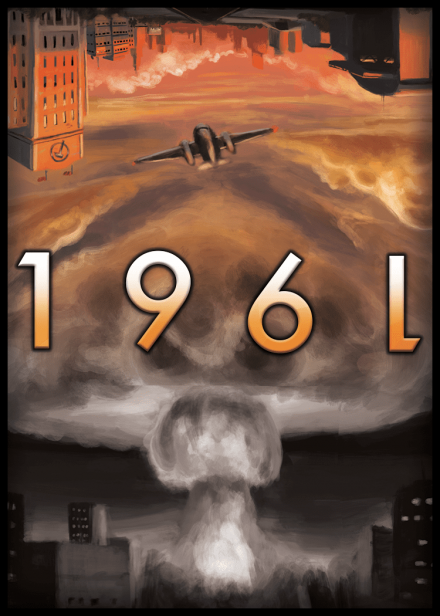
In 1961, you can invest in your space program, establish diplomatic relationships, and, most importantly, launch missiles as you and your components strive to win the Cold War. You can play cards in three different ways – as an action, a building, or a supply. But in a Cold War world, nothing is safe for long, and you have to balance internal development with defensive (and offensive) strategies.

There are three ways to win the game: win the Space Race, achieve diplomatic world peace, or be the sole survivor in a nuclear Armageddon. Do you have what it takes to come out on top in 1961?

Game Specifications:

  • 2 – 6 Players
  • 5 – 20 Minutes
  • Difficulty Weight 1.67

51st State: Master Set 🟠

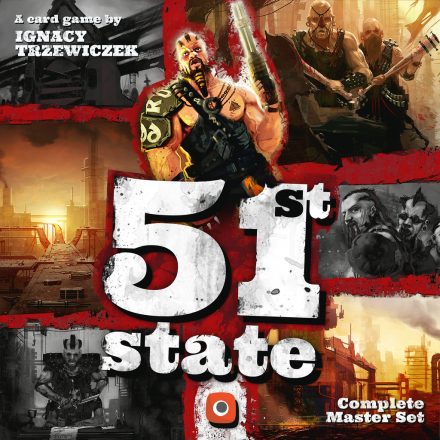
The world you know no longer exists. There is no government. No army. No civilization. The United States has collapsed, and now thirty years after the war started, new powers finally try to take control over the ruined country, try to establish a new order, try to control others and create a new country, a new state: the 51st State.

51st State is a card game in which players control one of four powers trying to build a new country. Players put new locations into play, hire leaders, and send people to work in buildings to gain resources and new skills. To do this, every card in 51st State can be used in three different ways:

  • Raze a location to gain many resources once.
  • Deal with this location to gain one resource every turn.
  • Build the location so that you can use its skill each turn.

51st State: Master Set marks the rebirth of the 51st State line, with this set containing 88 cards from the original base game, and 50 cards each from both the New Era and Winter expansions; one of these expansions can be mixed with the cards of the base game, but not both at the same time. The entire set has been rebalanced to offer a cohesive experience no matter which expansion you choose to use.

7 Wonders Duel 🟢

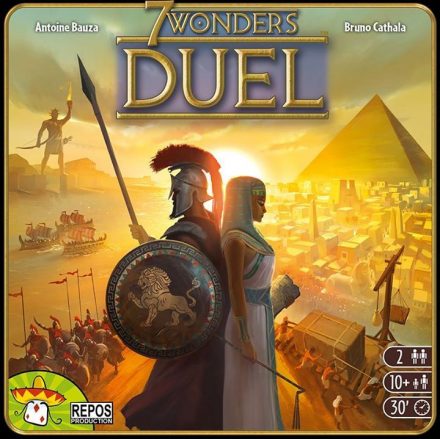
In many ways 7 Wonders Duel resembles its parent game 7 Wonders as over three ages players acquire cards that provide resources or advance their military or scientific development in order to develop a civilization and complete wonders.

What’s different about 7 Wonders Duel is that, as the title suggests, the game is solely for two players, with the players not drafting cards simultaneously from hands of cards, but from a display of face-down and face-up cards arranged at the start of a round. A player can take a card only if it’s not covered by any others, so timing comes into play as well as bonus moves that allow you to take a second card immediately. As in the original game, each card that you acquire can be built, discarded for coins, or used to construct a wonder.

Each player starts with four wonder cards, and the construction of a wonder provides its owner with a special ability. Only seven wonders can be built, though, so one player will end up short.

Players can purchase resources at any time from the bank, or they can gain cards during the game that provide them with resources for future building; as you acquire resources, the cost for those particular resources increases for your opponent, representing your dominance in this area.

A player can win 7 Wonders Duel in one of three ways: each time you acquire a military card, you advance the military marker toward your opponent’s capital, giving you a bonus at certain positions; if you reach the opponent’s capital, you win the game immediately; similarly, if you acquire any six of seven different scientific symbols, you achieve scientific dominance and win immediately; if none of these situations occurs, then the player with the most points at the end of the game wins.

7 Wonders 🟢

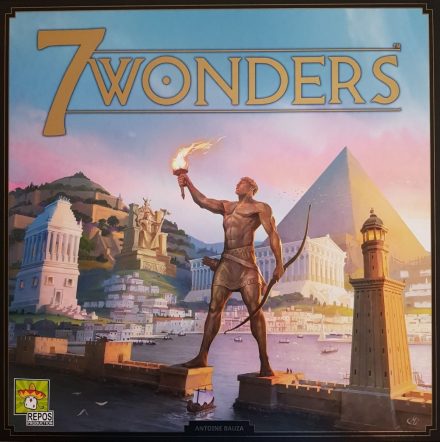
You are the leader of one of the 7 great cities of the Ancient World. Gather resources, develop commercial routes, and affirm your military supremacy. Build your city and erect an architectural wonder which will transcend future times.

7 Wonders lasts three ages. In each age, players receive seven cards from a particular deck, choose one of those cards, then pass the remainder to an adjacent player. Players reveal their cards simultaneously, paying resources if needed or collecting resources or interacting with other players in various ways. (Players have individual boards with special powers on which to organize their cards, and the boards are double-sided). Each player then chooses another card from the deck they were passed, and the process repeats until players have six cards in play from that age. After three ages, the game ends.

In essence, 7 Wonders is a card development game. Some cards have immediate effects, while others provide bonuses or upgrades later in the game. Some cards provide discounts on future purchases. Some provide military strength to overpower your neighbors and others give nothing but victory points. Each card is played immediately after being drafted, so you’ll know which cards your neighbor is receiving and how her choices might affect what you’ve already built up. Cards are passed left-right-left over the three ages, so you need to keep an eye on the neighbors in both directions.