Tag: Melding and Splaying

Forest Shuffle

In Forest Shuffle, players compete to gather the most valuable trees, then attract species to these trees, thus creating an ecologically balanced habitat for flora and fauna.

To start, each player has six cards in hand, with cards depicting either a particular type of tree or two forest dwellers (animal, plant, mushroom, etc.), with these latter cards being divided in half, whether vertically or horizontally, with one dweller in each card half.

On a turn, either draw two cards — whether face down from the deck or face up from the clearing — and add them to your hand, or play a card from your hand by paying the cost, then putting it into play.

During set-up, three winter cards were placed into the bottom third of the deck. When the third winter card is drawn, the game ends immediately, then players tally their points based on the trees and dwellers in their forest. Whoever scores the most points wins.

Forest Shuffle is the first in a line of Lookout games sporting the Lookout Greenline label, produced on FSC certified paper and avoiding plastic completely.

Game Specifications:

  • 2 – 5 Players
  • 40 – 60 Minutes
  • Difficulty Weight 2.21

Campsite

Campsite has players competing for the best camping spot. Play cards on top of each other to link elements like forests, mountains, and camping trails together to score the most points.

A clever card-based “tile” laying game that focus on maximizing your limited space!

Luck and strategy combine in the great outdoors (no actual camping required). Includes 72 cards 42 tokens, scorepad, and pencil.

Game Mechanics:

  • Connections
  • Map Addition
  • Melding and Splaying
  • Tile Placement

Game Specifications:

  • 2 – 6 Players
  • 20 – 60 Minutes
  • Difficulty Weight 1.00

Café

During the reign of King John V, Portugal was a major European power. From Brazil, the king ordered Sergeant Melo Palheta to travel to French Guiana to formally establish the Utrecht Treaty of 1713 and to secretly bring coffee seeds to Brazil. The Sergeant was successful and by 1800 Brazil was one of the largest coffee producers in the world.

In the early 20th century, coffee from Brazil, São Tomé and Príncipe, Angola and Timor is largely appreciated in Portugal and inspires the appearance of prestige coffee shops in emblematic locations that attract the elite. Through dedication, hard work and skill, the Portuguese 20th century witnesses the birth of one of the biggest coffee industries in the world.

In Café, 1 to 4 players represent coffee companies that from plantation, drying, roasting and distribution try to create and control the best supply chain of coffee.

Game Mechanics:

  • Layering
  • Melding and Splaying
  • Solo / Solitaire Game
  • Tile Placement

Game Specifications:

  • 1 – 4 Players
  • 20 – 45 Minutes
  • Difficulty Weight 2.05

7 Wonders Duel 🟢

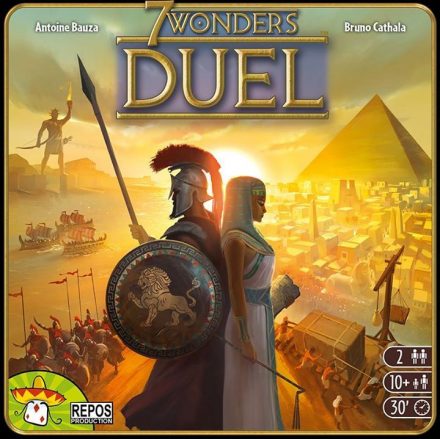
In many ways 7 Wonders Duel resembles its parent game 7 Wonders as over three ages players acquire cards that provide resources or advance their military or scientific development in order to develop a civilization and complete wonders.

What’s different about 7 Wonders Duel is that, as the title suggests, the game is solely for two players, with the players not drafting cards simultaneously from hands of cards, but from a display of face-down and face-up cards arranged at the start of a round. A player can take a card only if it’s not covered by any others, so timing comes into play as well as bonus moves that allow you to take a second card immediately. As in the original game, each card that you acquire can be built, discarded for coins, or used to construct a wonder.

Each player starts with four wonder cards, and the construction of a wonder provides its owner with a special ability. Only seven wonders can be built, though, so one player will end up short.

Players can purchase resources at any time from the bank, or they can gain cards during the game that provide them with resources for future building; as you acquire resources, the cost for those particular resources increases for your opponent, representing your dominance in this area.

A player can win 7 Wonders Duel in one of three ways: each time you acquire a military card, you advance the military marker toward your opponent’s capital, giving you a bonus at certain positions; if you reach the opponent’s capital, you win the game immediately; similarly, if you acquire any six of seven different scientific symbols, you achieve scientific dominance and win immediately; if none of these situations occurs, then the player with the most points at the end of the game wins.

7 Wonders 🟢

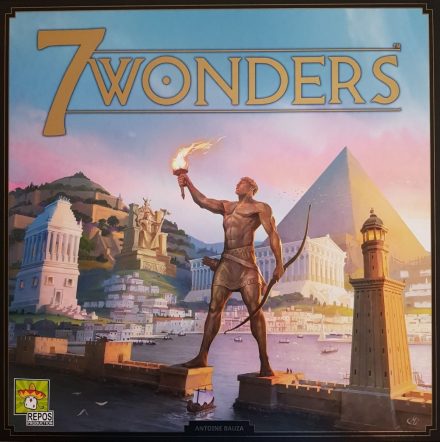
You are the leader of one of the 7 great cities of the Ancient World. Gather resources, develop commercial routes, and affirm your military supremacy. Build your city and erect an architectural wonder which will transcend future times.

7 Wonders lasts three ages. In each age, players receive seven cards from a particular deck, choose one of those cards, then pass the remainder to an adjacent player. Players reveal their cards simultaneously, paying resources if needed or collecting resources or interacting with other players in various ways. (Players have individual boards with special powers on which to organize their cards, and the boards are double-sided). Each player then chooses another card from the deck they were passed, and the process repeats until players have six cards in play from that age. After three ages, the game ends.

In essence, 7 Wonders is a card development game. Some cards have immediate effects, while others provide bonuses or upgrades later in the game. Some cards provide discounts on future purchases. Some provide military strength to overpower your neighbors and others give nothing but victory points. Each card is played immediately after being drafted, so you’ll know which cards your neighbor is receiving and how her choices might affect what you’ve already built up. Cards are passed left-right-left over the three ages, so you need to keep an eye on the neighbors in both directions.