Category: 1-2 Player Games

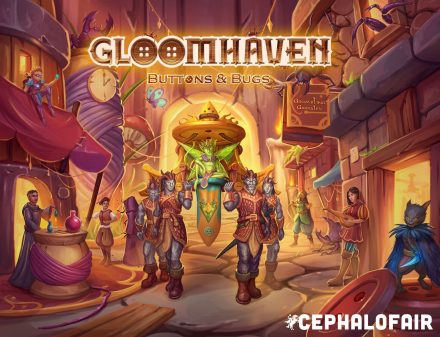
Gloomhaven: Buttons & Bugs

Gloomhaven: Buttons & Bugs is a solo play game, with an original campaign story written by Isaac Childres, that features a playstyle similar to Gloomhaven in a fraction of the size.

Gloomhaven: Buttons & Bugs is set after the events of Gloomhaven and Forgotten Circles. The Aesther recluse Hail has earned a reputation for being highly instrumental in saving the city from recurring disasters, and she absolutely hates it. Wannabe heroes are constantly barging in on her studies at the Crooked Bone, looking for help in becoming famous themselves — not to mention all the demons that come by looking for vengeance. She briefly considered moving, but as that would require effort, she instead just placed an enchantment on her front door: Anyone who attempts to open it becomes miniaturized and therefore is no longer a problem.

Your character is one such wannabe hero. In an ill-advised attempt at fame, they try to visit Hail, and poof. Now they’re the size of a mouse and have entered an entirely different realm of lawlessness and self-preservation. They must find a new way into the Crooked Bone to convince Hail to return them to their previous size.

Each scenario is a single card, pitting one mercenary against a handful of enemies with simplified actions and AI. Each mercenary has a hand of just four double-sided cards, but they can be used twice — both the front and the back — before they are discarded. Attacks are resolved using a die in conjunction with a modifier table, and both the table and the mercenary ability cards can be improved as you level up throughout the campaign.

Game Specifications:

  • 1 Players
  • ~20 Minutes
  • Difficulty Weight 3.32

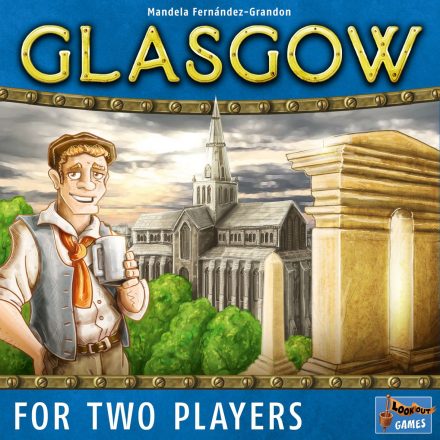
Glasgow

In Glasgow, players travel the city (in an abstract manner) to collect resources, take special actions, and most important of all construct buildings. Build a factory, and you’ll receive more goods from it when other buildings are constructed in the right areas in relation to it; build a train station, and you may or may not score from it depending on what else you build; build a monument, and you’ll merely collect a lot of points — and in the end, points are what matters.

In slightly more detail, to set up the game, lay out a ring of town figures at random, with two of them being removed from play each game. Whoever is farther behind in the circle around town takes the next turn, advancing to whichever town figure they want to visit. Most of them give you resources — brick, steel, or money — and you have a limit on how many resources of each type you can hold. Some figures have two random building plans at them, and if you visit one with the right resources, you can pay them, then build something. If you pay extra, you can then build something else, too!

The first building is placed anywhere in the midst of play, then each subsequent building is placed adjacent to something already built, with the buildings eventually filling in a 4×5 (or 5×4, determined as the game progresses) grid of the players’ own creation. As soon as the twentieth building is erected, the game ends and players score points for what they built. Who has contributed more to the current state of Glasgow?

Game Specifications:

  • 2 Players
  • ~30 Minutes
  • Difficulty Weight 2.02

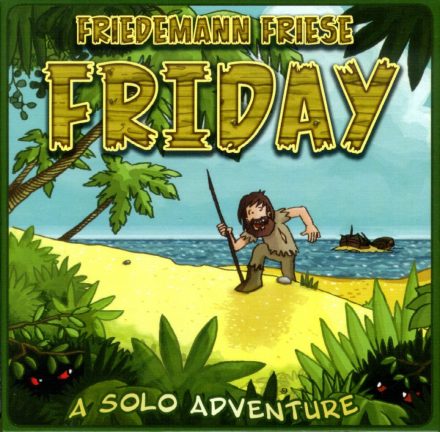
Friday

Friday, the second game in the Friedemann Friese Series: Freitag-Project (Friedemann Friese), is based on the story of Robinson Crusoe and his loyal partner Friday (Freitag). You play as Friday, and when Robinson Crusoe crashes his ship on your island, your peaceful times are disturbed. You must help Robinson to survive the island and prepare him to defeat the pirates that are coming for the island.

Friday is a solitaire deck-building game in which you optimize your deck of fight cards in order to defeat the hazards of the island. During a turn the player will attempt to defeat hazard cards by playing fight cards from their deck. If defeated, a hazard card will become a fight card and is added to the player’s deck. If failed, the player will lose life points but also get the opportunity to remove unwanted cards from their fight deck. In the end, the player will use their optimized fight deck to defeat the two pirate ships coming for the island, allowing Robinson Crusoe to escape the island and allowing you to finally have your peace back!

Game Specifications:

  • 1 Players
  • ~25 Minutes
  • Difficulty Weight 2.15

Fox in the Forest, The

The Fox in the Forest is a trick-taking game for two players. Aside from the normal ranked- and suited-cards used to win tricks, fairy characters such as the Fox and the Witch have special abilities that let you change the trump suit, lead even after you lose a trick, and more.

You score points by winning more tricks than your opponent, but don’t get greedy! Win too many tricks, and you will fall like the villain in so many fairy tales…

Game Specifications:

  • 2 Players
  • ~30 Minutes
  • Difficulty Weight 1.60

Fox in the Forest Duet, The

In the two-player, co-operative trick-taking game The Fox in the Forest Duet, players team up, helping each other move through the forest. Collect all the gems before the end of three rounds of play, and you win!

To set up the game, place gem tokens on the designated spaces of the game board and the team tracker token in the center of the movement path. At the start of each round, shuffle the deck of thirty cards — which contains three suits, each numbered 1-10 — and deal each player a hand of eleven cards. Reveal one card as the “decree” card to determine the trump suit. For each trick, one player leads a card, and the other must follow suit, if possible. The winner of the trick moves the team tracker toward them a number of spaces equal to the number of fox footprints on the cards played. If the tracker lands on a space next to a gem, the players collect one gem. If the tracker would move off the end of the path, return the tracker to the center of the path, then add a forest token to one end of the path, reducing the number of spaces upon which you can move (with you sliding gems next to this covered space next to the new end of the path).

The odd-numbered character cards have special abilities when played, allowing the trick winner to move the tracker in the direction of their choice or to ignore the footprints on one of the played cards so that you can land on just the right spot. One character allows players to exchange one card with each other, while another allows a player to change the decree card.

At the end of a round, you add five gems to designated spaces, add a forest space to shorten the path, then receive a new hand of eleven cards from a freshly shuffled deck. Collect all 22 gem tokens, and you win. Run out of time or head off the end of the path with no forest spaces in reserve, then you can just keep running in defeat or shuffle the cards and start the game anew.

Game Specifications:

  • 2 Players
  • ~30 Minutes
  • Difficulty Weight 1.77

Fortify

It’s a hot summer and you see a new family just moved in across the street and you know what that means, boxes! You round up your friends and a giant bag of water balloons. You quickly split into teams, start stacking boxes, and fill your water balloons because everyone knows its time to Fortify!

Use the variety of boxes (Cards) to create a closed wall around your Base. The larger you make it the more friends can fit inside. The more friends you have the faster you can build or the more water balloons (Dice) you can toss at your opponent’s fort. Roll well and land your water balloons on boxes, rival friends, and ultimately their base to claim the day and the pride of the neighborhood!

Game Specifications:

  • ~2 Players
  • 15 – 30 Minutes
  • Difficulty Weight 1.50

Floristry

Floristry is a 2 player, tile-laying game. Players compete at the historic Aalsmeer Dutch Auction to win the best flowers and then use them to create the most charming window display.

Each round features a Dutch auction, where the clock counts down from 15 seconds while the price drops every 3 seconds. The unique web app runs your auctions, so you have to think fast, bid carefully, and pay close attention to get what you want at the right price– but also keep an eye on what your rival needs.

Players simultaneously and strategically place their new flowers into their storefront frame. At the end of the game, players will earn Charm from their largest patch of each flower type, and whoever has the most Charm wins.

Game Mechanics:

Game Specifications:

  • 2 Players
  • 15 – 20 Minutes
  • Difficulty Weight 1.25

Flatiron

The Flatiron Building, originally known as the Fuller Building, is a historic 22-story skyscraper located in Manhattan, New York. It is known for its distinctive triangular shape reminiscent of an old-fashioned clothes iron. Since its construction in 1902, it has become one of the most recognizable icons on the New York City skyline, situated at the intersection of Fifth Avenue with Broadway, East 22nd Street, and East 23rd Street.

In Flatiron, you will be transported to the Big Apple to participate in the construction of this iconic building. Both you and your opponent will need to develop your companies by adding new cards to your personal board, thereby allowing you to perform more and better actions on each of the surrounding streets. The ultimate goal is to earn more points than your opponent, primarily by undertaking construction tasks but also by maintaining an impeccable public image and adhering to the decrees of the New York City Council. When the roof is placed, and everything is ready for the grand opening, the game ends. Victory and recognition will go only to the player who has accumulated the most points.

Game Specifications:

  • 1 – 2 Players
  • ~45 Minutes
  • Difficulty Weight 2.62

Everdell Duo

In Everdell Duo, you either compete against your single opponent or play co-operatively with another player to earn the most points. You accomplish this by placing workers to gather resources, then use those resources to play cards face up in front of you, creating your own woodland city.

Cards may be played from your hand or from the face-up area on the board called the meadow. However, only cards touching the sun or moon token may be played from the meadow, and players move these tokens each time they perform a turn. Therefore, planning for and timing which cards you play is critical.

Each game you try to achieve various events, the requirements of which differ from game to game, making certain cards and combinations more important to pursue.

The game lasts for four seasons, then players add their scores to determine the winner. If you’re playing co-operatively, check the requirements for the chapter you are playing to see whether you have won.

Agent Avenue

Agent Avenue is a competitive card game that combines bluffing, strategic set collection, and a race to uncover your opponent’s identity. Set in a colorful anthropomorphic world, players assume the roles of retired spies in a suburban neighborhood, outsmarting each other with cards that can score points or trigger special effects. The game’s art brings to life a quirky neighborhood of animal spies.

Use a unique “I split, you choose” mechanic to play one card face-up and one face-down each turn. Your opponent chooses one, influencing both your strategies. Cards feature different agents and tools that impact scoring and game progress on a track, advancing the “catch me” race to uncover the opposing spy.

Outwit your opponents by strategically collecting agent sets and effectively using spy tools. The game ends when a player successfully uncovers their opponent, combining both strategic depth and bluffing elements.

Perfect for those who love a mix of strategy and lighthearted competition, “Agent Avenue” challenges you to think like a spy and act like a friendly neighbor.

Game Specifications:

  • 2 – 4 Players
  • 10 – 20 Minutes
  • Difficulty Weight 1.30