Tag: Enclosure

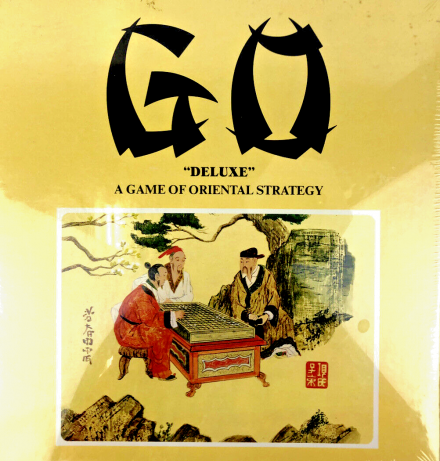
Go

In Go, players alternately place stones on the empty intersections of a 19×19 grid. The goal: to enclose territory behind stone perimeters and, secondarily, to tightly surround and capture enemy stones. After both players pass, they add up their territory and deduct the number of captives lost, higher score wins.

As you see, the concept is simple, yet the challenge can enrich a lifetime. In truth many lifetimes, for Go has been played for thousands of years. With that long of a lineage and a worldwide following, it has come to be known by different names (Weiqi, Igo, Baduk) and to be played by slightly differing rules, but those differences seldom affect play.

So welcome to this masterpiece that is the game of Go, the race for geographical control of an unclaimed land. Experience running battles and swift reversals, bold invasions and painful sacrifices, each sally, each setback playing out to the dulcet tap of stone on wood.

Game Specifications:

  • 2 Players
  • 30 – 180 Minutes
  • Difficulty Weight 3.91

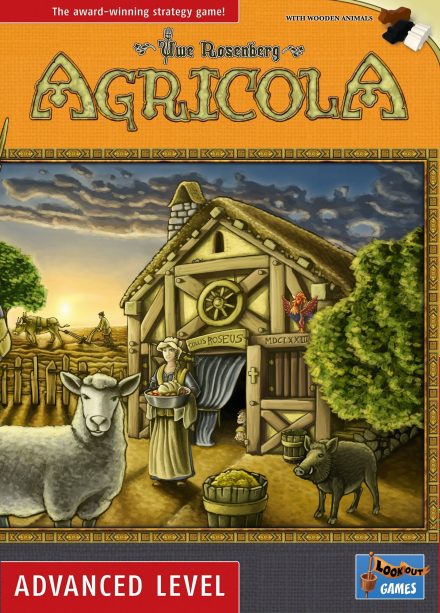
Agricola 🟠

In Agricola, you’re a farmer in a wooden shack with your spouse and little else. On a turn, you get to take only two actions, one for you and one for the spouse, from all the possibilities you’ll find on a farm: collecting clay, wood, or stone; building fences; and so on. You might think about having kids in order to get more work accomplished, but first you need to expand your house. And what are you going to feed all the little rugrats?

The game supports many levels of complexity, mainly through the use (or non-use) of two of its main types of cards, Minor Improvements and Occupations. In the beginner’s version (called the Family Variant in the U.S. release), these cards are not used at all. For advanced play, the U.S. release includes three levels of both types of cards; Basic (E-deck), Interactive (I-deck), and Complex (K-deck), and the rulebook encourages players to experiment with the various decks and mixtures thereof. Aftermarket decks such as the Z-Deck and the L-Deck also exist.

Agricola is a turn-based game. There are 14 game rounds occurring in 6 stages, with a Harvest at the end of each stage (after Rounds 4, 7, 9, 11, 13, and 14).
Each player starts with two playing tokens (farmer and spouse) and thus can take two turns, or actions, per round. There are multiple options, and while the game progresses, you’ll have more and more: first thing in a round, a new action card is flipped over.
Problem: Each action can be taken by only one player each round, so it’s important to do some things with high preference.
Each player also starts with a hand of 7 Occupation cards (of more than 160 total) and 7 Minor Improvement cards (of more than 140 total) that he/she may use during the game if they fit in his/her strategy. Speaking of which, there are countless strategies, some depending on your card hand. Sometimes it’s a good choice to stay on course, and sometimes it is better to react to your opponents’ actions…

Agricola: All Creatures Big and Small 🟢

Agricola: All Creatures Big and Small is a new take on Uwe Rosenberg’s Agricola designed for exactly two players and focused only on the animal husbandry aspect of that game. So long plows and veggies!

In Agricola: All Creatures Big and Small, you become an animal breeder of horses, cows, sheep and pigs and try to make the most of your pastures. Players start with a 3×2 game board that can be expanded during play to give more room for players to grow and animals to run free. Sixteen possible actions are available for players to take, with each player taking three actions total in each of the eight rounds.

The player who amasses the most victory points through enclosing space with fences and acquiring the largest number and variety of animals and victory point-generating buildings will be the winner.

Four Standard Buildings and 4 special buildings are available in the base game. These buildings each provide unique special abilities during play and/or VP at game end. Balancing the tension between building infrastructure (fenced pastures and buildings) and acquiring animals (the single biggest source of end-game scoring) is the key to success!