Tag: Animals

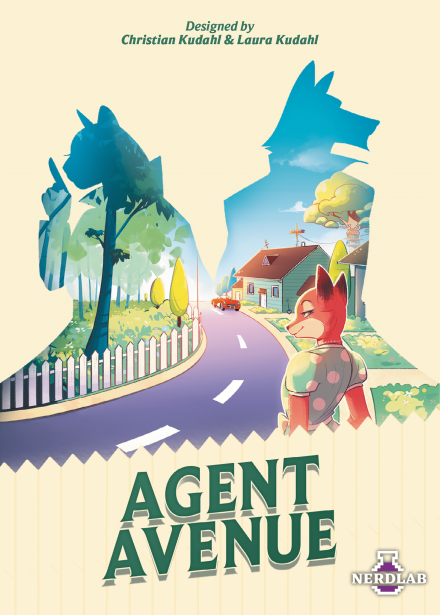
Agent Avenue

Agent Avenue is a competitive card game that combines bluffing, strategic set collection, and a race to uncover your opponent’s identity. Set in a colorful anthropomorphic world, players assume the roles of retired spies in a suburban neighborhood, outsmarting each other with cards that can score points or trigger special effects. The game’s art brings to life a quirky neighborhood of animal spies.

Use a unique “I split, you choose” mechanic to play one card face-up and one face-down each turn. Your opponent chooses one, influencing both your strategies. Cards feature different agents and tools that impact scoring and game progress on a track, advancing the “catch me” race to uncover the opposing spy.

Outwit your opponents by strategically collecting agent sets and effectively using spy tools. The game ends when a player successfully uncovers their opponent, combining both strategic depth and bluffing elements.

Perfect for those who love a mix of strategy and lighthearted competition, “Agent Avenue” challenges you to think like a spy and act like a friendly neighbor.

Game Specifications:

  • 2 – 4 Players
  • 10 – 20 Minutes
  • Difficulty Weight 1.30

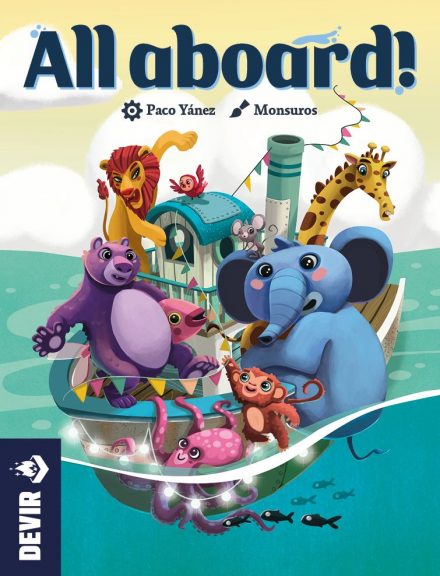
All Aboard!

“We sink!” shouts the elephant, “That mouse is too heavy!” “Don’t worry!” whispers the lion, “If I eat the giraffe, we can lose a little weight.”

In All Aboard! you must get your gang of animals to safety in the different boats, but be careful not to exceed their capacity, or else they will sink. Designed by Paco Yánez and illustrated by Monsuros, this fun card game can be played as a couple or in groups of up to 5 players, from 7 years old, in games lasting about 20 minutes.

Before starting, each player receives a set of 12 cards with the 12 different animals in the game (mouse, peacock, fox, octopus, monkey, sloth, elk, zebra, giraffe, lion, bear and elephant). The game is played over 4 rounds and each one consists of two phases: boarding the boats and setting sail. In the boarding phase, players will place one of the animals face up in any of the boats, taking into account that there can be no more than 3 animals in each one. In the second turn, they will place a new animal in any of the available boats, but this time face down; Finally, in the third turn a third animal will board the available boats, again face up.

At the beginning of the setting sail phase, all animal cards that have been played face down are revealed and then a check is made to see if there are two or more animals of the same species. If there are 2, they both fall in love (and the players will receive points for it). If there are 3, they fight and the boat sinks. Next, the animals activate their effects and finally the sum of the weight of the animals on board the boat is checked. If the weight of the animals is equal to or less than the weight that the boat can withstand, the animals manage to set sail and will score at the end of the game. Each player takes their animals and places them in a pile of saved animals in their playing area. If, on the other hand, the boat sinks, the animals are discarded.

Knowing when to play each animal is one of the keys to the game. However, depending on how your rivals play the cards, unforeseen situations can arise on the ships. Each animal has its own power, which can unleash chaos or balance the scales. Will you be able to save as many animals as possible?

Game Specifications:

  • 2 – 5 Players
  • ~20 Minutes
  • Difficulty Weight 1.60

Abducktion 🔵

A 15-minute light strategy game for adults of duck matching, a UFO, and logic! Players are all interns on an alien UFO, working for an intergalactic corporation that has one main function: abducting ducks. (For research purposes, duh).

But, ducks need to be collected in specific formations, and you’ll have to use spatial logic and cunning to rearrange your ducks before your opponents to win!

Abduct (collect) ducks in specific formations by using action cards to move your (or your opponent’s) ducks around. Each player gets an individual stream board that can hold 10 ducks. Put the ducks into patterns by moving them around with action cards. When your ducks in a single color match a pattern on one of the shared formation cards, you earn the card and abduct the ducks into the UFO. Grab more ducks out of the UFO and try to make another pattern before the cards run out.

Game Specifications:

  • 1 – 4 Players
  • ~15 Minutes
  • Difficulty Weight 1.33

Apiary 🟡

In a far-distant future, humans no longer inhabit Earth. The cause of their disappearance (or perhaps their demise) is unknown, but their absence left a void ready to be filled by another sentient species.

Over the span of untold generations, one species of the humble honeybee evolved to fill that void. They grew in size and intelligence to become a highly advanced society. They call themselves Mellifera, and they have made substantial technological advances in addition to the technology they adapted from human ruins, up to and including space travel.

In Apiary, each player controls one of twenty unique factions. Your faction starts the game with a hive, a few resources, and worker bees. A worker-placement, hive-building challenge awaits you: explore planets, gather resources, develop technologies, and create carvings to demonstrate your faction’s strengths (measured in victory points) over one year’s Flow. However, the Dearth quickly approaches, and your workers can take only a few actions before they must hibernate! Can you thrive or merely survive?

Game Specifications:

  • 1 – 5 Players
  • 60 – 90 Minutes
  • Difficulty Weight 2.97

Agricola 🟠

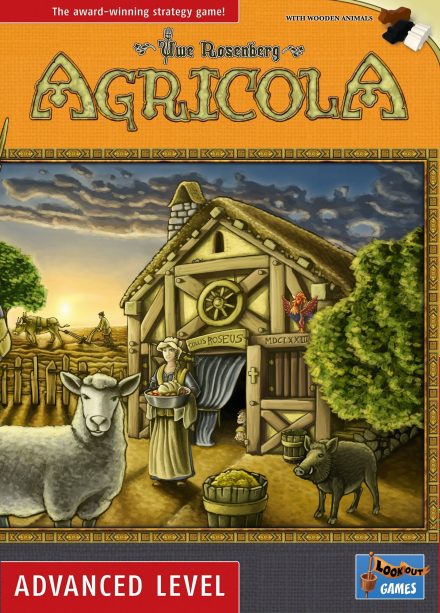
In Agricola, you’re a farmer in a wooden shack with your spouse and little else. On a turn, you get to take only two actions, one for you and one for the spouse, from all the possibilities you’ll find on a farm: collecting clay, wood, or stone; building fences; and so on. You might think about having kids in order to get more work accomplished, but first you need to expand your house. And what are you going to feed all the little rugrats?

The game supports many levels of complexity, mainly through the use (or non-use) of two of its main types of cards, Minor Improvements and Occupations. In the beginner’s version (called the Family Variant in the U.S. release), these cards are not used at all. For advanced play, the U.S. release includes three levels of both types of cards; Basic (E-deck), Interactive (I-deck), and Complex (K-deck), and the rulebook encourages players to experiment with the various decks and mixtures thereof. Aftermarket decks such as the Z-Deck and the L-Deck also exist.

Agricola is a turn-based game. There are 14 game rounds occurring in 6 stages, with a Harvest at the end of each stage (after Rounds 4, 7, 9, 11, 13, and 14).
Each player starts with two playing tokens (farmer and spouse) and thus can take two turns, or actions, per round. There are multiple options, and while the game progresses, you’ll have more and more: first thing in a round, a new action card is flipped over.
Problem: Each action can be taken by only one player each round, so it’s important to do some things with high preference.
Each player also starts with a hand of 7 Occupation cards (of more than 160 total) and 7 Minor Improvement cards (of more than 140 total) that he/she may use during the game if they fit in his/her strategy. Speaking of which, there are countless strategies, some depending on your card hand. Sometimes it’s a good choice to stay on course, and sometimes it is better to react to your opponents’ actions…

Atiwa

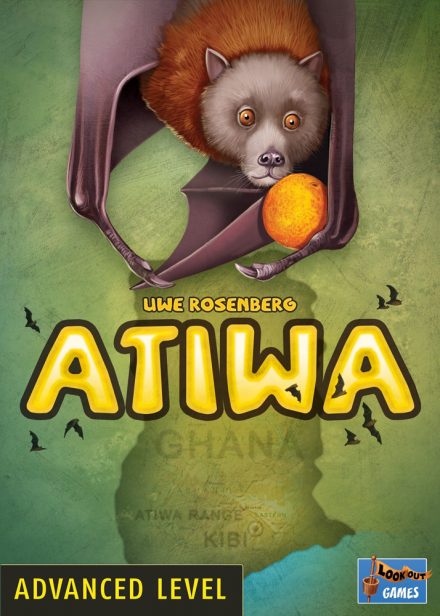
The Atiwa Range is a region of southeastern Ghana in Africa consisting of steep-sided hills with rather flat summits. A large portion of the range comprises an evergreen forest reserve, which is home to many endangered species. However, logging and hunting for bushmeat, as well as mining for gold and bauxite, are putting the reserve under a lot of pressure.

Meanwhile, in the nearby town of Kibi, the mayor is causing a stir by giving shelter to a large number of fruit bats in his own garden. This man has recognized the great value the animals have in deforested regions of our planet: Fruit bats sleep during the day and take off at sunset in search of food, looking for suitable fruit trees up to sixty miles away. They excrete the seeds of the consumed fruit, disseminating them across large areas as they fly home. A single colony of 150,000 fruit bats can reforest an area of up to two thousand acres a year.

Just like that mayor, in Atiwa, you know that fruit bats — once scorned and hunted as mere fruit thieves — are in fact incredibly useful animals, spreading seeds over large areas of the country. By doing so, they help to reforest fallow land and, in the medium term, improve harvests. This realization has led to a symbiotic co-operation between fruit bats and fruit farmers. The animals are kept as “pets” to increase the size of fruit farms more quickly. Tall trees are left as roosts, providing shelter for them rather than hunting them for their scant meat. However, if you have a lot of fruit bats, you need a lot of space…

In the game, you will develop a small community near the Atiwa Range, creating housing for new families and sharing your newly gained knowledge on the negative effects of mining and the importance that the fruit bats have for the environment. You must acquire new land, manage your animals and resources, and make your community prosper. The player who best balances the needs of their community and the environment wins.

Aftermath 🟡

Aftermath is an Adventure Book Game in which players take on the role of small critters struggling to survive and thrive in a big, dangerous world. Humans have mysteriously vanished, and the remnants of civilization are quickly being reclaimed by nature and the animals who still remain.

In the game, you play as a misfit band of critters known by their colony as “providers”. There’s the guinea pig with anger issues, a hamster that talks fast and drives faster, a small mouse with keen eyes and a lot to prove, and a mysterious vole who’s borderline feral. These characters each have their own personalities, play-styles, and personal goals.

You’ll leave the safety of your colony and venture out into the abandoned world on one of 20+ story-driven missions and side missions. Scavenge the ruins of mankind in search of food and supplies for your colony, but beware — the world is filled with bandits and predators, and you must fight or flee to stay alive.

Return to your colony with resources and information that will help your friends and family survive. Grow your colony and keep it safe by building structures and improvements with the spoils of your adventures, but plan accordingly, for the colony will face hardship each time you leave it…

Animal Kingdoms 🟢

In Animal Kingdoms, each player takes on the role of a house leader, battling to gain control of the five kingdoms. Cards in your hand represent noble beasts that have pledged their allegiance to you. Over the course of three ages, you must deploy your beasts to the various territories – making sure that you adhere to each kingdom’s decree – to try and improve your influential position in the kingdoms. The house that gains the most influence by the end of the third age is declared the one true leader of the realm.

Game Specifications:

  • 1 – 5 Players
  • ~45 Minutes
  • Difficulty Weight 1.77

Agricola: All Creatures Big and Small 🟢

Agricola: All Creatures Big and Small is a new take on Uwe Rosenberg’s Agricola designed for exactly two players and focused only on the animal husbandry aspect of that game. So long plows and veggies!

In Agricola: All Creatures Big and Small, you become an animal breeder of horses, cows, sheep and pigs and try to make the most of your pastures. Players start with a 3×2 game board that can be expanded during play to give more room for players to grow and animals to run free. Sixteen possible actions are available for players to take, with each player taking three actions total in each of the eight rounds.

The player who amasses the most victory points through enclosing space with fences and acquiring the largest number and variety of animals and victory point-generating buildings will be the winner.

Four Standard Buildings and 4 special buildings are available in the base game. These buildings each provide unique special abilities during play and/or VP at game end. Balancing the tension between building infrastructure (fenced pastures and buildings) and acquiring animals (the single biggest source of end-game scoring) is the key to success!

Animal Upon Animal 🔵

The animals want to show how good they are at making tall pyramids! They must be skillfully careful: Who will position the penguin on top of the crocodile, the sheep on top of the penguin, the serpent on the sheep? The hedgehog wants to stand on top of the pyramid but the height is making him dizzy.

Tier auf Tier (a.k.a. Animal Upon Animal, Pyramide d’animaux, and Dier op dier) is a simple stacking game, listed for ages 4-99, with 29 cute wooden animals.

Each turn a player rolls the die and either places one or two animals on to the stack of animals, passes one of his or her animals to another player for them to place, or places an animal on the table, extending the base for other players to build upon. Of course, if any pieces fall off whilst you are building, you get up to two of them back. The first player to have used all of their animals wins.

This game, intended for children, is equally popular with adults.

Game Specifications:

  • 2 – 4 Players
  • ~15 Minutes
  • Difficulty Weight 1.04