Tag: Turn Order: Claim Action

Great Wall, the

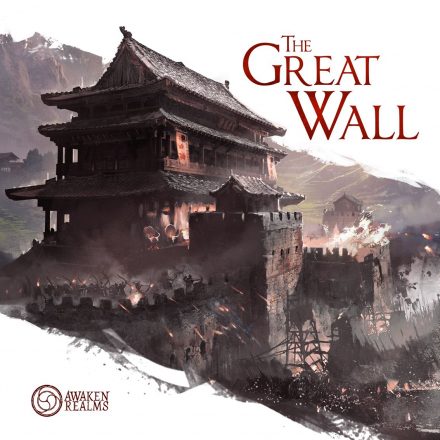
The Great Wall is a new asymmetric worker/soldier placement game with engine building themes and a twist in form of a constantly attacking AI (Mongolian Horde) that requires players to sometimes cooperate in order to defeat it. This is a new major board game from Awaken Realms.

Players will control ancient clans in China trying to defend against invading Mongolian hordes and build a Great Wall. While every player will want to win (by earning VP = Honor) they also need to sometimes cooperate to defend against the hordes. Each clan will be asymmetric through its chosen Leader (resource production/starting resources/starting workers and units) and this asymmetry will increase as the game progresses (players will hire Advisors with unique skills, often creating unique engines).

In The Great Wall, the players take the role of Generals defending the Wall against the Mongol Horde. The game is played over a series of turns called Years, each divided into 4 parts called Seasons.

During Spring, new barbaric hordes invade the fields in front of the Great Wall and prepare to launch their assault. Summer is the time when generals prepare for the assault and mobilize their forces. During Fall, players take their turns, playing Command cards, resolving their effects and Activating Locations to gain various benefits. In Winter, the last layer of Defense is activated, then, the hordes try to assault the Walls.

During the course of the game, players will create their own unique engines based on their clan strength as well as interact with other players during all phases of the game, trying to get the most Honor points, which can be gained in a lot of different ways.

At the end of the game, the player with the most Honor wins.

—description from the publisher

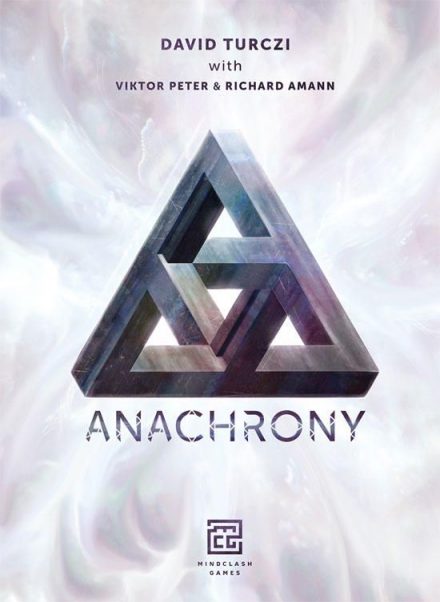
Anachrony 🟠

It is the late 26th century. Earth is recovering from a catastrophic explosion that exterminated the majority of the population centuries ago and made most of the surface uninhabitable due to unearthly weather conditions. The surviving humans organized along four radically different ideologies, called Paths, to rebuild the world as they see fit: Harmony, Dominance, Progress, and Salvation. Followers of the four Paths live in a fragile peace, but in almost complete isolation next to each other. Their only meeting point is the last major city on Earth, now just known as the Capital.

By powering up the mysterious Time Rifts that opened in the wake of the cataclysm, each Path is able to reach back to specific moments in their past. Doing so can greatly speed up their progress, but too much meddling may endanger the time-space continuum. But progress is more important than ever before: if the mysterious message arriving through the Time Rift is to be believed, an even more terrible cataclysm is looming on the horizon: an asteroid bearing the mysterious substance called Neutronium is heading towards Earth. Even stranger, the scientists show that the energy signature of the asteroid matches the explosion centuries ago…

Anachrony features a unique two-tiered worker placement system. To travel to the Capital or venture out to the devastated areas for resources, players need not only various specialists (Engineers, Scientists, Administrators, and Geniuses) but also Exosuits to protect and enhance them — and both are in short supply.

The game is played in 4-7 turns, depending on the time when the looming cataclysm occurs — unless, of course, it is averted! The elapsed turns are measured on a dynamic timeline. By powering up the Time Rifts, players can reach back to earlier turns to supply their past “self” with resources. Each Path has a vastly different objective that rewards it with a massive amount of victory points when achieved. The Paths’ settlements will survive the impact, but the Capital will not. Whichever Path manages to collect most points will be the new seat for the Capital, thus the most important force left on the planet…

Azul Duel

Decorate the magnificent ceilings of the palace. Will the vaults look more beautiful by day or by night? Azul Duel invites you to play with light and pit opposites against each other.

This competitive strategic game for two players retains the purity and elegance of the original Azul while adding an extra tactical dimension in which you determine the pattern in which tiles will be placed, in addition to drafting tiles to complete that pattern.

Arcs

Arcs is a sharp, tactical space opera game, for 2–4 players, set in a dark yet silly universe. Players represent officials from a distant, decaying and neglectful Empire who are now free to vie for dominance whether through battle, gathering scarce resources or diplomatic intrigue. Ready yourself for dramatic twists and turns as you launch into this galactic struggle.

A deck of cards in 4 suits with ranks from 1-7 (2-6 for less than 4 players) defines the action selection system. These cards are played in a trick-taking adjacent system to select actions, take the initiative and declare Ambitions. The 3 declared Ambitions are what will score in that deal. Timing is everything. Bad hands must be mitigated by careful card play and benefitting from other players’ card play.

Battles are resolved quickly with the attacker choosing their level of risk. The defenders must be prepared with adequate defensive ships and cards in their tableau.

Each game contains a hundred wooden ships and agents, 18 custom engraved dice, a beautiful six-panel board, and tons of cards with over 60 pieces of unique art. The base game may be played without the optional Leaders and Lore cards (for an easier teach) or with them for a richer, fuller and asymmetric game. It is also the core of the campaign game (requiring the Blighted Reach Expansion), which provides an epic, more thematic experience.

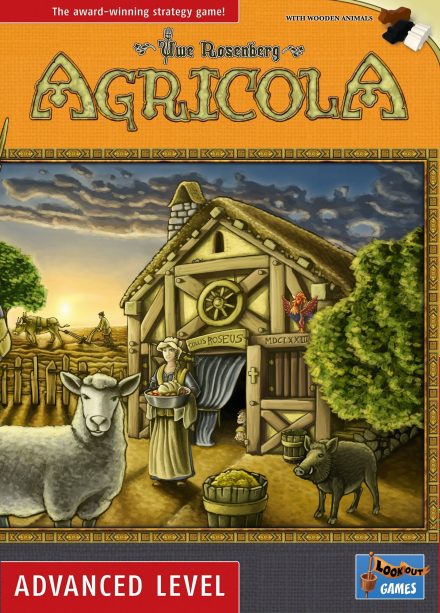
Agricola 🟠

In Agricola, you’re a farmer in a wooden shack with your spouse and little else. On a turn, you get to take only two actions, one for you and one for the spouse, from all the possibilities you’ll find on a farm: collecting clay, wood, or stone; building fences; and so on. You might think about having kids in order to get more work accomplished, but first you need to expand your house. And what are you going to feed all the little rugrats?

The game supports many levels of complexity, mainly through the use (or non-use) of two of its main types of cards, Minor Improvements and Occupations. In the beginner’s version (called the Family Variant in the U.S. release), these cards are not used at all. For advanced play, the U.S. release includes three levels of both types of cards; Basic (E-deck), Interactive (I-deck), and Complex (K-deck), and the rulebook encourages players to experiment with the various decks and mixtures thereof. Aftermarket decks such as the Z-Deck and the L-Deck also exist.

Agricola is a turn-based game. There are 14 game rounds occurring in 6 stages, with a Harvest at the end of each stage (after Rounds 4, 7, 9, 11, 13, and 14).
Each player starts with two playing tokens (farmer and spouse) and thus can take two turns, or actions, per round. There are multiple options, and while the game progresses, you’ll have more and more: first thing in a round, a new action card is flipped over.
Problem: Each action can be taken by only one player each round, so it’s important to do some things with high preference.
Each player also starts with a hand of 7 Occupation cards (of more than 160 total) and 7 Minor Improvement cards (of more than 140 total) that he/she may use during the game if they fit in his/her strategy. Speaking of which, there are countless strategies, some depending on your card hand. Sometimes it’s a good choice to stay on course, and sometimes it is better to react to your opponents’ actions…

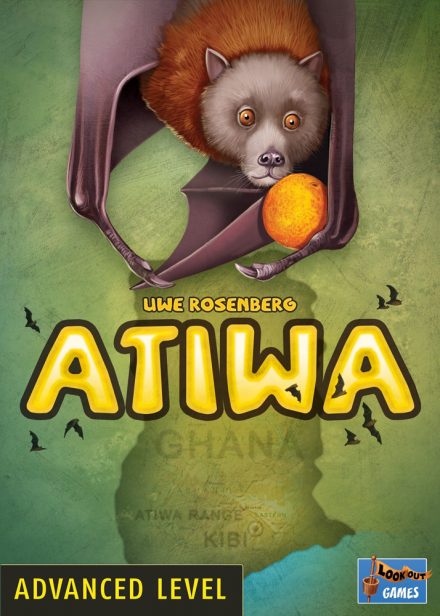
Atiwa

The Atiwa Range is a region of southeastern Ghana in Africa consisting of steep-sided hills with rather flat summits. A large portion of the range comprises an evergreen forest reserve, which is home to many endangered species. However, logging and hunting for bushmeat, as well as mining for gold and bauxite, are putting the reserve under a lot of pressure.

Meanwhile, in the nearby town of Kibi, the mayor is causing a stir by giving shelter to a large number of fruit bats in his own garden. This man has recognized the great value the animals have in deforested regions of our planet: Fruit bats sleep during the day and take off at sunset in search of food, looking for suitable fruit trees up to sixty miles away. They excrete the seeds of the consumed fruit, disseminating them across large areas as they fly home. A single colony of 150,000 fruit bats can reforest an area of up to two thousand acres a year.

Just like that mayor, in Atiwa, you know that fruit bats — once scorned and hunted as mere fruit thieves — are in fact incredibly useful animals, spreading seeds over large areas of the country. By doing so, they help to reforest fallow land and, in the medium term, improve harvests. This realization has led to a symbiotic co-operation between fruit bats and fruit farmers. The animals are kept as “pets” to increase the size of fruit farms more quickly. Tall trees are left as roosts, providing shelter for them rather than hunting them for their scant meat. However, if you have a lot of fruit bats, you need a lot of space…

In the game, you will develop a small community near the Atiwa Range, creating housing for new families and sharing your newly gained knowledge on the negative effects of mining and the importance that the fruit bats have for the environment. You must acquire new land, manage your animals and resources, and make your community prosper. The player who best balances the needs of their community and the environment wins.

Agricola: All Creatures Big and Small 🟢

Agricola: All Creatures Big and Small is a new take on Uwe Rosenberg’s Agricola designed for exactly two players and focused only on the animal husbandry aspect of that game. So long plows and veggies!

In Agricola: All Creatures Big and Small, you become an animal breeder of horses, cows, sheep and pigs and try to make the most of your pastures. Players start with a 3×2 game board that can be expanded during play to give more room for players to grow and animals to run free. Sixteen possible actions are available for players to take, with each player taking three actions total in each of the eight rounds.

The player who amasses the most victory points through enclosing space with fences and acquiring the largest number and variety of animals and victory point-generating buildings will be the winner.

Four Standard Buildings and 4 special buildings are available in the base game. These buildings each provide unique special abilities during play and/or VP at game end. Balancing the tension between building infrastructure (fenced pastures and buildings) and acquiring animals (the single biggest source of end-game scoring) is the key to success!

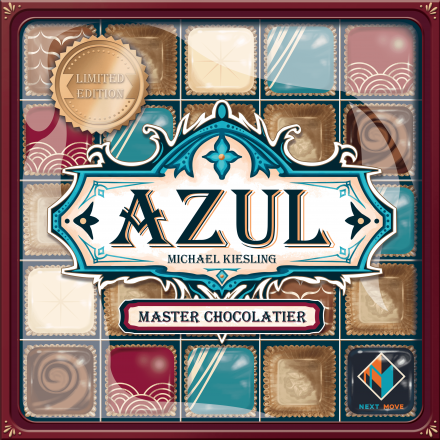
Azul: Master Chocolatier TAGS, EXCERPT, POST TAGS

In the game Azul, players take turns drafting colored tiles from suppliers to their player board. Later in the round, players score points based on how they’ve placed their tiles to decorate the palace. Extra points are scored for specific patterns and completing sets; wasted supplies harm the player’s score. The player with the most points at the end of the game wins.

Azul: Master Chocolatier includes double-sided factory boards, with these tiles being placed on these boards at the start of each round. One side of the factories is blank, and when using this side the game plays exactly like Azul. The other side of each factory tile has a special effect on it that modifies play in one way or another, putting a twist on the normal game. Additionally, the tiles are modeled to look like chocolates and other treats, despite remaining as inedible as the tiles in the original game.

Game Specifications:

  • 2 – 4 Players
  • 30 – 45 Minutes
  • Difficulty Weight 1.79

Azul

Introduced by the Moors, azuleijos (originally white and blue ceramic tiles) were fully embraced by the Portuguese when their king Manuel I, on a visit to the Alhambra palace in Southern Spain, was mesmerized by the stunning beauty of the Moorish decorative tiles. The king, awestruck by the interior beauty of the Alhambra, immediately ordered that his own palace in Portugal be decorated with similar wall tiles. As a tile-laying artist, you have been challenged to embellish the walls of the Royal Palace of Evora.

In the game Azul, players take turns drafting colored tiles from suppliers to their player board. Later in the round, players score points based on how they’ve placed their tiles to decorate the palace. Extra points are scored for specific patterns and completing sets; wasted supplies harm the player’s score. The player with the most points at the end of the game wins.