Tag: Ordering

Hanabi

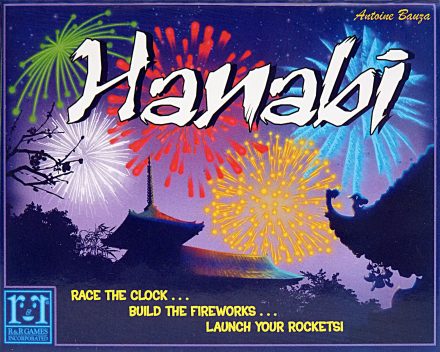
Hanabi—named for the Japanese word for “fireworks”—is a cooperative game in which players try to create the perfect fireworks show by placing the cards on the table in the right order. (In Japanese, hanabi is written as 花火; these are the ideograms flower and fire, respectively.)

The card deck consists of five different colors of cards, numbered 1–5 in each color. For each color, the players try to place a row in the correct order from 1–5. Sounds easy, right? Well, not quite, as in this game you hold your cards so that they’re visible only to other players. To assist other players in playing a card, you must give them hints regarding the numbers or the colors of their cards. Players must act as a team to avoid errors and to finish the fireworks display before they run out of cards.

An extra suit of cards, rainbow colored, is also provided for advanced or variant play.

Hanabi was originally published as part of Hanabi & Ikebana.

Game Specifications:

  • 2 – 5 Players
  • 25 Minutes
  • Difficulty Weight 1.69

Arboretum

Arboretum is a strategy card game for 2-4 players, aged 10 and up, that combines set collection, tile-laying and hand management while playing in about 25 minutes. Players try to have the most points at the end of the game by creating beautiful garden paths for their visitors.

The deck has 80 cards in ten different colors, with each color featuring a different species of tree; each color has cards numbered 1 through 8, and the number of colors used depends on the number of players. Players start with a hand of seven cards. On each turn, a player draws two cards (from the deck or one or more of the discard piles), lays a card on the table as part of her arboretum, then discards a card to her personal discard pile.

When the deck is exhausted, players compare the cards that remain in their hands to determine who can score each color. For each color, the player(s) with the highest value of cards in hand of that color scores for a path of trees in her arboretum that begins and ends with that color; a path is a orthogonally adjacent chain of cards with increasing values. For each card in a path that scores, the player earns one point; if the path consists solely of trees of the color being scored, the player scores two points per card. If a player doesn’t have the most value for a color, she scores zero points for a path that begins and ends with that color. Whoever has the most points wins.

Game Specifications:

  • 2 – 4 Players
  • ~30 Minutes
  • Difficulty Weight 2.13