Category: Competitive Games

Great Wall, the

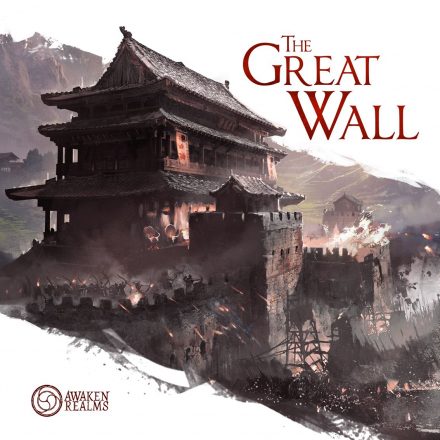
The Great Wall is a new asymmetric worker/soldier placement game with engine building themes and a twist in form of a constantly attacking AI (Mongolian Horde) that requires players to sometimes cooperate in order to defeat it. This is a new major board game from Awaken Realms.

Players will control ancient clans in China trying to defend against invading Mongolian hordes and build a Great Wall. While every player will want to win (by earning VP = Honor) they also need to sometimes cooperate to defend against the hordes. Each clan will be asymmetric through its chosen Leader (resource production/starting resources/starting workers and units) and this asymmetry will increase as the game progresses (players will hire Advisors with unique skills, often creating unique engines).

In The Great Wall, the players take the role of Generals defending the Wall against the Mongol Horde. The game is played over a series of turns called Years, each divided into 4 parts called Seasons.

During Spring, new barbaric hordes invade the fields in front of the Great Wall and prepare to launch their assault. Summer is the time when generals prepare for the assault and mobilize their forces. During Fall, players take their turns, playing Command cards, resolving their effects and Activating Locations to gain various benefits. In Winter, the last layer of Defense is activated, then, the hordes try to assault the Walls.

During the course of the game, players will create their own unique engines based on their clan strength as well as interact with other players during all phases of the game, trying to get the most Honor points, which can be gained in a lot of different ways.

At the end of the game, the player with the most Honor wins.

—description from the publisher

Grand Carnival, The

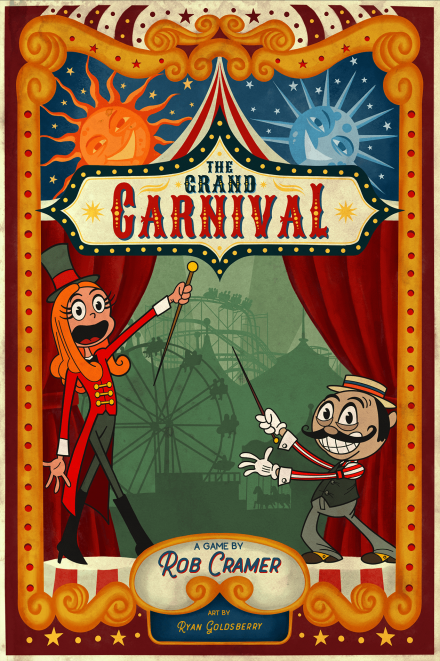
Ladies and gentlemen, step right up — the carnival is coming to town! In The Grand Carnival, players compete to create the most impressive carnival this town has ever seen. You’ll need to carefully plan your carnival’s layout, build attractions, hire staff, and manage the crowds, all while learning a few tricks of the trade.

Each turn, players cover a number on their player board, then select an action. The covered number determines the effectiveness of their action — and won’t become available again until the next round — so players need to think carefully about which number to use. Possible actions include:

• Place a Foundation Tile: Select a foundation tile to place on your fairground. The higher the number you cover, the more tile options you have. Each tile is a 2×2 grid and is made up of construction sites and walkways. Attractions can be placed only on construction sites, whereas guests can move only on walkways, so place your tiles carefully.

• Build an Attraction: Select a polyomino attraction and place it on the construction sites on your fairground. The size of the attraction you can select depends on the number you cover. Larger attractions can collect more tickets (and can be worth more points), but can be difficult for guests to move around.

• Move a Guest: Select a guest token and move it along the walkways on your fairground. The distance a guest can move depends on the number you cover. If a guest moves next to an attraction, place a ticket token on that attraction. If you move enough guests, you can hire a carnival barker; barkers help guests move quickly through your carnival, but take up precious space in your fairground.

After taking your action, see whether you qualify for any of the three “Tricks of the Trade” cards. Each trick has a requirement that must be met before you unlock its unique ability. Once a player unlocks a trick, each of their opponents has one turn to meet the same requirement or lose access to that trick for the rest of the game.

After seven rounds, the game ends. Players earn points from sets of the same size attractions, sets of each size of attraction, carnival barkers, guests that move all the way through your park, and their tickets. The player with the most points wins!

—description from the designer

Game Specifications:

  • 1 – 4 Players
  • 45 – 60 Minutes
  • Difficulty Weight 2.21

Gnome Hollow

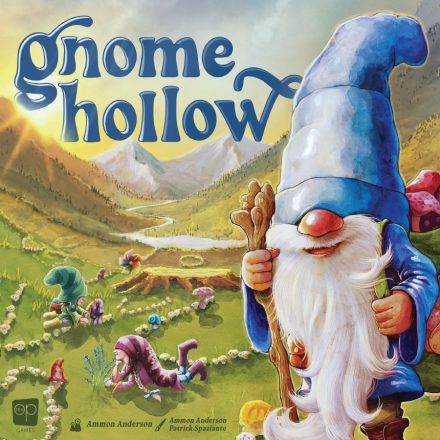
Since the beginning of time, gnomes have been the humble caretakers of nature. In secret, they emerge from their underground homes to maintain meticulous rings of mushrooms known to the human folk as “fairy rings”. But the work must be done quickly because as soon as a mushroom path is finished, the mushrooms are ready for picking. Who will be the cleverest gnome and harvest the most mushrooms by the end of the season?

Gnome Hollow is a spatial, tile-placement, worker-placement game in which you grow a tabletop garden of mushrooms and flowers. Every piece is a hand-painted watercolor that captures the whimsical feel of gnomes and nature. Turns are deceptively simple: Players place tiles into the garden, and move a gnome to take a single action on their turn. Come to Gnome Hollow and experience a peaceful garden, the thrill of competing to harvest buckets of mushrooms, and the reward of gathering in all your shiny treasures!

Game Specifications:

  • 2 – 4 Players
  • 45 – 60 Minutes
  • Difficulty Weight 2.38

Glen More II: Chronicles

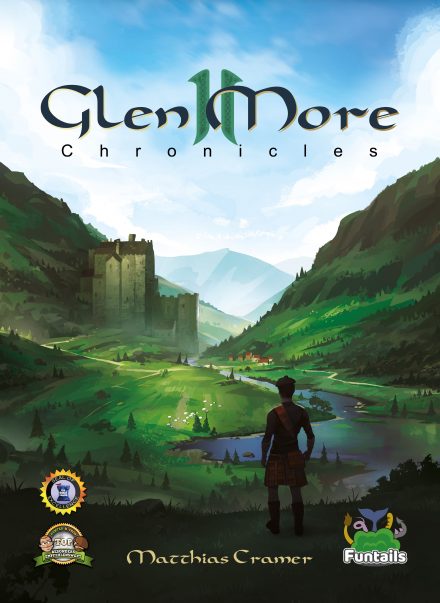
Glen More II: Chronicles is a sequel to Glen More, expanding the gameplay substantially compared to the original game.

In Glen More II: Chronicles, each player represents the leader of a Scottish clan from the early medieval ages until the 19th century, a leader looking to expand their territory and wealth. The success of your clan depends on your ability to make the right decision at the right time, be it by creating a new pasture for your livestock, growing barley for whisky production, selling your goods on the various markets, or gaining control of special landmarks such as lochs and castles.

The game lasts four rounds, represented by four stacks of tiles. After each round, a scoring phase takes place in which players compare their number of whisky casks, scotsmen in the home castle, landmark cards, and persons against the player with the fewest items in each category and receives victory points (VPs) based on the relative difference. After four rounds, additional VPs are awarded for gold coins and some landmarks while VP penalties are assessed based on territory size, comparing each player’s territory to the smallest one in play.

The core mechanism of Glen More II: Chronicles and Glen More functions the same way: The last player in line takes a tile from a time track, advancing as far as they wish on this track. After paying the cost, they place this tile in their territory, with this tile activating itself and all neighboring tiles, triggering the production of resources, movement points, VPs, etc. Then the player who is last in line takes their turn.

Improvements over the original Glen More include bigger tiles, better materials, new artwork, the ability for each player to control the end of the game, and balancing adjustments to the tiles for a better suspense curve. The game is designed to consist of one-third known systems, one-third new mechanisms, and one-third improvements to Glen More.

The “Chronicles” in the title — a set of eight expansions to the base game — are a major part of these new mechanisms. Each Chronicle adds a new gameplay element to the base game. The “Highland Boat Race” Chronicle, for example, tells the story of a boat race in which the winner needs to be the first to reach their home castle after navigating their boat along the river through all the other players’ territories. The “Hammer of the Scots” Chronicle adds a neutral “Englishman” playing piece to the time track that players struggle to control to get an additional turn — if they can afford him, that is, as he is paid using the market mechanism. All Chronicles can be freely combined, although designer Matthias Cramer suggests that players use only one or two unless they want a “monster game”.

Another major change to the game is the ability to invest in famous Scottish people of the time, who are represented through a new “person” tile type. Persons not only have their own scoring, they also trigger one-time or ongoing effects on the tactical clan board. This adds a new layer of decision making, especially since the ongoing effects allow players to focus on a personal strategy of winning through the use of the clan board.

Game Specifications:

  • 2 – 4 Players
  • 90 – 120 Minutes
  • Difficulty Weight 3.01

Galileo Galilei

“And yet it moves”, he said.

Galileo Galilei is a Euro-style game in which you take on the role of an astronomer who will discover new planets, find unknown star systems, develop their telescope, and make a scientific breakthrough in the difficult ages of obscurantism.

Use your telescope to select one of the five actions available, with you being able to evolve these actions into better ones. Collect cards of different planets and star systems. Collect lenses of the three main colors to make a discovery. Be wary of inquisitors as they might arrive unwelcomed and ruin your fame in no time. Better find a way to profit from their visit instead.

Game Specifications:

  • 1 – 4 Players
  • 50 – 100 Minutes
  • Difficulty Weight 3.04

Galaxy Hunters

In Galaxy Hunters, 2 to 4 players take on the role of mercenaries hired by the Megacorps to hunt and harvest the rampant mutations. Featuring an inventive pilot and mech combination system, pairing different pilots with different mechs unlocks new powers and special abilities. Using money earned for harvesting DNA from the creatures, players upgrade their mechs with new weapons and items. Galaxy Hunters seamlessly blends the excitement of crafting a unique character with the deep strategy of Eurogame-style worker placement.

Game Specifications:

  • 2 – 4 Players
  • 60 – 120 Minutes
  • Difficulty Weight 3.21

Galactic Renaissance

Following InisGalactic Renaissance is the second installment of the “Political Trilogy” by designer Christian Martinez and publisher Matagot.

Throughout Galactic Renaissance, you build your team, adding new specialists — each one unique — to the core in your deck of cards. With this team, you discover new planets and systems, reconnect with lost civilizations, expand your influence, build embassies, and sow disorder in opposing factions — all in an effort to score victory points faster than your opponents. Sending emissaries to new planets, for example, allows you to discover new civilizations or cement relationships on known planets. Opponents may try to convince a planet to join them instead with their own emissaries, causing disorder in the process.

Game Specifications:

  • 2 – 4 Players
  • ~90 Minutes
  • Difficulty Weight 2.75

Galactic Cruise

Hello, and welcome to Galactic Cruise. Here, we offer our guests something special: the comfort of a luxury cruise with the innovation of space travel. As the first company to offer extended-stay space vacations, we are excited to have you working for us! As a supervisor of this company, you’ll be expected to not only build these ships and satisfy our guests, but also to help the company thrive by enhancing our company network, inventing new technologies, and growing our workforce. We are a united company, and you’ll often find that what another supervisor does will make your job easier. Let me be clear, though, this is a competition. Our current CEO will be stepping down in three years, and the supervisor who comes out on top will take his place.

On your turn, you will either place a worker to take two actions in the ever-expanding network, launch a ship and send one of your workers to space as a pilot, or recall all your earthbound workers to collect funding bonuses. Actions include acquiring blueprints, constructing ships, attracting guests, and building developments–connections between locations that increase action selection throughout the game. You will also be affecting resource markets that ebb and flow with the actions of all the players.

Throughout the game, you will also be competing with your fellow supervisors to complete company goals, which will earn you progress cubes throughout the game. Progress cubes are also placed when you launch ships, and when a certain number of cubes are placed onto the company’s progress track, the game ends, and the player with the most Victory Points becomes the new CEO of Galactic Cruise.

Do you still think you have what it takes to work for us? You do? Great. Let’s get started.

Game Specifications:

  • 1- 4 Players
  • 90 – 150 Minutes
  • Difficulty Weight 3.99

Fromage

You are a French cheesemaker in the early 20th century making, aging, and selling your artisanal cheeses. Become the most prestigious cheesemaker in all of France by running a highly successful creamery and crafting exceptional cheese.

Fromage is a simultaneous worker-placement game where players place Workers to make cheese and gather resources from the quadrant of the board facing them. Once all players have placed their Workers, the board rotates, aging any cheese that was made, and presenting each player with a new quadrant to place Workers into. Score Prestige Points by selling cheese to the four locations, and by efficiently managing and upgrading your creamery.

Game Specifications:

  • 1 – 4 Players
  • 30 – 45 Minutes
  • Difficulty Weight 2.38

From the Moon

In From the Moon, players are representatives of factions trying to complete missions departing from our Moon in order to help humankind survive elsewhere in the galaxy. Indeed, the fate of the Earth is sealed, and time is running out!

The plan is to launch three survival missions before all life on Earth ends. To do that, each faction will contribute by building parts of the ships and build their own lunar base to store the necessary resources.

In the end, which faction will be most suited to lead the future of our race out there, far away in space?

Game Specifications:

  • 1 – 4 Players
  • ~90 Minutes
  • Difficulty Weight 3.47