Tag: Income

Furnace

Furnace is an engine-building Eurogame in which players take on the roles of 19th-century capitalists building their industrial corporations and aspiring to make as much money as they can by purchasing companies, extracting resources, and processing them in the best combinations possible.

Each player starts the game with a random start-up card, the resources depicted at the top of that card, and four colored discs valued 1-4.

The game is played over four rounds, and each round consists of two phases: Auction and Production. During the auction, 6-8 company cards are laid out with their basic sides face up. Players take turns placing one of their discs on one of these cards, but you cannot place a disc on a card if a disc of the same value or color is already present. Thus, you’ll place discs on four cards.

Once all the discs are placed, the cards are resolved from left to right. Whoever placed the highest-valued disc will claim this card, but first anyone with a lower-valued disc on this card will gain compensation, either the resources depicted multiplied by the value of their disc or a processing ability (exchange X for Y) up to as many times as the value of their disc.

Once all the cards have been claimed or discarded, players enter the production phase, using their cards in the order of their choice. Each company card has one action — either production or processing — on its basic side and two actions on its upgraded side. During the production phase, you can use each of your cards once to gain resources, process those resources into other resources or money, and upgrade your cards.

At the end of four rounds, whoever has the most money wins.

Furnace also includes capitalist cards that contain unique effects, and if you want, you can choose to deal one out to each player at the start of the game. For an additional challenge, you can require players to create a “production chain”, with each newly acquired company card being placed somewhere in that chain and locked in position for the remainder of the game.

Game Specifications:

  • 2 – 4 Players
  • 30 – 60 Minutes
  • Difficulty Weight 2.32

Dinner in Paris

The restaurant industry in Paris is buzzing after the inauguration of a new pedestrian square in a very popular district for Parisians and tourists from all around the globe. It is a golden opportunity for you, restaurant owners, to open one of the addresses that will contribute to the culinary diversity and the reputation of the French capital. However, there isn’t space for everyone and your opponents could throw a wrench in your gears!

Game Mechanics:

  • Area Majority / Influence
  • Contracts
  • Hand Management
  • Income
  • Race
  • Set Collection
  • Tile Placement

Game Specifications:

  • 2 – 4 Players
  • 40 – 60 Minutes
  • Difficulty Weight 2.16

CATAN: 3D Edition

In CATAN, players try to be the dominant force on the island of Catan by building settlements, cities, and roads. On each turn, dice are rolled to determine what resources — sheep, wheat, wood, brick and ore — the island produces. Players spend these resources to build settlements, roads, and cities and to purchase development cards that have different effects. Each settlement and city you have is worth points, and you can gain additional points by building the longest road, acquiring the largest army, or collecting certain development cards. The first player to collect 10 points wins.

In CATAN: 3D Edition, the island of Catan rises off the table for an immersive experience like no other. Your settlements grow from fertile grain fields, and your cities nestle into the sides of majestic mountains. The look of the land is based on terrain tiles hand-sculpted by game designer Klaus Teuber. All of the terrain is hand-painted for stunning color, and the intricately designed player pieces are antiqued for a look that’s full of history and character.

Game Mechanics:

  • Hand Management
  • Income
  • Modular Board
  • Network and Route Building
  • Trading
  • Variable Set-up

Game Specifications:

  • 3 – 4 Players
  • 60 – 120 Minutes
  • Difficulty Weight 1.80

CATAN

In CATAN (formerly The Settlers of Catan), players try to be the dominant force on the island of Catan by building settlements, cities, and roads. On each turn dice are rolled to determine what resources the island produces. Players build by spending resources (sheep, wheat, wood, brick and ore) that are depicted by these resource cards; each land type, with the exception of the unproductive desert, produces a specific resource: hills produce brick, forests produce wood, mountains produce ore, fields produce wheat, and pastures produce sheep.

Setup includes randomly placing large hexagonal tiles (each showing a resource or the desert) in a honeycomb shape and surrounding them with water tiles, some of which contain ports of exchange. Number disks, which will correspond to die rolls (two 6-sided dice are used), are placed on each resource tile. Each player is given two settlements (think: houses) and roads (sticks) which are, in turn, placed on intersections and borders of the resource tiles. Players collect a hand of resource cards based on which hex tiles their last-placed house is adjacent to. A robber pawn is placed on the desert tile.

A turn consists of possibly playing a development card, rolling the dice, everyone (perhaps) collecting resource cards based on the roll and position of houses (or upgraded cities—think: hotels) unless a 7 is rolled, turning in resource cards (if possible and desired) for improvements, trading cards at a port, and trading resource cards with other players. If a 7 is rolled, the active player moves the robber to a new hex tile and steals resource cards from other players who have built structures adjacent to that tile.

Points are accumulated by building settlements and cities, having the longest road and the largest army (from some of the development cards), and gathering certain development cards that simply award victory points. When a player has gathered 10 points (some of which may be held in secret), he announces his total and claims the win.

Game Mechanics:

  • Hand Management
  • Income
  • Modular Board
  • Network and Route Building
  • Trading
  • Variable Set-up

Game Specifications:

  • 3 – 6 Players
  • 60 – 120 Minutes
  • Difficulty Weight 2.29

Acquire 🟢

In Acquire, each player strategically invests in businesses, trying to retain a majority of stock. As the businesses grow with tile placements, they also start merging, giving the majority stockholders of the acquired business sizable bonuses, which can then be used to reinvest into other chains. All of the investors in the acquired company can then cash in their stocks for current value or trade them 2-for-1 for shares of the newer, larger business. The game is a race to acquire the greatest wealth.

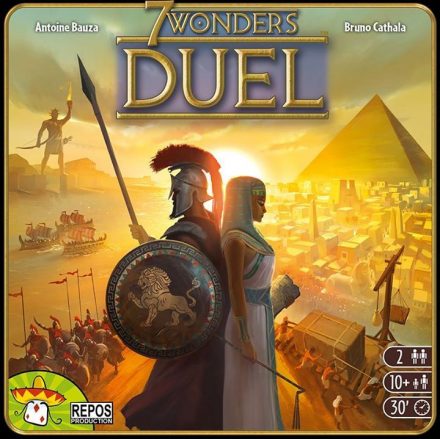
7 Wonders Duel 🟢

In many ways 7 Wonders Duel resembles its parent game 7 Wonders as over three ages players acquire cards that provide resources or advance their military or scientific development in order to develop a civilization and complete wonders.

What’s different about 7 Wonders Duel is that, as the title suggests, the game is solely for two players, with the players not drafting cards simultaneously from hands of cards, but from a display of face-down and face-up cards arranged at the start of a round. A player can take a card only if it’s not covered by any others, so timing comes into play as well as bonus moves that allow you to take a second card immediately. As in the original game, each card that you acquire can be built, discarded for coins, or used to construct a wonder.

Each player starts with four wonder cards, and the construction of a wonder provides its owner with a special ability. Only seven wonders can be built, though, so one player will end up short.

Players can purchase resources at any time from the bank, or they can gain cards during the game that provide them with resources for future building; as you acquire resources, the cost for those particular resources increases for your opponent, representing your dominance in this area.

A player can win 7 Wonders Duel in one of three ways: each time you acquire a military card, you advance the military marker toward your opponent’s capital, giving you a bonus at certain positions; if you reach the opponent’s capital, you win the game immediately; similarly, if you acquire any six of seven different scientific symbols, you achieve scientific dominance and win immediately; if none of these situations occurs, then the player with the most points at the end of the game wins.