Author: OTSG Staff

Hunt a Killer: Game Night Gone Wrong

Connor’s murder mystery birthday party goes wrong when the game ends abruptly, his roommate is dead, and he must decide which of his friends is the killer.

Be the detective and help Connor prove his innocence.

Put your detective skills to the test with Game Night Gone Wrong, a gripping true crime board game from Hunt A Killer. A party turns deadly—and it’s up to you to figure out who did it, how, and why. Examine realistic evidence, analyze witness statements, and uncover hidden motives in this mystery game designed for solo or group play.

Difficulty 3/5

—description from the publisher

Game Specifications:

  • 1+ Players
  • 90 – 120 Minutes
  • Difficulty Weight 2.00

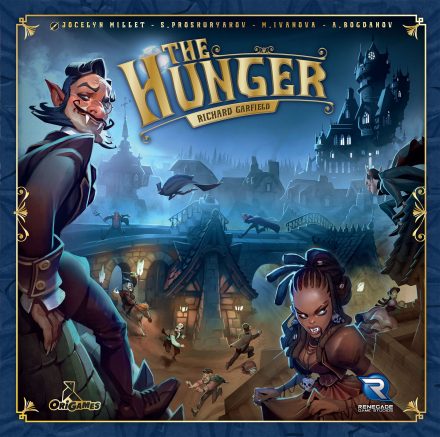
Hunger, the

The Hunger is a race in which each vampiric player must optimize their card deck, hunt humans to gain victory points, fulfill secret missions, and eventually acquire a rose and return to the castle before sunrise. The more you hunt, the slower both you and your deck become, which will make it harder and harder to get back before daybreak. Can you become the most notorious vampire without burning to ashes at sunrise?

During the game, players spend “speed” to move their vampires around the map, hunt humans worth victory points, and add new cards to their deck.

The game ends at dawn, after which the surviving player with the most victory points on their cards wins!

—description from publisher

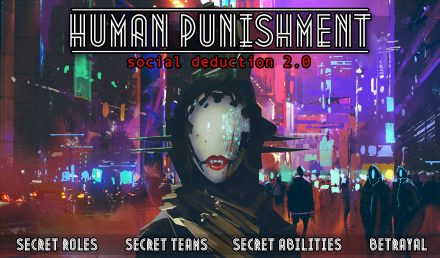
Human Punishment: Social Deduction 2.0

Human Punishment is a combination of social deduction, social experiment, and party game for 4-16 players. Each player takes on the role of a human, a machine, or an outlaw in a distant future. Players must investigate others to figure out who is on their side, grab one of the four different weapons, and eliminate the enemies. Stay focused because hidden enemies may be on your team! Find your team, trust no one!

The traitor mechanism in Human Punishment transforms the table into a social experiment…

Game Specifications:

  • 4 – 16 Players
  • 15 – 90 Minutes
  • Difficulty Weight 2.57

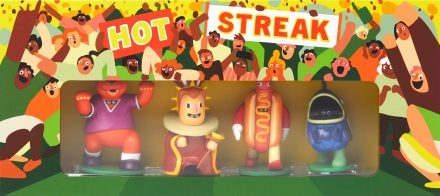
Hot Streak

Hot Streak is a game for hard luck gamblers who love to bet on and scream at the racers, who in this case happen to be mascots who may (or may not) keep running in the right direction.

At the start of the game, set up the racing deck with one card for each mascot and a number of random cards based on the player count. Reveal these cards to all players, after which players draft a betting ticket from those on display, then in reverse order draft a second bet. For each bet, you can play it safe — or flip it to the risky side, which might pay out more – or cost you money if you lose. After betting, each player chooses one of three cards in their hand to secretly add to the racing deck.

Shuffle the deck, burn three cards, then reveal cards one by one from the deck, moving the mascots along the track, with them sometimes swerving into another lane and knocking over another racer, sometimes turning around, sometimes all moving at once, and sometimes just going backwards! If a racer runs off the track or would be knocked over while already fallen, they’re disqualified. If needed, shuffle all cards in the deck, burn three cards again, and keep racing until all four spots on the box podium are filled. Pay out bets based on these results.

For races #2-3, first deal each player a random card from the deck, then place bets again, then have each player contribute a card from their hand to the deck. After race #3, everyone tallies their money.

Game Specifications:

  • 2 – 8 Players
  • 20 Minutes
  • Difficulty Weight 1.22

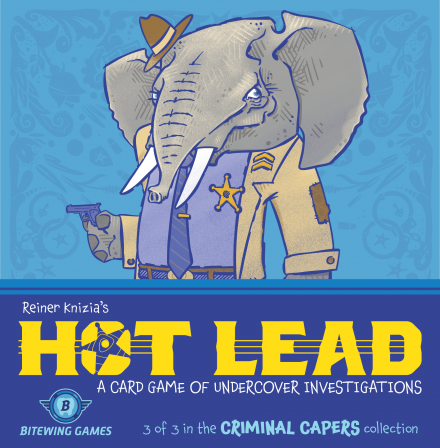
Hot Lead

Lead the undercover investigation against five criminal groups to gather enough evidence to convict them. However, if you investigate too aggressively, the criminals will smell a rat and go dark!

In each round of Hot Lead, criminal cards are displayed in a column equal to the number of players. Players then make their bid by simultaneously revealing an investigator card from their hand. The highest investigator bid takes the criminal card closest to the deck, the second highest takes the second closest, and so on. These cards are worth points equal to their face value (0-5).

Gather enough evidence on one criminal organization to convict them when the game concludes after ten rounds; in game terms, by having exactly three of a suit, you earn 10 bonus points. Ten bonus points are also awarded to those who acquire criminal cards of all five suits. If you investigate too aggressively and grab the fourth card of a suit, those criminals will sense a rat and you’ll scare them underground, thereby losing all of those cards. The player with the most points at the end of the game wins.

—description from publisher

Game Specifications:

  • 2 – 5 Players
  • 15 Minutes
  • Difficulty Weight 1.25

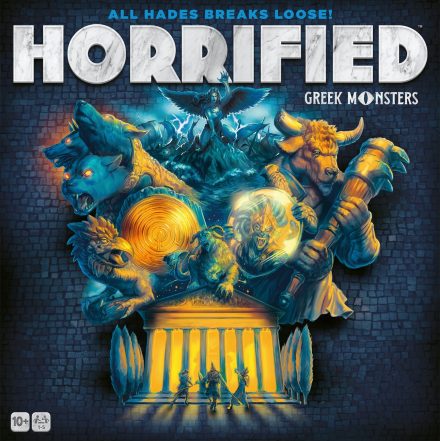
Horrified: Greek Monsters

Pandora’s Box has been opened, and Greece’s most notorious monsters have escaped.

Horrified: Greek Monsters is a standalone game that features gameplay similar to 2019’s Horrified. In this co-operative game, players become avatars of the Greek gods and must work together to re-capture these monsters.

To do that, they must first uncover the monsters’ lairs. Medusa, Cerberus, Chimera, and Minotaur are hidden in locations that must be discovered: the Statue Garden, Underworld Door, Chimera’s Cave, and Labyrinth. Similar to the myths that inspired the game, uncovering the lairs comes with a cost: Players must discard three color items before the lair token can be flipped over to reveal which monster’s hideout they’ve discovered.

Horrified: Greek Monsters includes six monsters, each with unique abilities, and the more monsters in the game, the harder the challenge, with players needing to use their unique powers to figure out how to defeat each monster.

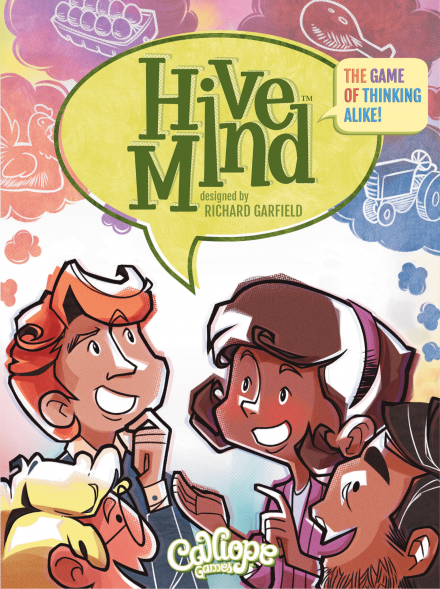
Hive Mind

Richard Garfield introduces Hive Mind™, a party game that rewards thinking alike, and there are no wrong answers! Gather 3-12 friends and family, then choose and ask questions everyone might answer the same, because thinking differently might send you right off the board! “What are 3 unusual pets?” “What are the 4 best ice cream flavors?”

In Hive Mind™, players answer trivia and opinion questions trying to match their answers with other players, scoring points for each match they achieve. They don’t have to be correct! They just have to be the same as what other players think. Each round, players will roll the die to determine how many lowest scoring answers move down the player board. Then a question will be asked, and answers given and scored. Once one or more players moves lower than level six, they are eliminated from the Hive Mind and everyone else wins!

Game Specifications:

  • 3 – 12 Players
  • 30 – 90 Minutes
  • Difficulty Weight 1.09

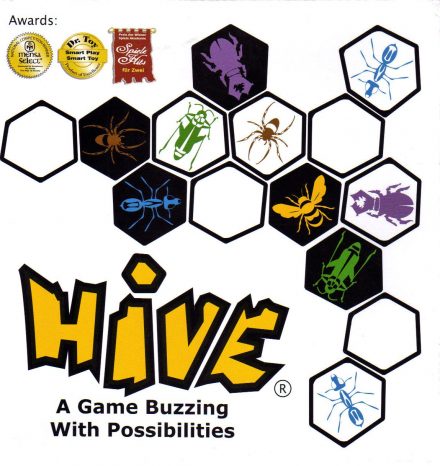
Hive

Hive is a strategic game for two players that is not restricted by a board and can be played anywhere on any flat surface. Hive is made up of twenty two pieces, eleven black and eleven white, resembling a variety of creatures each with a unique way of moving.

With no setting up to do, the game begins when the first piece is placed down. As the subsequent pieces are placed this forms a pattern that becomes the playing surface (the pieces themselves become the board). Unlike other such games, the pieces are never eliminated and not all have to be played. The object of the game is to totally surround your opponent’s queen, while at the same time trying to block your opponent from doing likewise to your queen. The player to totally surround his opponent’s queen wins the game.

Game Specifications:

  • 2 Players
  • 20 Minutes
  • Difficulty Weight 2.31

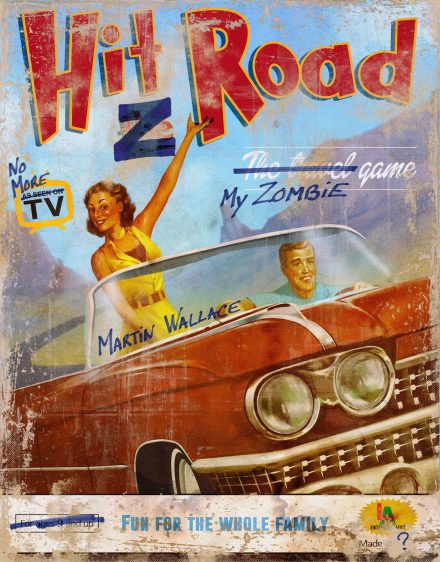
Hit Z Road

In the fast-paced and morbidly kitschy game Hit Z Road, you and your fellow players embark on a road trip going south from Chicago along America’s famous Route 66 — now infested by zombies. As you travel though a deck of adventure cards rife with dangers, you battle zombie hordes, drive abandoned school buses, scavenge for gas and bullets, and explore a darkened, tainted American countryside full of shambling undead, haunted carnivals, and plumes of toxic gas. Your goal is to stay alive until you reach the safe, sandy beaches of the California coast.

Three different stages of adventure cards create an experience of increasing difficulty and ensure that each playthrough is unique. Each round begins with an auction that determines both player order and which cards you will encounter. Since the resources used for bidding are the same as those used to battle the oncoming zombie hordes, your survival depends as much on your resource management as it does upon winning those bidding wars. The player who either accumulates the most points or survives the longest wins.

Zombies of all types await, with cannibals, anti-personnel mines and radioactive wastes also being among the hazards awaiting the players. Who will survive the zombie onslaught?

—description from the publisher

Game Specifications:

  • 1 – 4 Players
  • 30 – 60 Minutes
  • Difficulty Weight 1.86

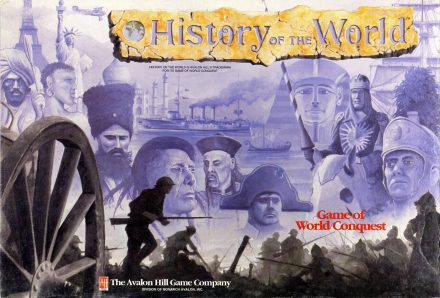
History of the World

History of the World works under the assumptions that all empires eventually fade and that the only things differentiating great empires from lesser ones is how much territory they conquer and how long it takes for their civilizations to disappear. The game is played out over 7 epochs or rounds, from the ancient 3000 B.C. Sumerians to the pre-WW1 Germany, with every player controlling a new rising empire from history. Some empires are stronger than others (like the Romans), but the game’s clever mechanisms can help balance that out. At the end of each epoch, players score points for all units of their color (from both the current and any previous empires) remaining on the board.

Before the start of their turn a player may play up to two Event cards from their hand. The Events played are resolved before the player starts his Empire’s actions. If the player’s active Empire has navigation a ship token is placed in each sea or ocean listed (if an ocean is listed all adjacent seas to the ocean have ship markers put into them). A Reallocation Greater Event allows an Empire with Navigation to exchange Fleets in seas and oceans for Coins that can be used to buy back defeated troops (1 coin per troop). If the active Empire has a capitol it is taken and placed in the Empire’s starting land with one unit of the Empire’s available troops. Since each land space may only contain one troop the player begins expanding from their starting land by placing troops in any adjacent land space that they wish to occupy or conquer. To conquer a land the attacker moves one unit into the land space either from adjacent land or through a sea with a ship in it. Then dice are rolled, the attacker gets 2 dice and the defender only one, unless the attacker traveled across a strait or the defender’s land has either a forest, the great wall of China, or mountains on the border of the land that the attacker came from. In this case the defender receives 2 dice as well. If the attack comes from the sea the defender gets 3 dice for defense. Highest score wins with ties killing off both the defender and attacker. In this case the attacker can merely place the next troop, if he has any left, in the now-empty land space.

At any time the active Empire player may exchange an unplaced troop for a fort. On later turns, a fort gives the player a +1 to defensive rolls in that land. Also, if the defender in a fort loses or ties with an attacker only the fort is removed and the battle continues. Whenever an army conquers a land with a capitol the capitol mini is flipped reducing it to a city (if it was a city to begin with it is removed from board when conquered). After the active player’s Empire is finished with it’s actions check to see if it conquered to land spaces with resource symbols, if so it can build a monument.

Then scoring takes place. Each area (Middle-East, Northern Europe, Eurasia, etc…) has a tile with 3 values for the current Epoch. One value is for having a presence in the area (at least one land). Another value is for having Dominance in the area (at least 2 lands and more than any other player in area). The last value is for having Control of an area (at least 3 lands and no other player has any in area). These values vary from Epoch to Epoch and Area to Area (Middle-East is more valuable in early Epochs and fades in later Epochs, for example). Total the scores from each area for all pieces of the player’s color from all Empires controlled that remain on board. Then add 2 points for each capitol controlled, 1 point per city and one point for each monument controlled. After all areas are scored the next Empire called takes its turn.

After all players have taken their turns and scored, for the first Epoch, the player with the highest score gets to take a pre-eminence marker and places it in front of him. These are secret bonus points (worth somewhere from 3 to 6) for the end of the game and may not be examined till then. This bonus to leader helps balance the Empire-draw mechanic and makes it valuable to score maximal points even early in the game, rather than tanking to get a better draw later. Then drawing begins for the next Epoch with the player having the lowest score drawing first on up to the person with the highest score drawing last (and likely being given a less than optimal Empire by another player).

After the last player has scored for Epoch 7 and the leader has drawn a pre-eminence marker, all players reveal their pre-eminence markers and add them to their scores. The player with the highest score wins.

Game Specifications:

  • 3 – 6 Players
  • 135 – 270 Minutes
  • Difficulty Weight 2.77