Tag: Variable Player Powers

Blood on the Clocktower

In the quiet village of Ravenswood Bluff, ‌a demon walks amongst you…

During a hellish thunderstorm, on the stroke of midnight, there echoes a bone-chilling scream. The townsfolk rush to investigate and find the town storyteller murdered, their body impaled on the hands of the clocktower, blood dripping onto the cobblestones below. A Demon is on the loose, murdering by night and disguised in human form by day. Some have scraps of information. Others have abilities that fight the evil or protect the innocent. But the Demon and its evil minions are spreading lies to confuse and breed suspicion. Will the good townsfolk put the puzzle together in time to execute the true demon and save themselves? Or will evil overrun this once peaceful village?

Blood on the Clocktower is a bluffing game enjoyed by 5 to 20 players on opposing teams of Good and Evil, overseen by a Storyteller player who conducts the action and makes crucial decisions. The goal of the game is to successfully deduce and execute the demons before they outnumber the townfolk.

During a ‘day’ phase players socialize openly and whisper privately to trade knowledge or spread lies, culminating in a player’s execution if a majority suspects them of being Evil. Of a ‘night’ time, players close their eyes and are woken one at a time by the Storyteller to gather information, spread mischief, or kill.

The Storyteller uses the game’s intricate playing pieces to guide each game, leaving others free to play without a table or board. Players stay in the thick of the action to the very end even if their characters are killed, haunting Ravenswood Bluff as ghosts trying to win from beyond the grave.

If you arrive late to a game, you can enter after it’s started as a powerful Traveller character with unusual talents and questionable allegiances. Each character comes with their own special ability and no two players in a game are ever the same character.

Game Mechanics:

  • Bluffing
  • Deduction
  • Hidden Roles
  • Negotiation
  • Team-Based Game
  • Variable Player Powers
  • Voting

Game Specifications:

  • 6 – 21 Players
  • 30 – 120 Minutes
  • Difficulty Weight 3.03

Ankh: Gods of Egypt 🟡

Play as a god of ancient Egypt, competing to survive as society begins to forget the old ways, so that only you and your followers remain.

Build caravans, summon monsters, and convert followers in your quest to reign supreme in Ankh: Gods of Egypt. Deities, monsters, and the people of ancient Egypt have been lovingly reimagined and interpreted in beautiful illustrations and detailed miniatures, and players will truly feel like gods as they shake the very foundations of Egypt. All gameplay in Ankh, including combat, is streamlined and non-random. Compete and win solely on your godly wits alone.

Game Specifications:

  • 2 – 5 Players
  • ~90 Minutes
  • Difficulty Weight 3.12

Abomination: The Heir of Frankenstein 🟡

It’s been twenty years since Victor Frankenstein died on a ship in the arctic, but his vengeful creature lives on, as does Robert Walton, the sea captain who vowed to kill the fiend before mercy stayed his hand. It’s now 1819, and a sinister darkness descends upon the city of Paris. A mysterious benefactor of gigantic stature has emerged in the scientific community, never showing his face, claiming to possess the late Frankenstein’s research. He sponsors a grand competition, offering an even grander prize: unlocking the mystery of mortality!

Renowned scientists from around the world come to take part: some drawn to solve this eternal riddle, others coerced against their will. But a certain captain comes as well, one deeply suspicious of the secretive patron, hoping to finally fulfill his vow.

Abomination: The Heir of Frankenstein is a competitive game of strategic monster building for 2-4 players, inspired by Mary Shelley’s classic novel of gothic horror. In the game, the creature demands your help to accomplish what his own creator would not: to bring to life an abomination like itself, a companion to end its miserable solitude. Through worker placement and careful management of decomposing resources, you’ll gather materials from the cemeteries and morgues around the city, conduct valuable research at the Academy of Science, hire less-than-reputable associates, and toil away in your lab — all in an effort to assemble a new form of life and infuse it with a “spark of being”. Do well, and the creature may reward you during one of its surprise visits; do poorly, and you may come to regret not putting forth more effort. Narrative elements come into play throughout the game, guided by your decisions, leading to potentially unsavory outcomes.

The game ends when you succeed in bringing your creation to life or when the Captain kills the creature, whichever happens first. Then the player with the most points fulfills Frankenstein’s dark legacy, becoming his heir, for good or ill…

Furnace

Furnace is an engine-building Eurogame in which players take on the roles of 19th-century capitalists building their industrial corporations and aspiring to make as much money as they can by purchasing companies, extracting resources, and processing them in the best combinations possible.

Each player starts the game with a random start-up card, the resources depicted at the top of that card, and four colored discs valued 1-4.

The game is played over four rounds, and each round consists of two phases: Auction and Production. During the auction, 6-8 company cards are laid out with their basic sides face up. Players take turns placing one of their discs on one of these cards, but you cannot place a disc on a card if a disc of the same value or color is already present. Thus, you’ll place discs on four cards.

Once all the discs are placed, the cards are resolved from left to right. Whoever placed the highest-valued disc will claim this card, but first anyone with a lower-valued disc on this card will gain compensation, either the resources depicted multiplied by the value of their disc or a processing ability (exchange X for Y) up to as many times as the value of their disc.

Once all the cards have been claimed or discarded, players enter the production phase, using their cards in the order of their choice. Each company card has one action — either production or processing — on its basic side and two actions on its upgraded side. During the production phase, you can use each of your cards once to gain resources, process those resources into other resources or money, and upgrade your cards.

At the end of four rounds, whoever has the most money wins.

Furnace also includes capitalist cards that contain unique effects, and if you want, you can choose to deal one out to each player at the start of the game. For an additional challenge, you can require players to create a “production chain”, with each newly acquired company card being placed somewhere in that chain and locked in position for the remainder of the game.

Game Specifications:

  • 2 – 4 Players
  • 30 – 60 Minutes
  • Difficulty Weight 2.32

Forbidden Desert

Gear up for a thrilling adventure to recover a legendary flying machine buried deep in the ruins of an ancient desert city. You’ll need to coordinate with your teammates and use every available resource if you hope to survive the scorching heat and relentless sandstorm. Find the flying machine and escape before you all become permanent artifacts of the forbidden desert!

In Forbidden Desert, a thematic sequel to Forbidden Island, players take on the roles of brave adventurers who must throw caution to the wind and survive both blistering heat and blustering sand in order to recover a legendary flying machine buried under an ancient desert city. While featuring cooperative gameplay similar to Forbidden IslandForbidden Desert is a fresh, new game based around an innovative set of mechanisms such as an ever-shifting board, individual resource management, and a unique method for locating the flying machine parts.

Game Specifications:

  • 2 – 5 Players
  • ~45 Minutes
  • Difficulty Weight 2.05

Flash Point: Fire Rescue

The call comes in… “911, what is your emergency?” On the other end is a panicked response of “FIRE!” Moments later you don the protective suits that will keep you alive, gather your equipment and rush to the scene of a blazing inferno. The team has only seconds to assess the situation and devise a plan of attack – then you spring into action like the trained professionals that you are. You must face your fears, never give up, and above all else work as a team because the fire is raging, the building is threatening to collapse, and lives are in danger.

You must succeed. You are the brave men and women of fire rescue; people are depending on you. This is what you do every day.

Flash Point: Fire Rescue is a cooperative game of fire rescue.

There are two versions of game play in Flash Point, a basic game and expert game.
In both variants, players are attempting to rescue 7 of 10 victims from a raging building fire.
As the players attempt to rescue the victims, the fire spreads to other parts of the building, causing structural damage and possibly blocking off pathways through the building. Each turn a player may spend action points to try to extinguish fires, move through the building, move victims out of the building or perform various special actions such as moving emergency vehicles. If 4 victims perish in the blaze or the building collapses from taking too much structural damage, the players lose. Otherwise, the players win instantly when they rescue a 7th victim.

The expert variant included in the game adds thematic elements such as flash over, combustible materials, random setup, and variations on game difficulty from novice to heroic. The game includes a double sided board with two different building plans and several expansion maps are available.

Game Specifications:

  • 2 – 6 Players
  • ~45 Minutes
  • Difficulty Weight 2.20

Elder Sign

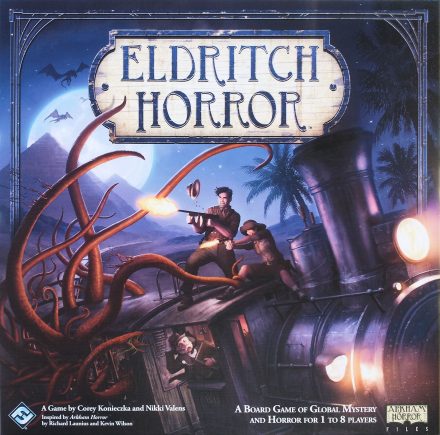
It is 1926, and the museum’s extensive collection of exotic curios and occult artifacts poses a threat to the barriers between our world and the elder evils lurking between dimensions. Gates to the beyond begin to leak open, and terrifying creatures of increasing strength steal through them. Animals, the mad, and those of more susceptible minds are driven to desperation by the supernatural forces the portals unleash. Only a handful of investigators race against time to locate the eldritch symbols necessary to seal the portals forever. Only they can stop the Ancient One beyond from finding its way to Earth and reducing humanity to cinders.

Elder Sign is a fast-paced, cooperative dice game of supernatural intrigue for one to eight players by Richard Launius and Kevin Wilson, the designers of Arkham Horror. Players take the roles of investigators racing against time to stave off the imminent return of the Ancient One. Armed with tools, allies, and occult knowledge, investigators must put their sanity and stamina to the test as they adventure to locate Elder Signs, the eldritch symbols used to seal away the Ancient Ones and win the game.

To locate Elder Signs, investigators must successfully endure Adventures within the museum and its environs. A countdown mechanism makes an Ancient One appear if the investigators are not quick enough. The investigators must then battle the Ancient One. A clever and thematic dice mechanism pits their exploration against monsters and the sheer difficulty of staying sane and healthy, all within the standard game duration of one to two hours.

Game Specifications:

  • 1 – 8 Players
  • ~90 Minutes
  • Difficulty Weight 2.34

Dragonlance

In the Dragonlance Boardgame, each player commands an army of dragons in search of the fabled Dragonlance. The first player to snatch the Dragonlance from the top of the central tower and successfully deliver it back home wins! But be careful! Your opponents will attack your dragons, trying to make them crash-or even steal the Dragonlance and use it against you. The game comes with a large hex mapboard, 30 dragons figures in six different colors, two sets of rules (Basic and Advanced), Cards, dice, altitude markers and more.

Game Specifications:

  • 2 – 6 Players
  • ~60 Minutes
  • Difficulty Weight 1.82

Dice Throne: Season Two – Battle Chest

The Battle Chest contains all 4 sets from Season Two.

Dice Throne is a game of intriguing dice, tactical card play, powerful heroes, and unique abilities.

It’s a fast-paced 2-6 player combat game (1v1, 2v2, 3v3, 2v2v2, or free-for-all). Select from a variety of heroes that play and feel completely distinct from one another. Attack opponents and activate abilities by rolling your hero’s unique set of five dice. Accumulate combat points and spend them on cards that have a large range of effects, such as granting permanent hero upgrades, applying status effects, and manipulating dice directly (yours, your teammate’s, or even your opponent’s).

Dice Throne: Season Two introduces a roster of new heroes and intriguing new matchups.

Game Mechanics:

  • Dice Rolling
  • Take That
  • Team-Based Game
  • Variable Player Powers

Game Specifications:

  • 2 – 6 Players
  • 20 – 40 Minutes
  • Difficulty Weight 2.16

Dice Throne: Season One

Dice Throne is a game of intriguing dice, tactical card play, powerful heroes, and unique abilities.

It’s a fast-paced 2-6 player combat game (1v1, 2v2, 3v3, 2v2v2, or free-for-all). Select from a variety of heroes that play and feel completely distinct from one another. Attack opponents and activate abilities by rolling your hero’s unique set of five dice. Accumulate combat points and spend them on cards that have a large range of effects, such as granting permanent hero upgrades, applying status effects, and manipulating dice directly (yours, your teammate’s, or even your opponent’s).

Game Mechanics:

  • Dice Rolling
  • Re-rolling and Locking
  • Take That
  • Team-Based Game
  • Variable Player Powers

Game Specifications:

  • 2 – 6 Players
  • 20 – 40 Minutes
  • Difficulty Weight 2.07