Tag: Solo / Solitaire Game

Barrage

In the dystopic 1930s, the industrial revolution pushed the exploitation of fossil-based resources to the limit, and now the only thing powerful enough to quench the thirst for power of the massive machines and of the unstoppable engineering progress is the unlimited hydroelectric energy provided by the rivers.

Barrage is a resource management strategic game in which players compete to build their majestic dams, raise them to increase their storing capacity, and deliver all the potential power through pressure tunnels connected to the energy turbines of their powerhouses.

Each player represents one of the four international companies who are gathering machinery, innovative patents and brilliant engineers to claim the best locations to collect and exploit the water of a contested Alpine region crossed by rivers.

Barrage includes two innovative and challenging mechanisms. First, the players must carefully plan their actions and handle their machinery, since both their action tokens and resources are stored on a Construction Wheel and will only be available after a full turn of the wheel. The better you manage your wheel, the earlier your resources and actions come back to you.

Second, the water flow on the rivers depicted on the board is a shared and contested resource. Players have to intercept and store as much of the water as they can, build dams (upstream dams are expensive but can block part of the water before it reaches the downstream dams), raise the dams to increase their capacity, and build long tunnels to channel the water to their powerhouses. Water is never consumed — its flow is just used to produce energy —, it is instead released back to the rivers, so you have to strategically place your dams to recover the water diverted by you and the other players.

Over five rounds, the players must fulfill power requirements represented by a common competitive power track and meet specific requests of personal contracts. At the same time, by placing a limited number of engineers, they attempt to enhance their machinery to acquire new and more efficient construction actions and to build and activate special unique-effect buildings to forward their own developing strategy.

Game Specifications:

  • 1 – 4 Players
  • 60 – 120 Minutes
  • Difficulty Weight 4.12

Arkham Horror: The Card Game

Something evil stirs in Arkham, and only you can stop it. Blurring the traditional lines between role-playing and card game experiences, Arkham Horror: The Card Game is a Living Card Game of Lovecraftian mystery, monsters, and madness!

In the game, you and your friend (or up to three friends with two Core Sets) become characters within the quiet New England town of Arkham. You have your talents, sure, but you also have your flaws. Perhaps you’ve dabbled a little too much in the writings of the Necronomicon, and its words continue to haunt you. Perhaps you feel compelled to cover up any signs of otherworldly evils, hampering your own investigations in order to protect the quiet confidence of the greater population. Perhaps you’ll be scarred by your encounters with a ghoulish cult.

No matter what compels you, no matter what haunts you, you’ll find both your strengths and weaknesses reflected in your custom deck of cards, and these cards will be your resources as you work with your friends to unravel the world’s most terrifying mysteries.

Each of your adventures in Arkham Horror LCG carries you deeper into mystery. You’ll find cultists and foul rituals. You’ll find haunted houses and strange creatures. And you may find signs of the Ancient Ones straining against the barriers to our world…

The basic mode of play in Arkham LCG is not the adventure, but the campaign. You might be scarred by your adventures, your sanity may be strained, and you may alter Arkham’s landscape, burning buildings to the ground. All your choices and actions have consequences that reach far beyond the immediate resolution of the scenario at hand—and your actions may earn you valuable experience with which you can better prepare yourself for the adventures that still lie before you.

Arkham Horror

The year is 1926, and it is the height of the Roaring Twenties. Flappers dance till dawn in smoke-filled speakeasies, drinking alcohol supplied by rum runners and the mob. It’s a celebration to end all celebrations in the aftermath of the War to End All Wars.

Yet a dark shadow grows in the city of Arkham. Alien entities known as Ancient Ones lurk in the emptiness beyond space and time, writhing at the thresholds between worlds. Occult rituals must be stopped and alien creatures destroyed before the Ancient Ones make our world their ruined dominion.

Only a handful of investigators stand against the Arkham Horror. Will they prevail?

Arkham Horror (Third Edition) is a cooperative board game for one to six players who take on the roles of investigators trying to rid the world of eldritch beings known as Ancient Ones. Based on the works of H.P. Lovecraft, players will have to gather clues, defeat terrifying monsters, and find tools and allies if they are to stand any chance of defeating the creatures that dwell just beyond the veil of our reality.

Ark Nova

In Ark Nova, you will plan and design a modern, scientifically managed zoo. With the ultimate goal of owning the most successful zoological establishment, you will build enclosures, accommodate animals, and support conservation projects all over the world. Specialists and unique buildings will help you in achieving this goal.

Each player has a set of five action cards to manage their gameplay, and the power of an action is determined by the slot the card currently occupies. The cards in question are:

  • CARDS: Allows you to gain new zoo cards (animals, sponsors, and conservation project cards).
  • BUILD: Allows you to build standard or special enclosures, kiosks, and pavilions.
  • ANIMALS: Allows you to accommodate animals in your zoo.
  • ASSOCIATION: Allows your association workers to carry out different tasks.
  • SPONSORS: Allows you to play a sponsor card in your zoo or to raise money.

255 cards featuring animals, specialists, special enclosures, and conservation projects, each with a special ability, are at the heart of Ark Nova. Use them to increase the appeal and scientific reputation of your zoo and collect conservation points.

Agricola 🟠

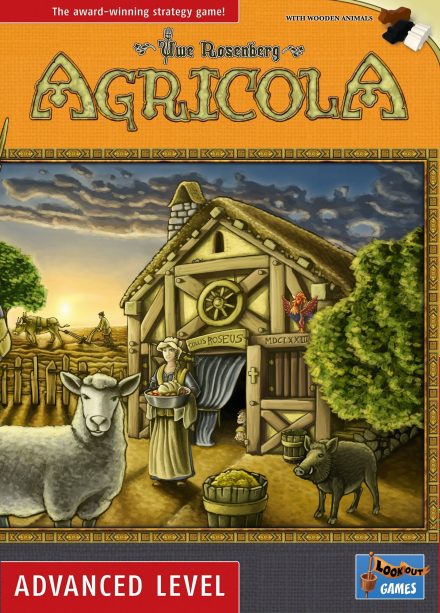
In Agricola, you’re a farmer in a wooden shack with your spouse and little else. On a turn, you get to take only two actions, one for you and one for the spouse, from all the possibilities you’ll find on a farm: collecting clay, wood, or stone; building fences; and so on. You might think about having kids in order to get more work accomplished, but first you need to expand your house. And what are you going to feed all the little rugrats?

The game supports many levels of complexity, mainly through the use (or non-use) of two of its main types of cards, Minor Improvements and Occupations. In the beginner’s version (called the Family Variant in the U.S. release), these cards are not used at all. For advanced play, the U.S. release includes three levels of both types of cards; Basic (E-deck), Interactive (I-deck), and Complex (K-deck), and the rulebook encourages players to experiment with the various decks and mixtures thereof. Aftermarket decks such as the Z-Deck and the L-Deck also exist.

Agricola is a turn-based game. There are 14 game rounds occurring in 6 stages, with a Harvest at the end of each stage (after Rounds 4, 7, 9, 11, 13, and 14).
Each player starts with two playing tokens (farmer and spouse) and thus can take two turns, or actions, per round. There are multiple options, and while the game progresses, you’ll have more and more: first thing in a round, a new action card is flipped over.
Problem: Each action can be taken by only one player each round, so it’s important to do some things with high preference.
Each player also starts with a hand of 7 Occupation cards (of more than 160 total) and 7 Minor Improvement cards (of more than 140 total) that he/she may use during the game if they fit in his/her strategy. Speaking of which, there are countless strategies, some depending on your card hand. Sometimes it’s a good choice to stay on course, and sometimes it is better to react to your opponents’ actions…

51st State: Master Set 🟠

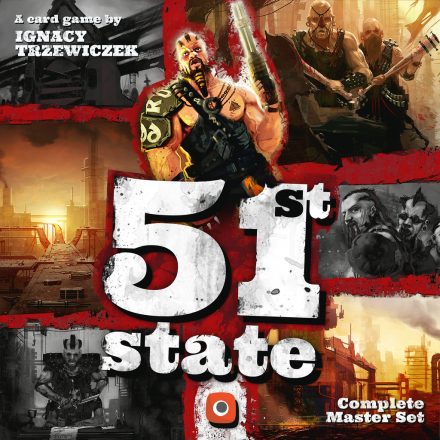
The world you know no longer exists. There is no government. No army. No civilization. The United States has collapsed, and now thirty years after the war started, new powers finally try to take control over the ruined country, try to establish a new order, try to control others and create a new country, a new state: the 51st State.

51st State is a card game in which players control one of four powers trying to build a new country. Players put new locations into play, hire leaders, and send people to work in buildings to gain resources and new skills. To do this, every card in 51st State can be used in three different ways:

  • Raze a location to gain many resources once.
  • Deal with this location to gain one resource every turn.
  • Build the location so that you can use its skill each turn.

51st State: Master Set marks the rebirth of the 51st State line, with this set containing 88 cards from the original base game, and 50 cards each from both the New Era and Winter expansions; one of these expansions can be mixed with the cards of the base game, but not both at the same time. The entire set has been rebalanced to offer a cohesive experience no matter which expansion you choose to use.

Glass Road

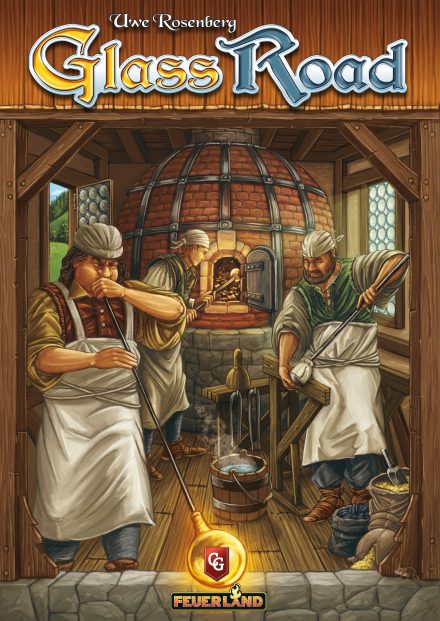
The game Glass Road commemorates the 700-year-old tradition of glass-making in the Bavarian Forest. (Today, the “Glass Road” is a route through the Bavarian forest that takes visitors to many of the old glass houses and museums of that region.) You must skillfully manage your glass and brick production in order to build the right structures that help you keep your business flowing. Cut the forest to keep the fires burning in the ovens, and spread and remove ponds, pits, and groves to supply yourself with the items you need. Fifteen specialists are there at your side to carry out your orders…

In more detail, the game consists of four building periods. Each player has an identical set of fifteen specialist cards, and each specialist comes with two abilities. At the beginning of each building period, you choose a hand of five specialists. If during this building period, you play a specialist that no other player has in hand, you may use both abilities on that card; if two or more players play the same specialist, each of them may use only one of the two abilities. Exploiting the abilities of these specialists lets you collect resources, lay out new landscape tiles (e.g., ponds and pits), and build a variety of buildings, which come in three types:

  • Processing buildings
  • “Immediate” buildings with a one-time effect
  • Buildings that provide bonus points at the end of the game for various accomplishments

Mastering the balance of knowing the best specialist card to play and being flexible about when you play it — together with assembling a clever combination of buildings — is the key to this game.

Game Specifications:

  • 1 – 4 Players
  • 20 – 80 Minutes
  • Difficulty Weight 2.96

Ginkgopolis

2212: Ginkgo Biloba, the oldest and strongest tree in the world, has become the symbol of a new method for building cities in symbiosis with nature. Humans have exhausted the resources that the Earth offered them, and humanity must now develop cities that maintain a delicate balance between resource production and consumption. Habitable space is scarce, however, and mankind must now face the challenge of building ever upwards. To develop this new type of city, you will gather a team of experts around you, and try to become the best urban planner for Ginkgopolis.

In Ginkgopolis, the city tiles come in three colors: yellow, which provides victory points; red, which provides resources; and blue, which provides new city tiles. Some tiles start in play, and they’re surrounded by letter markers that show where new tiles can be placed.

On a turn, each player chooses a card from his hand simultaneously. Players reveal these cards, adding new tiles to the border of the city in the appropriate location or placing tiles on top of existing tiles. Each card in your hand that you don’t play is passed on to your left-hand neighbor, so keep in mind how your play might set up theirs!

When you add a new tile to the city, you take a “power” card of the same color, and these cards provide you additional abilities during the game, allowing you to scale up your building and point-scoring efforts.

Game Specifications:

  • 1 – 5 Players
  • ~45 Minutes
  • Difficulty Weight 2.91

Ghost Stories

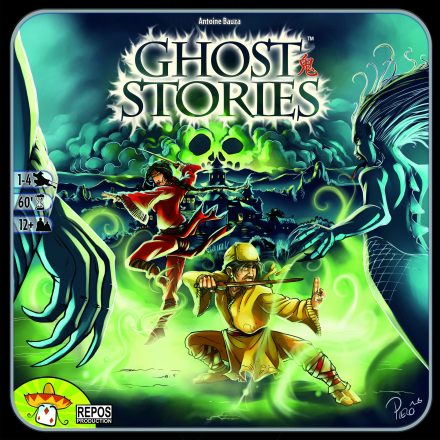
Ghost Stories is a cooperative game in which the players protect the village from incarnations of the lord of hell – Wu-Feng – and his legions of ghosts before they haunt a town and recover the ashes that will allow him to return to life. Each Player represents a Taoist monk working together with the others to fight off waves of ghosts.

The players, using teamwork, will have to exorcise the ghosts that appear during the course of the game. At the beginning of his turn, a player brings a ghost into play and places it on a free spot, and more than one can come in at the same time. The ghosts all have abilities of their own – some affecting the Taoists and their powers, some causing the active player to roll the curse die for a random effect, and others haunting the villager tiles and blocking that tile’s special action. On his turn, a Taoist can move on a tile in order to exorcise adjacent ghosts or to benefit from the villager living on the tile, providing it is not haunted. Each tile of the village allows the players to benefit from a different bonus. With the cemetery, for example, Taoists can bring a dead Taoist back to life, while the herbalist allows to recover spent Tao tokens, etc. It will also be possible to get traps or move ghosts or unhaunt other village tiles.

To exorcise a ghost, the Taoist rolls three Tao dice with different colors: red, blue, green, yellow, black, and white. If the result of the roll matches the color(s) of the ghost or incarnation of Wu-Feng, the exorcism succeeds. The white result is a wild color that can be used as any color. For example, to exorcise a green ghost with 3 resistance, you need to roll three green, three white, or a combination of both. If your die rolls fall short, you can also use Tao tokens that match the color in addition to your roll. You may choose to use these after your roll. Taoists gain these tokens by using certain village tiles or by exorcising certain ghosts. One of the Taoists has a power that allows him to receive such a token once per turn.

To win, the players must defeat the incarnation of Wu-Feng, a boss who arrives at the end of the game. There are also harder difficulty levels that add more incarnations of Wu-Feng, in which to win, you must defeat all of them.

There are many more ways to lose, however. The players lose if three of the village’s tiles are haunted, if the draw pile is emptied while the incarnation of Wu-Feng is still in play, or if all the priests are dead.

Game Specifications:

  • 1 – 4 Players
  • ~60 Minutes
  • Difficulty Weight 2.91

Gentes: Deluxified Edition

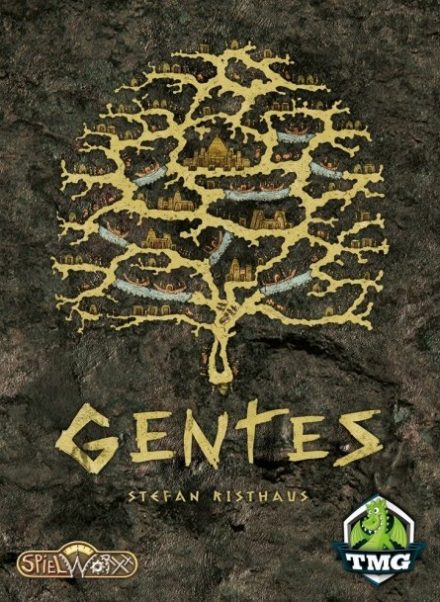
“Gentes” is the Latin plural word for greater groups of human beings (e.g., tribes, nations, people; singular: “gens”). In this game, players take the role of an ancient people who are attempting to develop by building monuments and colonizing or founding new cities in the Mediterranean sea.

The game is played in six rounds, each consisting of two phases: action phase, and tidying up. There are three eras — rounds 1-2, 3-4, 5-6 — with new monument cards entering the game at the beginning of rounds 1, 3 and 5. Each player has a personal player mat with a time track for action markers and sand timer markers. In the action phase of a round, the players take their turns in clockwise order, conducting one action per turn. Each action requires an action marker from the main board that is placed on the time track. Depending on the information on the action marker, you have to also pay some money or take sand timers that are placed on the time track. When you have no free spaces on your time track, you must pass for the remainder of the round. Therefore, the number of actions per player in a single round may vary significantly if, for example, you choose double sand timers instead of two single ones or take action markers that require more money but fewer sand timers. Single sand timers are dropped in the tidying up phase, while double sand timers are flipped to become single sand timer markers and stay for another round. The actions are:

Buy new cards from the common display
Build monuments (playing cards from your hand to your personal display for victory points and new options)
Train/Educate your people
Build/found cities
Take money
To play a card, you must meet the requirements printed on that card, such as having specific persons on your personal board (e.g., two priests and four soldiers). These requirements are why training — i.e., getting specific people — is important, but that is not that easy because there are six different types of people — three on the left and three on the right side of your personal player board — and you have only six spaces in total for the two types in the same line. If you have three merchants, for example, you move your marker for counting merchants three spaces toward the side of the soldiers and thus you have only three spaces left for soldiers. By educating a fourth soldier and moving your soldier marker forward to its fourth space, you automatically lose one merchant because that marker is pushed back to its second space.

It is crucial to generate additional actions by using the specific functions of monuments in your display and cities you have built. Cities are expensive, but they create benefits at the end of each round or provide new options for taking an action without acquiring an action marker, gaining only a sand timer marker instead.

Try to have a steady income to avoid wasting actions to take money. Pay attention to the display of common cards, which is new in every single game, because the monument cards are shuffled randomly within the decks of eras I, II and III. Collect identical achievement symbols on the cards to benefit from the increasing victory points for a series of symbols. Build cities to enlarge your options!

Game Specifications:

  • 1 – 4 Players
  • 75 – 120 Minutes
  • Difficulty Weight 3.25