Category: Competitive Games

Burning Banners: Rage of the Witch Queen

In the five centuries since the Wound was closed, the kingdoms of Kalar have struggled to rebuild their shattered societies. A resurgent Empire spread across the great sea, bringing civilization to the untamed eastern continent of Kheros. But Lilith, one of the immortal sorcerers responsible for the Worldwound, arrived first, preparing the way for the return of her dark mistress. For nearly six hundred years she has plotted and schemed. In 588 (2023 Gregorian), the wait is over.

Burning Banners: Rage of the Witch Queen is a fantasy wargame for two to six players. Fast playing and intuitive, a whopping 29 scenarios range from short campaigns with 2 Kingdoms and one map, to the entire 12-year war, in which 6 kingdoms battle over four maps. The rules include a quick-playing Basic Game as well as an Advanced Game which introduces Magic, Heroes, and Monsters guarding powerful treasures.

March 1” Armies and Heroes through huge, lovingly detailed hexes. Explore a vast, detailed fantasy world encompassing four mounted game maps with six unique kingdoms and dozens of troop types. Designed and illustrated by acclaimed fantasy artist, Christopher Moeller!

Game Mechanics:

  • Deck Building
  • Campaign
  • Team-Based Game
  • Variable Player Powers
  • Variable Set-up
  • Worker Placement

Game Specifications:

  • 2 – 6 Players
  • ~60 Minutes
  • Difficulty Weight 3.22

Bruxelles 1893

Bruxelles 1893 is a worker placement game with elements of bidding and majority control. Each player is an architect of the late 19th century and is trying to achieve, through various actions, an architectural work in the Art Nouveau style. The most successful building yields the most points. Each player can also create works of art to increase his score.

The action board is modular, with not every player having access to each action each turn. Some actions cost money – acquiring high-quality materials, building a level of your personal house, finding a patron, creating a work of art, selling that art for money and prestige – while other actions are free but can potentially cause you to lose one of your workers; these latter actions include acquiring low-quality materials, activating your patrons, visiting the stock exchange, and taking one of the actions with a cost. Once everyone has passed on taking more actions, the round ends and players have an art exhibition during which they can sell works. After this, players receive prestige points or bonus cards based on the symbols they’ve placed their workers next to on the action board.

After five rounds, the game ends and players score bonus points based on their architect level, their bonus cards, how well they’ve completed their work, and their money on hand. The player with the most points wins.

Game Mechanics:

  • Area Majority / Influence
  • Auction / Bidding
  • Modular Board
  • Open Drafting
  • Worker Placement

Game Specifications:

  • 2 – 5 Players
  • 50 – 125 Minutes
  • Difficulty Weight 3.59

Bloody Inn, The

France 1831: In a remote corner of Ardèche, the little village of Peyrebeille sees numerous travelers pass through. A family of greedy rural farmers is determined to make its fortune and has devised a diabolical stratagem to achieve this goal: Invest in an inn so they can rob traveling guests, getting rich without arousing the suspicions of the police! Whether or not their plan will work out, one thing is certain: Not every guest will leave this inn alive.

The Bloody Inn is a card game in which you play one member of a family of greedy, murderous innkeepers. At the start of each round, cards are placed face up to fill the inn with guests. Each card carries a cost representing how many cards a player must discard from her hand in order to take an action related to that card. Certain guests have an affinity for particular actions, so those cards return to a player’s hand after being discarded. Cards also show how much money, in francs, each guest possesses. A round has two phases in which players take one action each, in turn order. Players choose one of the following actions:

  • bribe a guest into becoming an accomplice (take a card from the inn to their hand)
  • build an annex (move a card from their hand to their player area; it now represents a structure under which a victim may be buried)
  • kill a guest (move a card from the inn to their player area, awaiting burial)
  • bury a victim (place an unburied victim card under an annex card and take the money from the victim’s pockets)
  • launder money (players may only have a certain amount of cash on hand; excess must be converted to 10F checks by the local notary)

At the end of the round, if any room of the inn contains one of the police, then they conduct an investigation; if a player has any unburied victims, then he must pay 10F per victim to the local gravedigger to hurriedly — and quietly — bury the bodies! Lastly in the round, any cards (accomplices) in each player’s hand must be paid 1F each. After the guest deck has been depleted the second time, players take a final round, then tally their francs. The player with the most money wins!

Game Mechanics:

  • Hand Management
  • Open Drafting
  • Solo / Solitaire Game

Game Specifications:

  • 1 – 4 Players
  • 30 – 60 Minutes
  • Difficulty Weight 2.36

Black Forest

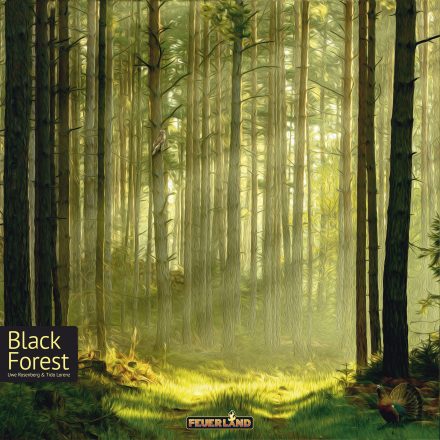
In Black Forest, you start out with a small domain in need of new buildings and livestock. You’ll travel from village to village, to enlist the aid of the best specialists. Exploiting the abilities of these specialists lets you collect resources, lay out new landscape tiles (e.g. ponds and fields), and build a variety of buildings, which come in four types. Choose the right buildings, place landscapes, fire up your glass production, and expand your domain.

Uwe Rosenberg’s resource wheels, made famous in Glass Road (2013), return in Black Forest. Two resource wheels on your tableau help you keep track of your resources and production. Black Forest continues the story – as the name suggests — in the Black Forest. Among others, the main difference between the two games is the use of worker placement in Black Forest instead of simultaneous action selection.

A wide selection of buildings and their different effects offer many different paths to victory.

Game Mechanics:

  • Set Collection
  • Solo / Solitaire Game
  • Tile Placement
  • Variable Set-up
  • Worker Placement

Game Specifications:

  • 1 – 4 Players
  • 60 – 120 Minutes
  • Difficulty Weight 3.23

Biohack

Dr. Johann Maischberger caused a stir in the scientific academia for playing god with his experiments. The young researchers involved in his experiments were all expelled from the academia due to this unethical work.
This incident was known as the “Biohack Incident.”

And then, twenty years later.

Dr. Maischberger’s daughter is trying to bring back the experiment back to life once again. However, the blueprints left behind by her father were incomprehensible to ordinary people. Thus, they called upon the “mad scientists,” namely those who were expelled from the academia.

Biohack is a medium-complexity game for 1-4 players. Each players will use workers called “Noman” to procure funds and DNAs, then create new creatures. The scientists, who are the players’ avatars, have various abilities. In addition, the creatures created by the experiments will also bring various beneficial effects. The game ends after the designated number of rounds or if a player able to creates 7 creatures. The players will tally all of their Evaluation Points and the player who has the most Evaluation Points wins the game.

Game Mechanics:

  • Open Drafting
  • Set Collection
  • Solo / Solitaire Game
  • Worker Placement

Game Specifications:

  • 1 – 4 Players
  • 60 – 90 Minutes
  • Difficulty Weight 2.73

Beyond the Horizon

Beyond the Horizon is a civilization game in which players compete to become the most influential society in history through exploration and expansion, development and production, research and technological advancement.

The game is played over a variable number of rounds until enough goals have been achieved to signal the end of the game. Along the way, players will earn points for exploring new lands, settling and building new cities, advancing technologically, and increasing their cultural and economic development. The player with the most points at the end of the game wins.

Game Specifications:

  • 2 – 4 Players
  • 90 – 120 Minutes
  • Difficulty Weight 3.42

Atlantis Exodus

The legendary Atlantis is shrouded in so many stories and myths, an island realm that was reputed to have completely drowned in only one night.

Atlantis Exodus presents the player kings with the challenge of rescuing as many citizens as possible before the impending downfall and, by doing so, saving the knowledge they have acquired for a different world and time.

Thanks to an innovative rotation mechanism, 1-4 kings have to face constantly changing conditions and keep adjusting their own strategy to the different action possibilities in order to ultimately become the savior of the achievements of their time.

Game Specifications:

  • 1 – 4 Players
  • ~90 Minutes
  • Difficulty Weight 3.24

Bamboo

For generations, harvesting bamboo has brought prosperity to your home. Work, perseverance, balance and prayer have made a small town flourish that has grown at the expense of the cane fields. Today, various clans live in harmony with nature.

In Bamboo, players take on the role of clans that grow bamboo and use the fruits of their labor to take care of their family and thus add happiness points. This is an action management and tile optimization game that is both accessible and deep. With a very careful setting, Bamboo is part of the Kemushi saga, to which Bitoku and Silk also belong.

Bamboo games are made up of 4 years or rounds, which in turn are divided into 4 phases or seasons. On their turns, players will burn incense in temples to seek favor from the spirits, and use bamboo shoots to perform actions such as seeking balance, cooking, home improvement, or managing finances.

Following the doctrines of the home balance discipline allows for better optimization of home tiles, making it a fundamental pillar for progressing through the game. To score balance tiles you must use the balance action and follow the pattern indicated on the tile, which always has something to do with the type of home tiles you get during the game. There are four classes of home tiles: decoration, garden, faith, or useful. Depending on how they place them on their board, players will earn happiness points.

In addition to managing the household, players will need to prepare for when tough times come. To get through the winter, it will be necessary to feed the family members with the tea, rice or ramen that has been prepared and stored in the previous season. And all this without forgetting to honor spirits and ancestors in the temples. The player who has made the largest offering of incense in each sacred space will receive the favor of one of the seven spirits of the forest, as a token of thanks. Spirit tiles, in addition to helping players throughout the game, offer bonus points in the final phase based on the number of different spirits in each player’s play area.

With accessible and easy-to-learn rules, Bamboo is a very versatile title that will fit into any shelves. However, behind its apparent simplicity lies great strategic depth, with plenty of options available to players. In addition, Bamboo has an advanced game mode on the back of the personal boards, which will give the games an extra level of demand. Harvest bamboo and find balance in your home to win the game. May the spirits be with you!

Game Specifications:

  • 2 – 4 Players
  • 90 – 110 Minutes
  • Difficulty Weight 2.89

Arcs

Arcs is a sharp, tactical space opera game, for 2–4 players, set in a dark yet silly universe. Players represent officials from a distant, decaying and neglectful Empire who are now free to vie for dominance whether through battle, gathering scarce resources or diplomatic intrigue. Ready yourself for dramatic twists and turns as you launch into this galactic struggle.

A deck of cards in 4 suits with ranks from 1-7 (2-6 for less than 4 players) defines the action selection system. These cards are played in a trick-taking adjacent system to select actions, take the initiative and declare Ambitions. The 3 declared Ambitions are what will score in that deal. Timing is everything. Bad hands must be mitigated by careful card play and benefitting from other players’ card play.

Battles are resolved quickly with the attacker choosing their level of risk. The defenders must be prepared with adequate defensive ships and cards in their tableau.

Each game contains a hundred wooden ships and agents, 18 custom engraved dice, a beautiful six-panel board, and tons of cards with over 60 pieces of unique art. The base game may be played without the optional Leaders and Lore cards (for an easier teach) or with them for a richer, fuller and asymmetric game. It is also the core of the campaign game (requiring the Blighted Reach Expansion), which provides an epic, more thematic experience.

Apiary 🟡

In a far-distant future, humans no longer inhabit Earth. The cause of their disappearance (or perhaps their demise) is unknown, but their absence left a void ready to be filled by another sentient species.

Over the span of untold generations, one species of the humble honeybee evolved to fill that void. They grew in size and intelligence to become a highly advanced society. They call themselves Mellifera, and they have made substantial technological advances in addition to the technology they adapted from human ruins, up to and including space travel.

In Apiary, each player controls one of twenty unique factions. Your faction starts the game with a hive, a few resources, and worker bees. A worker-placement, hive-building challenge awaits you: explore planets, gather resources, develop technologies, and create carvings to demonstrate your faction’s strengths (measured in victory points) over one year’s Flow. However, the Dearth quickly approaches, and your workers can take only a few actions before they must hibernate! Can you thrive or merely survive?

Game Specifications:

  • 1 – 5 Players
  • 60 – 90 Minutes
  • Difficulty Weight 2.97