Tag: Team-Based Game

Carrom

Carrom is most easily described as “finger pool”. On a 29″ x 29″ wooden board, players flick a large weighted disc (the striker) at smaller wooden discs (the carrom-men). The goal is to sink your 9 carrom-men (black or white), as well as the red Queen, in the four corner pockets. The first player or team to accomplish this collects points for the round (commonly called a “board”). A standard game of Carrom continues until one player has 25 points or 8 boards have been completed.

Carrom is typically played with powder, and some variations of the game use cues. The most widely played form of ‘proper’ Carrom is supported by a world wide set of rules known as The Laws of Carrom, and are available from the International Carrom Federation.

Carrom bears similarities to Pool and Crokinole, but is a fascinating game in its own right with varied strategies and techniques. No one knows exactly where the game originated. It could have come from Bangladesh, Burma, Egypt, or Ethiopia, but most believe it originated in India.

Game Mechanics:

  •  Dexterity
  • Team-Based Game

Game Specifications:

  • 2 – 4 Players
  • ~60 Minutes
  • Difficulty Weight 1.46

Burning Banners: Rage of the Witch Queen

In the five centuries since the Wound was closed, the kingdoms of Kalar have struggled to rebuild their shattered societies. A resurgent Empire spread across the great sea, bringing civilization to the untamed eastern continent of Kheros. But Lilith, one of the immortal sorcerers responsible for the Worldwound, arrived first, preparing the way for the return of her dark mistress. For nearly six hundred years she has plotted and schemed. In 588 (2023 Gregorian), the wait is over.

Burning Banners: Rage of the Witch Queen is a fantasy wargame for two to six players. Fast playing and intuitive, a whopping 29 scenarios range from short campaigns with 2 Kingdoms and one map, to the entire 12-year war, in which 6 kingdoms battle over four maps. The rules include a quick-playing Basic Game as well as an Advanced Game which introduces Magic, Heroes, and Monsters guarding powerful treasures.

March 1” Armies and Heroes through huge, lovingly detailed hexes. Explore a vast, detailed fantasy world encompassing four mounted game maps with six unique kingdoms and dozens of troop types. Designed and illustrated by acclaimed fantasy artist, Christopher Moeller!

Game Mechanics:

  • Deck Building
  • Campaign
  • Team-Based Game
  • Variable Player Powers
  • Variable Set-up
  • Worker Placement

Game Specifications:

  • 2 – 6 Players
  • ~60 Minutes
  • Difficulty Weight 3.22

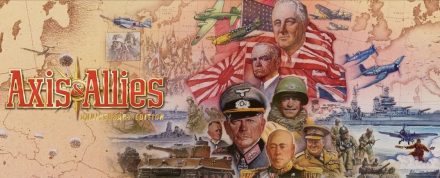
Axis & Allies Anniversary Edition

Put yourself into the shoes of the great strategic thinkers and generals of WWII with this special anniversary edition of Axis & Allies! Now you can play with Italy as a third Axis nation, the new cruiser unit, and over 600 pieces.

Game Specifications:

  • 2 – 6 Players
  • 360 Minutes
  • Difficulty Weight 3.11

Earth

Earth is a tableau builder with simple rules and countless strategic possibilities. With its encyclopedic nature and a near-infinite number of tableau combinations, every single game will allow you to discover new synergies and connections, just as our vast and fascinating world allows us to do!

It’s time to jump into these rich environments and create some amazing natural synergies that replicate and extrapolate on Earth’s amazing versatility and plethora of natural resources. Over thousands of years of evolution and adaptation the flora and fauna of this unique planet have grown and developed into amazing life forms, creating symbiotic ecosystems and habitats.

Players create a self-supporting engine of growth, expansion and supply where even your unused plants become compost for future growth. They use their cards to choose actions (which affect all players) and gain resources. The first player to complete their Tableau triggers the end of the game. The player with the most points wins.

Game Specifications:

  • 1 – 5 Players
  • 45 – 90 Minutes
  • Difficulty Weight 2.91

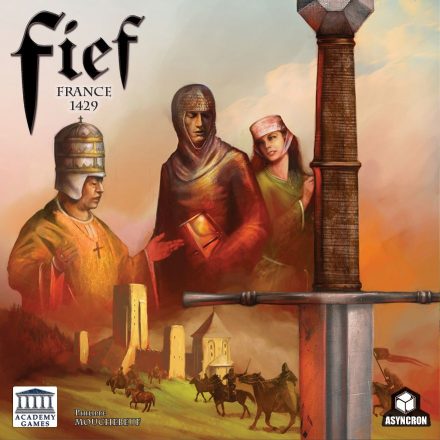
Fief France

FIEF: France is a game of dynastic ambition in which players assume the roles of nobles in the 15th century kingdom of France. Each player strives to become the most powerful ruling force in the kingdom by gaining control of Fiefs and Bishoprics. In turn, they acquire Royal and Ecclesiastical (church) titles which give their families influence to elect the next Pope and King. Players strengthen their positions by negotiating marriage alliances between their families, setting the stage for love, treachery, and deception!

FIEF is a classic game and this edition includes a new board (FIEF France: Gameboard)!

The game board represents the Kingdom of France in the Middle Ages. Villages have square outlines that are connected by roads that allow Lord and Troop movement. The villages are grouped into eight colored background areas that represent individual Fiefs, which are domains given to Lords to preside over. Fiefs have different colored backgrounds. Each village also belongs to one of five church Bishoprics; each Bishopric is outlined with a heavy border line and is numbered between 1-5 along the edge of the board inside a Bishop’s Mitre. Bishoprics include several different Fiefs’ villages.

Each player controls up to four family members, comprised of male and female nobles. These family members will rise in power by gaining Royal and Ecclesiastic Titles.

In FIEF France edition, a player may attempt to gain control of all the villages in a Fief to gain the Royal Title of Baron, Earl, or Duke. For each Fief a player controls, they gain 1 VP. These Titled Lords may now take part in the election for the next King. They may even be a candidate to become King, thus bringing 1 VP and more power to the family! Other members of your family may follow the calling of the Church to gain the Ecclesiastical Titles of Bishop and then Cardinal. These titles allow you to Tithe Bishoprics, taking the Church’s (i.e. “your”) fair share of income from other Fief Lords! The highest goal your clerical family member can attain is to be elected Pope, bringing 1 VP and special privileges to your family!

You win the game as soon as you have 3 VPs. This is easier said than done and you may need to form alliances with other players through diplomacy and marriage to attain your goal. When one of your family members marries a noble of another family, the two of you become allied. You now win the game together with 4 VPs and cannot win alone, unless your marriage is annulled by the Pope or your spouse is “mysteriously” murdered or dies by some other foul means!

In addition to being wary of your fellow players, you draw event cards that can quickly change your destiny. Bounty Event cards are beneficial to the Player and include “Good Harvest”, “Good Weather”, and “Added Taxes” cards. But some cards are Disaster Cards that can randomly affect all players in specific Bishoprics. These include “The Plague”, “Heavy Rain”, “Famine”, and “Peasant Uprising”!

Income can be increased by players imposing church tithes on their opponent’s villages or taxing their own Fiefs. Players may purchase new Fief titles, improve their village incomes with mills, and fortify their cities.

Players will also need to protect their land and castles. Men-at-Arms and Knights can be purchased, as well as Archers and Bombards. If you feel that other players are not running their Fiefs as well as you can, you may try to invade their territories! But you must risk one of your family members to lead the troops into possible battle, where they might be killed or taken prisoner. If two opposing armies are in the same village square, a Battle may be initiated. The players assess the size and strength of their armies, which determine the number of Battle Dice each may roll. Each “f” rolled is a hit. Men-at-Arms are defeated with one hit, while Knights require three hits to be removed from the battle.

Game Specifications:

  • 3 – 6 Players
  • 60 – 180 Minutes
  • Difficulty Weight 3.92

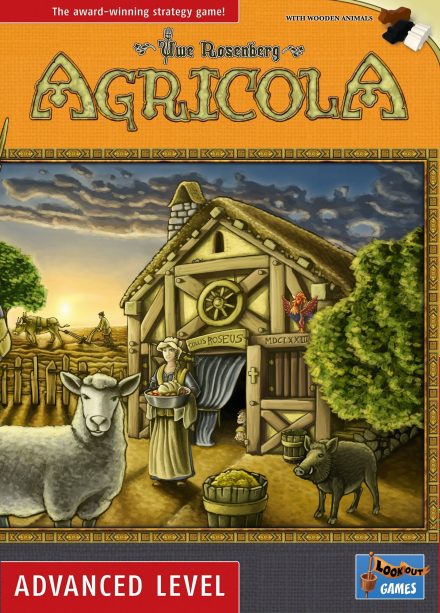
Agricola 🟠

In Agricola, you’re a farmer in a wooden shack with your spouse and little else. On a turn, you get to take only two actions, one for you and one for the spouse, from all the possibilities you’ll find on a farm: collecting clay, wood, or stone; building fences; and so on. You might think about having kids in order to get more work accomplished, but first you need to expand your house. And what are you going to feed all the little rugrats?

The game supports many levels of complexity, mainly through the use (or non-use) of two of its main types of cards, Minor Improvements and Occupations. In the beginner’s version (called the Family Variant in the U.S. release), these cards are not used at all. For advanced play, the U.S. release includes three levels of both types of cards; Basic (E-deck), Interactive (I-deck), and Complex (K-deck), and the rulebook encourages players to experiment with the various decks and mixtures thereof. Aftermarket decks such as the Z-Deck and the L-Deck also exist.

Agricola is a turn-based game. There are 14 game rounds occurring in 6 stages, with a Harvest at the end of each stage (after Rounds 4, 7, 9, 11, 13, and 14).
Each player starts with two playing tokens (farmer and spouse) and thus can take two turns, or actions, per round. There are multiple options, and while the game progresses, you’ll have more and more: first thing in a round, a new action card is flipped over.
Problem: Each action can be taken by only one player each round, so it’s important to do some things with high preference.
Each player also starts with a hand of 7 Occupation cards (of more than 160 total) and 7 Minor Improvement cards (of more than 140 total) that he/she may use during the game if they fit in his/her strategy. Speaking of which, there are countless strategies, some depending on your card hand. Sometimes it’s a good choice to stay on course, and sometimes it is better to react to your opponents’ actions…

Descent: Journeys in the Dark (Second Edition)

In Descent: Journeys in the Dark (Second Edition), one player takes on the role of the treacherous overlord, and up to four other players take on the roles of courageous heroes. During each game, the heroes embark on quests and venture into dangerous caves, ancient ruins, dark dungeons, and cursed forests to battle monsters, earn riches, and attempt to stop the overlord from carrying out his vile plot.

With danger lurking in every shadow, combat is a necessity. For such times, Descent: Journeys in the Dark (Second Edition) uses a unique dice-based system. Players build their dice pools according to their character’s abilities and weapons, and each die in the pool contributes to an attack in different ways. Surges, special symbols that appear on most dice, also let you trigger special effects to make the most of your attacks. And with the horrors awaiting you beneath the surface, you’ll need every advantage you can take…

Featuring double-sided modular board pieces, countless hero and skill combinations, and an immersive story-driven campaign, Descent: Journeys in the Dark (Second Edition) transports heroes to a vibrant fantasy realm where they must stand together against an ancient evil.

Compared to the first edition of Descent: Journeys in the Dark, this game features:

  • Simpler rules for determining line of sight
  • Faster setup of each encounter
  • Defense dice to mitigate the tendency to “math out” attacks
  • Shorter quests with plenty of natural stopping points
  • Cards that list necessary statistics, conditions, and effects
  • A new mechanism for controlling the overlord powers
  • Enhanced hero selection and creation process
  • Experience system to allow for hero growth and development
  • Out-of-the-box campaign system

Game Mechanics:

  • Hand Management
  • Modular Board
  • Role Playing
  • Scenario / Mission / Campaign Game
  • Solo / Solitaire Game
  • Team-Based Game
  • Variable Player Powers

Game Specifications:

  • 1 – 5 Players
  • ~120 Minutes
  • Difficulty Weight 3.21

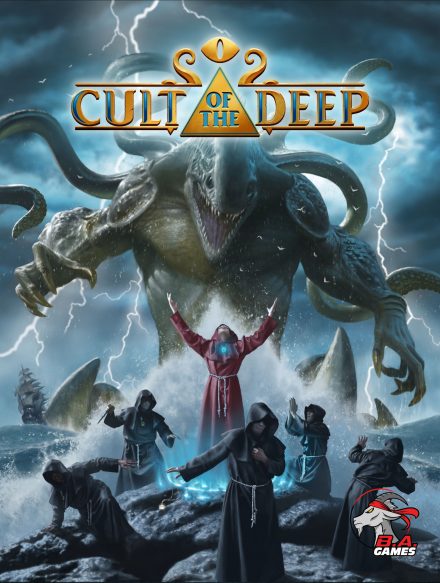
Cult of the Deep

You are a cultist, trying to establish your faction’s rise to power. Fight over rituals and mythical monsters as you seek victory and control of the cult.

Roles

Each player is given a role that will remain hidden throughout the game, except the High Priest. This role will determine your win condition:

  • High Priest – Root out corruption in the cult. Kill all Cabalists, the Heretic, and survive.
  • Cabalists – Seek to take control of the cult. Kill the High Priest.
  • Faithful – Protect the High Priest from threats to their power. Kill all Cabalists, the Heretic, and the High Priest must survive.
  • Heretic – Burn the whole cult to the ground. Kill the entire cult, yourself included if necessary.

Extra abilities

Each player will also be given a:

  • Character card that determines their starting healthspecial ability, and a power symbol that provides an additional way to gain life from the dice.
  • Secret sigil card, which gives each cultist a once per game power, will also be given to each player.

Mechanics

A player will take a turn by first rolling their dice up to 3 times. They then decide where to commit their dice: to rituals to gain altar effects to temporarily empower themselves, finish a ritual in order to gain its powerful effects permanently, stab other cultists, gain life, or give life to other cultists.

If a player is killed, they are not eliminated. Instead, they become a wraith. They will roll dice on their turn still, just less. They cannot commit dice like normal but instead haunt the dice of enemies and allies by giving, replacing, or discarding dice.

Game Mechanics:

  • Bribery
  • Deduction
  • Hidden Roles
  • Push Your Luck
  • Re-rolling and Locking
  • Team-Based Game
  • Variable Player Powers

Game Specifications:

  • 4 – 8 Players
  • 45 – 75 Minutes
  • Difficulty Weight 2.71

Blood on the Clocktower

In the quiet village of Ravenswood Bluff, ‌a demon walks amongst you…

During a hellish thunderstorm, on the stroke of midnight, there echoes a bone-chilling scream. The townsfolk rush to investigate and find the town storyteller murdered, their body impaled on the hands of the clocktower, blood dripping onto the cobblestones below. A Demon is on the loose, murdering by night and disguised in human form by day. Some have scraps of information. Others have abilities that fight the evil or protect the innocent. But the Demon and its evil minions are spreading lies to confuse and breed suspicion. Will the good townsfolk put the puzzle together in time to execute the true demon and save themselves? Or will evil overrun this once peaceful village?

Blood on the Clocktower is a bluffing game enjoyed by 5 to 20 players on opposing teams of Good and Evil, overseen by a Storyteller player who conducts the action and makes crucial decisions. The goal of the game is to successfully deduce and execute the demons before they outnumber the townfolk.

During a ‘day’ phase players socialize openly and whisper privately to trade knowledge or spread lies, culminating in a player’s execution if a majority suspects them of being Evil. Of a ‘night’ time, players close their eyes and are woken one at a time by the Storyteller to gather information, spread mischief, or kill.

The Storyteller uses the game’s intricate playing pieces to guide each game, leaving others free to play without a table or board. Players stay in the thick of the action to the very end even if their characters are killed, haunting Ravenswood Bluff as ghosts trying to win from beyond the grave.

If you arrive late to a game, you can enter after it’s started as a powerful Traveller character with unusual talents and questionable allegiances. Each character comes with their own special ability and no two players in a game are ever the same character.

Game Mechanics:

  • Bluffing
  • Deduction
  • Hidden Roles
  • Negotiation
  • Team-Based Game
  • Variable Player Powers
  • Voting

Game Specifications:

  • 6 – 21 Players
  • 30 – 120 Minutes
  • Difficulty Weight 3.03

Axis & Allies

Axis and Allies is the most successful of Milton Bradley’s Gamemaster series.

It depicts WWII on a grand scale, full global level. Up to five players can play on two different teams. The Axis which has Germany and Japan, and the Allies which has the USA, the United Kingdom, and the USSR. A full map of the world is provided, broken up in various chunks similar to Risk. The game comes with gobs of plastic miniatures that represent various military units during WWII. Players have at their disposal infantry, armor, fighters, bombers, battleships, aircraft carriers, submarines, troop transports, anti-air guns, and factories. All of the units perform differently, and many have special functions. Players have to work together with their teammates in order to coordinate offenses and decide how best to utilize their production points. Players also have the option of risking production resources on the possibility of developing a super technology that might turn the tide of war.

Game Specifications:

  • 2 – 5 Players
  • ~180 Minutes
  • Difficulty Weight 3.04