Tag: Worker Placement

Games with a Worker Placement mechanic require players to coordinate various workers as those workers gather resources.

Atlantis Rising (Second Edition)

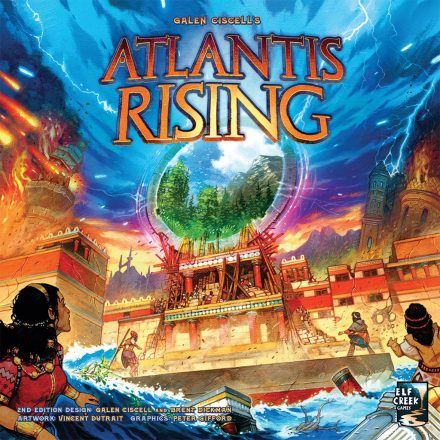
The isle of Atlantis, your home, is sinking. Will you be able to save your people in time?

Atlantis Rising is a co-operative worker placement game in which you must work together with up to six other players to deploy citizens across your homeland, gathering resources in order to build a cosmic gate that can save your people. Workers placed close to the shoreline are more rewarding, but are more likely to be flooded and the actions lost.

Every turn, each player draws a misfortune card that will flood certain locations along the ever-shrinking Atlantis shoreline, or may otherwise work to undermine your efforts to save your people. So you must race to gather the necessary resources to build and power the gate, before the island disappears beneath the waves forever.

This edition contains all new art and graphic design, created to bring even more attention to the thematic setting of the game. The Athenians Attack phase has been replaced with the Wrath of the Gods phase, requiring more strategic planning and adding to the sense of urgency. Now, instead of placing workers in an Atlantean Navy, players must cooperatively decide to flood a set number of tiles at the end of each round. To further aid them in their task, Councilor player powers have been expanded and made more impactful, and the knowledge deck has similarly been revised and expanded. The variable gate components, once built, no longer offer one-time bonuses, but create new worker placement spots where players can send Atlantean workers to unleash actions to help save their island.

Agricola: All Creatures Big and Small 🟢

Agricola: All Creatures Big and Small is a new take on Uwe Rosenberg’s Agricola designed for exactly two players and focused only on the animal husbandry aspect of that game. So long plows and veggies!

In Agricola: All Creatures Big and Small, you become an animal breeder of horses, cows, sheep and pigs and try to make the most of your pastures. Players start with a 3×2 game board that can be expanded during play to give more room for players to grow and animals to run free. Sixteen possible actions are available for players to take, with each player taking three actions total in each of the eight rounds.

The player who amasses the most victory points through enclosing space with fences and acquiring the largest number and variety of animals and victory point-generating buildings will be the winner.

Four Standard Buildings and 4 special buildings are available in the base game. These buildings each provide unique special abilities during play and/or VP at game end. Balancing the tension between building infrastructure (fenced pastures and buildings) and acquiring animals (the single biggest source of end-game scoring) is the key to success!

War of Whispers, A

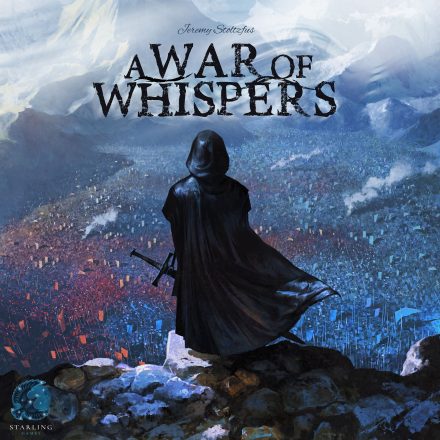
A War of Whispers is a competitive board game for 2 to 4 players. Five mighty empires are at war for the world, but you are no mighty ruler. Instead, you play a secret society that is betting on the results of this war while pulling strings to rig the results and ensure their bets pay off. A War of Whispers is a game of deep strategy, hidden agendas, and shifting loyalties.

You start the game with five loyalty tokens, each corresponding to one of the five different empires, bet randomly on a loyalty value. Your primary goal is to ensure that when the game ends, the empires you are most loyal to control the most cities across the globe. Gameplay consists of turns broken down into four phases:

  1. Deploy agents phase: In player order (starting with the first player and proceeding clockwise), each player removes, then deploys agents to empire councils, the positions on the board marked Sheriff, Steward, Marshall, and Chancellor.
  2. Empire turns phase: Each council position on each empire council will take an action. If a player has acquired cards, they may play them during this phase.
  3. Cleanup phase: Add the turn marker to the next space on the turn tracker, then each player discards down to the hand limit of five cards.
  4. Swap phase: In player order, each player may swap two of their unrevealed loyalty tokens. If you choose to do so, you must reveal both of the swapped loyalty tokens. They remain revealed for the rest of the game.

Gameplay repeats itself in this order four times. When the last space on the turn track is filled, the game ends immediately and scoring commences. The player with the most points based off their empire loyalties and the cities they control wins.

Game Specifications:

  • 2 – 4 Players
  • 30 – 60 Minutes
  • Difficulty Weight 2.57

Tokaido

Tokaido

In Tokaido, each player is a traveler crossing the “East sea road”, one of the most magnificent roads of Japan. While traveling, you will meet people, taste fine meals, collect beautiful items, discover great panoramas, and visit temples and wild places but at the end of the day, when everyone has arrived at the end of the road you’ll have to be the most initiated traveler – which means that you’ll have to be the one who discovered the most interesting and varied things.

The potential action spaces in Tokaido are laid out on a linear track, with players advancing down this track to take actions. The player who is currently last on the track takes a turn by advancing forward on the track to their desired action and taking that action, so players must choose whether to advance slowly in order to get more turns, or to travel more rapidly to beat other players to their desired action spaces.

The action spaces allow a variety of actions that will score in different, but roughly equal, ways. Some action spaces allow players to collect money, while others offer players a way to spend that money to acquire points. Other action spaces allow players to engage in various set collections that score points for assembling those sets. Some action spaces simply award players points for stopping on them, or give the player a randomly determined action from all of the other types.

Game Mechanics:

  • Set Collection
  • Worker Placement

Game Specifications:

  • 2 – 5 Players
  • ~45 Minutes
  • Difficulty Weight 1.75

Garum

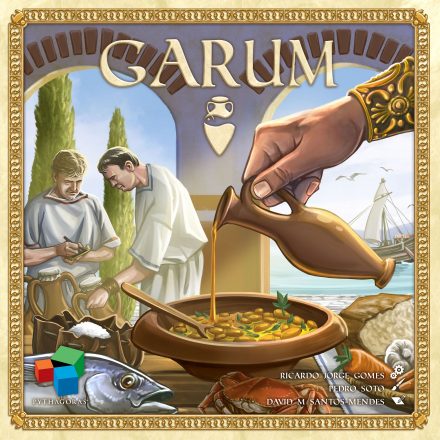
Garum was a fermented fish sauce used as a condiment in the old ages; its manufacture and export was an element of prosperity and perhaps an impetus for the Roman penetration of Lusitanian and Hispanian coastal regions.

Garum from today’s Portugal and Spain was highly prized in Rome and has now inpired a versatile strategy boardgame for the whole family, ages 8 and up, that plays 2 to 4 players. Garum is a tile-laying game, which plays in about 30 minutes, it is language independent and features endless replayability, due to its board system, that ensures no two games are alike.

In Garum, each player represents a master in the preparation of a specific type of fish sauce and receives a set of 16 Cetarian Tiles; each one has 4 spaces filled by 4 colors in different proportions, though the color that the player is defending is the predominant one.

The goal of the game is to play Cetarian Tiles strategically, in order to get a huge number of his own colour symbols in selected rows or columns – the greater the influence, the higher the reward! While placing the tiles, players may apply to score, collect some bonuses and also block their opponent’s intents. Whoever scores most points is the winner.

Game Specifications:

  • 2 – 4 Players
  • 30 – 40 Minutes
  • Difficulty Weight 1.62