Tag: Modular Board

Bruxelles 1893

Bruxelles 1893 is a worker placement game with elements of bidding and majority control. Each player is an architect of the late 19th century and is trying to achieve, through various actions, an architectural work in the Art Nouveau style. The most successful building yields the most points. Each player can also create works of art to increase his score.

The action board is modular, with not every player having access to each action each turn. Some actions cost money – acquiring high-quality materials, building a level of your personal house, finding a patron, creating a work of art, selling that art for money and prestige – while other actions are free but can potentially cause you to lose one of your workers; these latter actions include acquiring low-quality materials, activating your patrons, visiting the stock exchange, and taking one of the actions with a cost. Once everyone has passed on taking more actions, the round ends and players have an art exhibition during which they can sell works. After this, players receive prestige points or bonus cards based on the symbols they’ve placed their workers next to on the action board.

After five rounds, the game ends and players score bonus points based on their architect level, their bonus cards, how well they’ve completed their work, and their money on hand. The player with the most points wins.

Game Mechanics:

  • Area Majority / Influence
  • Auction / Bidding
  • Modular Board
  • Open Drafting
  • Worker Placement

Game Specifications:

  • 2 – 5 Players
  • 50 – 125 Minutes
  • Difficulty Weight 3.59

Borderlands: Mister Torgue’s Arena of Badassery

Borderlands: Mister Torgue’s Arena of Badassery! is a co-operative combat-action board game.

You and a team of Vault Hunters enter Mister Torgue’s Arena of Badassery to face off against his collection of skags, bandits, and assorted psychos. You can play a one-off battle filled with explosions, slaughter-splosions, sauce-plosions, and loot-splosions!!! Or play a series of deadly fights in campaign-mode that will see your Vault Hunter level up between games. Visit vending machines to buy better gear, advance your character using unique skill trees, equip epic new guns, and enter the next game even more BADASS than before!!! Just make sure your tough enough to take on the final boss, an Ultimate Murder-Machine, hellbent on sending you back to the borderlands as moist and meaty skag-snacks.

Game Mechanics:

  • Campaign
  • Cooperative Game
  • Modular Board

Game Specifications:

  • 1 – 4 Players
  • ~60 Minutes
  • Difficulty Weight 3.00

Beacon Patrol

You are captains of the Coast Guard. Together you check beacon buoys and lighthouses to ensure the safety of the North Sea coast.

You place your tiles next to tiles that are already placed, move your ships, and explore the sea.

Your goal is to explore as many tiles as possible. A tile is considered explored when it’s connected to other tiles on all four of its sides.

Beacon Patrol is a co-op tile-laying exploration game in which you navigate the coast of the North Sea to secure its beacon buoys, lighthouses and waterways.

Game Specifications:

  • 1 – 4 Players
  • ~30 Minutes
  • Difficulty Weight 1.35

Assassin’s Creed: Brotherhood of Venice

Assassin’s Creed: Brotherhood of Venice is a co-operative miniature board game taking place in the heart of the Italian Renaissance through a story-driven campaign of 26 “memories” in Venice, in 1509. Choose your assassins according to their unique abilities, level up during the campaign, and unlock new skills for each of them.

Fight or stay incognito thanks to the equipment found in chests or manufactured by Leonardo Da Vinci. Evade your pursuers by climbing on roofs and towers, then synchronize to reveal new game elements. Bribe your enemies, use secret hideouts to escape patrols, and flip mechanisms to change the level layout. After each memory, fall back to your headquarters to heal your wounds, grow your brotherhood’s fame, and craft special equipment. The game features a save system that allows the number of players to vary between each campaign and the level of play adjusts according to the number of players.

The retail edition of Assassin’s Creed: Brotherhood of Venice features the same scenarios as the original Kickstarter release and therefore the same gameplay experience. What has changed is that all of the miniatures other than the five detailed assassin figurines have been replaced with standees, so the game includes 5 miniatures, 139 standees, 6 secret envelopes, 41 tiles, and more than 400 cards.

Many surprises await in the sealed envelopes. Meet the many famous personalities you’ve encountered in the Assassin’s Creed video games as well as four unique ones created especially for this game.

Altiplano 🟡

Altiplano is a bag-building game along the lines of Orléans, set in the South American highlands of the Andes (the “Altiplano”). The competition for limited resources is considerable, as it was in Orléans, but the greater focus in Altiplano is on building up your own production to be the best that it can be – or at least better than that of the other players!

The object of the game is for players to use their goods to produce more goods that will be worth points in the end. Each player starts with a unique role tile, giving them access to different goods and methods of production. Players have limited access to production at the start, but they can acquire additional production sites during the game that open up new options. The various types of goods — such as fish, alpaca, cacao, silver and corn — all have their own characteristics and places where they can be used. For example, silver can be sold for a high price at the market, fish can be exchanged for other goods at the harbor and alpaca can produce wool at the farm that can then be made into cloth.

Aside from building up an effective production, players must fulfill their orders at the right time, develop the road in good time and store their goods cleverly enough to fill their warehouses in the most valuable way. Often, a good warehouse keeper is more relevant in the end than the best producer.

Age of Innovation 🔴

Age of Innovation is a standalone game set in the world of Terra Mystica.

Twelve factions, each with unique characteristics, populate this world of varying terrains. Here you will compete to erect buildings and merge them into cities. Each game allows you to create new combinations of factions, homelands, and abilities so that each game isn’t the same as another.

You control one of these factions and will terraform the game map’s terrain into your homelands where you can erect your buildings. Proximity to other factions may limit your expansion, but it also gains you significant advantages in the game. This tension adds to the appeal of the Terra Mystica series.

Upgrade your buildings to gain valuable resources such as tools, scholars, money, and power. Build schools to advance in different sciences and collect books, which you can use to make innovations. Build your palace to gain a powerful new ability or build workshops, guilds, and universities to complete your culture.

Adventure Zone: Bureau of Balance, The 🔵

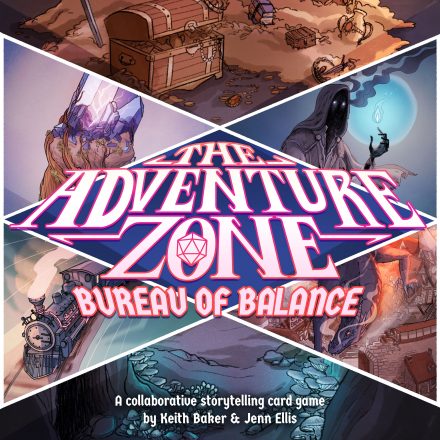
The Adventure Zone: Bureau of Balance, based on the very popular podcast and series of graphic novels of the same name, lets players embark on their own adventure as they attempt to rescue various artifacts of immense power. Battle a myriad of enemies, from scary to sarcastic, as you and your friends work through a dynamic dungeon made from numerous decks of cards – ensuring that each game will be different!

Game Specifications:

  • 2 – 5 Players
  • 60 – 90 Minutes
  • Difficulty Weight 1.71

Bites

New version of the Spiel des Jahres Recommended Big Points with a new theme, more engaging components, and rule tweak cards to make sure every play is different.

Four page illustrated rulebook. 20min play time. Highly interactive with no direct conflict.

Players move ants along a trail and collect food as they go. However, the value of that food depends on how the other ants move.

Shared incentives mean you are always trying to figure out what the other players are up to. Variable “rules cards” tweak the rules to every game so that each play is fresh.


During setup, a trail of food is laid out. On each player’s turn, they can move any ant to the next food in the trail that matches their color (red ant to apple, purple ant to grapes, etc). Then the player takes the food token directly in front of or behind the ant, saving it to score at the end of the game.

However, players don’t know for sure how much the food is going to be worth until the matching ant makes it to the ant hill at the end of the trail. This creates shared incentives as players work together to advance some ants and hold others back.

Along the way players also have the chance to pick up chocolate, which can be turned into special actions, and wine, which provides a way to score bonus points.

There are four decks of cards that define the rules for the game. Each game, one card is chosen from each deck to provide a unqiue combination. Players have to adapt their strategy to the actions the other players are taking and the unique rules for this game. The “rule decks” are:

  • Ant Hill – Food tokens are worth more points if the matching ant gets to the hill FIRST. Or, food tokens are worth more points if the matching ants get to the ant hill LAST.
  • Wine – The wine tokens have a different way of scoring in every game.
  • Chocolate – The chocolate tokens provide a different special power in every game. And, the best way to use that power will change based on the other special rules in play.
  • Variant – One special rule that applies to this game which offers an extra twist.

Your actions will change the incentives for the other players. Can you manage these cascading effects to collect the most valuable food collection?

Game Mechanics:

  • Modular Board
  • Set Collection
  • Variable Set-up

Game Specifications:

  • 2 – 5 Players
  • ~20 Minutes
  • Difficulty Weight 1.46

Gaia Project

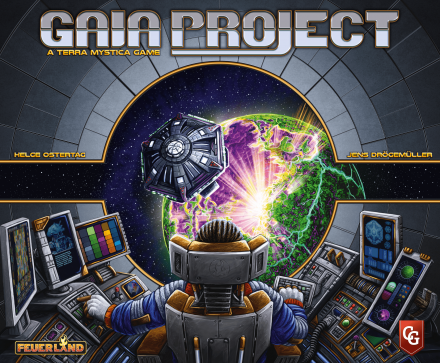
Gaia Project is a new game in the line of Terra Mystica. As in the original Terra Mystica, fourteen different factions live on seven different kinds of planets, and each faction is bound to their own home planets, so to develop and grow, they must terraform neighboring planets into their home environments in competition with the other groups. In addition, Gaia planets can be used by all factions for colonization, and Transdimensional planets can be changed into Gaia planets.

All factions can improve their skills in six different areas of development — Terraforming, Navigation, Artificial Intelligence, Gaiaforming, Economy, Research — leading to advanced technology and special bonuses. To do all of that, each group has special skills and abilities.

The playing area is made of ten sectors, allowing a variable set-up and thus an even bigger replay value than its predecessor Terra Mystica. A two-player game is hosted on seven sectors.

Game Specifications:

  • 1 – 4 Players
  • 60 – 150 Minutes
  • Difficulty Weight 4.40

Frostpunk: The Board Game

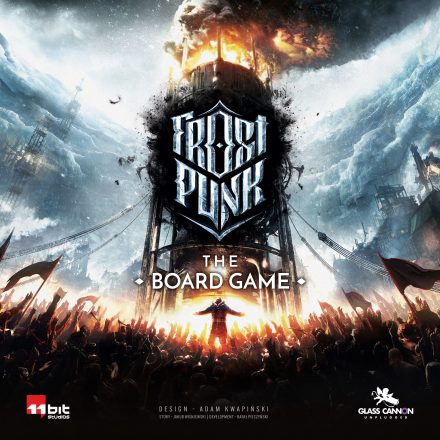
In Frostpunk: The Board Game, up to four players will take on the role of leaders of a small colony of survivors in a post-apocalyptic world that was hit by a severe ice age. Their duty is to effectively manage both its infrastructure and citizens. The core gameplay will be brutal, challenging, and complex, but easy to learn. The citizens won’t just be speechless pieces on the board. Society members will issue demands and react accordingly to the current mood, so every decision and action bears consequences.

The players will decide the fate of their people. Will you treat them like another resource? Are you going to be an inspiring builder, a fearless explorer, or a bright scientist? Is your rule going to be a sting of tyranny or an era of law and equality?

The game is based on a bestseller video game by 11bit studios, the creators of This War Of Mine. The original (digital) edition of Frostpunk is a highly successful strategy-survival-city-builder, a BAFTA-nominee that originally launched in 2018.

Game Specifications:

  • 1 – 4 Players
  • 120 – 150 Minutes
  • Difficulty Weight 4.39