Tag: Area Majority / Influence

Andromeda’s Edge 🟠

Behold, Andromeda’s Edge: A dazzling, uncharted region of space on the edge of the Andromeda Galaxy. Littered with the modular debris of the precursor civilization, patrolled by malicious extragalactic raiders, and bordered by dense nebulae, The Edge is a last resort for the brave and foolhardy who seek a new life beyond the oppressive reach of the Lords of Unity.

In this game, you lead a desperate faction seeking to build a new civilization on Andromeda’s Edge. You begin with only a space station, a few ships, and a handful of resources. By carefully placing your ships, you will gather resources, claim moons, acquire modules to add to your station, populate planets and build developments on them. You will battle opponents and compete with others to ascend the progress tracks: Science, Industry, Commerce, Civilization and Supremacy.

On your turn, you either launch a starship or return your ships to your station. Launching sends one of your starships to a region of Andromeda, either collecting resources from planetary systems or taking actions at Alliance Bases. If the region is occupied by your opponents or fearsome raiders, face off in a dice battle, with Supremacy on the line but where strategic manipulation can turn a loss into a reward. Returning to your station allows you to activate your engine, using the modules you’ve acquired to generate energy, gain resources and carry out actions.

Throughout the game you will build up your unique faction, building developments (Observatories, Factories, Spaceports, Cities and Obelisks) and gaining station modules which move you up the progress tracks. Advancement on the tracks is rewarded both during mid-game events and at the conclusion, and is the key to victory.

Game Specifications:

  • 2 – 4 Players
  • 80 – 160 Minutes
  • Difficulty Weight 3.71

Coffee Traders

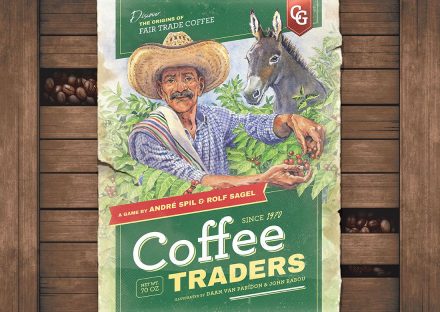
Thousands of coffee farmers all over the world support their families by using small stretches of hillside land for their coffee plantations. Farmers work day in and day out for very little, but the future of coffee farming is bright. Fair Trade organizations strive to improve living conditions for these farmers by helping them set up cooperatives. This enables them to establish better pricing agreements and take out loans for new plantations, all to help provide education and improve the quality of their lives, families, societies, and environment.

In Coffee Traders, set in 1970s Central and South America, Africa, and Asia, the delicious Arabica coffee beans farmers harvest are sold in Antwerp — and all over the world — to coffee roasters large and small. Work with your competitors to develop the regions you see fit for the best coffee beans while keeping a watchful eye on the market. Construct buildings to help your Fair Trade coffee plantations thrive while enhancing your network for trading coffee. Will your plantations fall to ruin, or will you rise to the top and become the world’s greatest coffee trader?

Game Mechanics:

  • Action Points
  • Area Majority / Influence
  • Contracts

Game Specifications:

  • 2 – 5 Players
  • 120 – 150 Minutes
  • Difficulty Weight 4.26

Fief France

FIEF: France is a game of dynastic ambition in which players assume the roles of nobles in the 15th century kingdom of France. Each player strives to become the most powerful ruling force in the kingdom by gaining control of Fiefs and Bishoprics. In turn, they acquire Royal and Ecclesiastical (church) titles which give their families influence to elect the next Pope and King. Players strengthen their positions by negotiating marriage alliances between their families, setting the stage for love, treachery, and deception!

FIEF is a classic game and this edition includes a new board (FIEF France: Gameboard)!

The game board represents the Kingdom of France in the Middle Ages. Villages have square outlines that are connected by roads that allow Lord and Troop movement. The villages are grouped into eight colored background areas that represent individual Fiefs, which are domains given to Lords to preside over. Fiefs have different colored backgrounds. Each village also belongs to one of five church Bishoprics; each Bishopric is outlined with a heavy border line and is numbered between 1-5 along the edge of the board inside a Bishop’s Mitre. Bishoprics include several different Fiefs’ villages.

Each player controls up to four family members, comprised of male and female nobles. These family members will rise in power by gaining Royal and Ecclesiastic Titles.

In FIEF France edition, a player may attempt to gain control of all the villages in a Fief to gain the Royal Title of Baron, Earl, or Duke. For each Fief a player controls, they gain 1 VP. These Titled Lords may now take part in the election for the next King. They may even be a candidate to become King, thus bringing 1 VP and more power to the family! Other members of your family may follow the calling of the Church to gain the Ecclesiastical Titles of Bishop and then Cardinal. These titles allow you to Tithe Bishoprics, taking the Church’s (i.e. “your”) fair share of income from other Fief Lords! The highest goal your clerical family member can attain is to be elected Pope, bringing 1 VP and special privileges to your family!

You win the game as soon as you have 3 VPs. This is easier said than done and you may need to form alliances with other players through diplomacy and marriage to attain your goal. When one of your family members marries a noble of another family, the two of you become allied. You now win the game together with 4 VPs and cannot win alone, unless your marriage is annulled by the Pope or your spouse is “mysteriously” murdered or dies by some other foul means!

In addition to being wary of your fellow players, you draw event cards that can quickly change your destiny. Bounty Event cards are beneficial to the Player and include “Good Harvest”, “Good Weather”, and “Added Taxes” cards. But some cards are Disaster Cards that can randomly affect all players in specific Bishoprics. These include “The Plague”, “Heavy Rain”, “Famine”, and “Peasant Uprising”!

Income can be increased by players imposing church tithes on their opponent’s villages or taxing their own Fiefs. Players may purchase new Fief titles, improve their village incomes with mills, and fortify their cities.

Players will also need to protect their land and castles. Men-at-Arms and Knights can be purchased, as well as Archers and Bombards. If you feel that other players are not running their Fiefs as well as you can, you may try to invade their territories! But you must risk one of your family members to lead the troops into possible battle, where they might be killed or taken prisoner. If two opposing armies are in the same village square, a Battle may be initiated. The players assess the size and strength of their armies, which determine the number of Battle Dice each may roll. Each “f” rolled is a hit. Men-at-Arms are defeated with one hit, while Knights require three hits to be removed from the battle.

Game Specifications:

  • 3 – 6 Players
  • 60 – 180 Minutes
  • Difficulty Weight 3.92

Fall of the Mountain King

The gnome attack was sudden and relentless. They swarmed our tunnels, defiling our mountain home and driving us from our ancestral caverns. Trolls from every clan rushed to the heart of the mountain to defend our Great Halls. We’ve lost track of how long we’ve been beating back the endless waves of invaders. Soon, it will be time for a final stand. Will we rise up like champions, or be driven out to the wilderness to fight for survival? Sharpen your blades, brothers and sisters! Raise your hammers! If we trolls must fall, we’ll fall fighting like kings!

Fall of the Mountain King is a standalone prequel to In the Hall of the Mountain King, set during the catastrophic war that drove the trolls from their mountain kingdom generations ago. Build your ancestry to drive your actions in the caverns, win the loyalty of the clan Champions, and strive to be trolldom’s greatest defender against the gnomish onslaught.

Game Specifications:

  • 1 – 5 Players
  • 60 – 90 Minutes
  • Difficulty Weight 3.58

Dune

Imagine you can control the forces of a noble family, guild, or religious order on a barren planet which is the only source for the most valuable substance in the known universe.

Imagine you can rewrite the script for one of the most famous science fiction books of all time. Welcome to the acclaimed 40-year-old board game which allows you to recreate the incredible world of Frank Herbert’s DUNE.

In DUNE you will become the leader of one of six great factions. Each wishes to control the most valuable resource in the universe – melange, the mysterious spice only found at great cost on the planet DUNE. As Duke Leto Atreides says “All fades before melange. A handful of spice will buy a home on Tupile. It cannot be manufactured, it must be mined on Arrakis. It is unique and it has true geriatric properties.” And without melange space travel would be impossible. Only by ingesting the addictive drug can the Guild Steersman continue to experience visions of the future, enabling them to plot a safe path through hyperspace.

Who will control DUNE? Become one of the characters and their forces from the book and . . . You decide!

Dominant Species Marine

Sixty-Something Millions of Years Ago — A great ice age has ended. With massive warming altering the globe, another titanic struggle for supremacy has unwittingly commenced between the varying animal species.

Dominant Species: Marine is a game that abstractly recreates a small portion of ancient history: the ending of an onerous ice age and what that entails for the living creatures trying to adapt to the slowly-changing earth.

Each player will assume the role of one of four major aquatic-based animal classes — reptiles, fish, cephalopod or crustacean. Each begins the game more or less in a state of natural balance in relation to one another. But that won’t last: It is indeed “survival of the fittest.”

Through wily action pawn placement, you will attempt to thrive in as many different habitats as possible in order to claim powerful card effects. You will also want to propagate your individual species in order to earn victory points for your animal. You will be aided in these endeavors via speciation, migration and adaptation actions, among others.

All of this eventually leads to the end game – the final ascent of a vast tropical ocean and its shorelines – where the player having accumulated the most victory points will have their animal crowned the Dominant Species.

But somebody better become dominant quickly, because there’s a large asteroid heading this way….

Game Play

The large hexagonal tiles are used throughout the game to create an ever-expanding interpretation of the main ocean on earth as it might have appeared tens of millions of years ago. The smaller Hydrothermal Vent tiles will be placed atop some of the larger tiles throughout play, converting them into Vents in the process.

The action pawns drive the game. Each pawn allows a player to perform the various actions that can be taken—such as speciation, environmental change, migration or evolution. When placed on the action display, a pawn will immediately trigger that particular action for its owning player. Dominant Species: Marine includes new “special” pawns that can be acquired during the course of play. These special pawns have enhanced placement capabilities over the “basic” pawns that each player begins the game with.

Generally, players will be trying to enhance their own animal’s survivability while simultaneously trying to hinder that of their opponents’—hopefully collecting valuable victory points along the way. The various cards will aid in these efforts, giving players useful one-time abilities, ongoing benefits, or an opportunity for recurring VP gains.

Throughout the game species cubes will be added to, moved about on, and removed from the tiles in play (“earth”). Element disks will be added to and removed from both animals and earth.

When the game ends, players will conduct a final scoring of each tile and score their controlled special pawns—after which the player controlling the animal with the highest VP total wins the game.

Dominant Species Veterans

For players of the original Dominant Species, this iteration introduces several key evolutions to the system (pun definitely intended):

  1. Actions are taken immediately whenever a pawn is placed instead of waiting to execute actions after all pawns are on the board. This gives players a bit more flexibility in their strategy, doesn’t increase game time when more pawns are acquired by players, and lessens the brain-burn quite a bit since it alleviates the burden of having to plan out an entire turn in advance.
  2. Domination is no longer on a per-tile basis, and is no longer ‘competitive’ with other players. In this game you check dominance for each element type over the entire earth, and whether or not you dominate an element type is independent of whether one or more opponents also dominate it. Domination of an element is how you acquire – and try to maintain – control of the special pawns.
  3. Animals no longer have default special abilities. Now, players are dealt 3 Trait cards during setup, choosing one to keep and putting the others back in the box. The chosen Trait gives their animal one of eighteen unique abilities spread amongst the Trait cards.
  4. Acquiring special pawns through domination gives a player great flexibility in planning and executing a strategy. Special pawns can ‘bump’ an opponent’s basic pawn in order to take an action that would otherwise be blocked. They can be placed anywhere on the action display (where basic pawns must be placed in top-to-bottom order only). There are powerful action spaces where only a special pawn can be placed. And at the end of the game, each special pawn awards its owner VPs according to its highest achieved dominance value.

Game Mechanics:

  • Area Majority / Influence
  • Map Addition
  • Open Drafting
  • Tile Placement
  • Variable Player Powers
  • Worker Placement

Game Specifications:

  • 2 – 4 Players
  • 90 – 150 Minutes
  • Difficulty Weight 3.69

Dominant Species

90,000 B.C. — A great ice age is fast approaching. Another titanic struggle for global supremacy has unwittingly commenced between the varying animal species.
Dominant Species is a game that abstractly recreates a tiny portion of ancient history: the ponderous encroachment of an ice age and what that entails for the living creatures trying to adapt to the slowly-changing earth.
Each player will assume the role of one of six major animal classes—mammal, reptile, bird, amphibian, arachnid, or insect. Each begins the game more or less in a state of natural balance in relation to one another. But that won’t last: It is indeed “survival of the fittest”.
Through wily action pawn placement, players will strive to become dominant on as many different terrain tiles as possible in order to claim powerful card effects. Players will also want to propagate their individual species in order to earn victory points for their particular animal. Players will be aided in these endeavors via speciation, migration, and adaptation actions, among others.
All of this eventually leads to the end game—the final ascent of the ice age—where the player having accumulated the most victory points will have his animal crowned the Dominant Species.
But somebody better become dominant quickly, because it’s getting mighty cold…

Game Play
The large hexagonal tiles are used throughout the game to create an ever-expanding interpretation of earth as it might have appeared a thousand centuries ago. The smaller tundra tiles will be placed atop the larger tiles—converting them into tundra in the process—as the ice age encroaches.
The cylindrical action pawns (or “AP”s) drive the game. Each AP will allow a player to perform the various actions that can be taken, such as speciation, environmental change, migration, or glaciation. After being placed on the action display during the Planning Phase, an AP will trigger that particular action for the owning player during the Execution Phase.
Generally, players will be trying to enhance their own animal’s survivability while simultaneously trying to hinder that of their opponents’—hopefully collecting valuable victory points (or “VP”s) along the way. The various cards will aid in these efforts, giving players useful one-time abilities or an opportunity for recurring VP gains.
Throughout the game, species cubes will be added to, moved about in, and removed from the tiles in play (the “earth”). Element disks will be added to and removed from both animals and earth.
When the game ends, players will conduct a final scoring of each tile—after which the player controlling the animal with the highest VP total wins.

Game Mechanics:

  • Area Majority / Influence
  • Map Addition
  • Take That
  • Tile Placement
  • Variable Player Powers
  • Worker Placement

Game Specifications:

  • 2 – 6 Players
  • 120 – 240 Minutes
  • Difficulty Weight 4.04

Circadians: Chaos Order

The initial quakes were only minor tremors, but as the land began to unravel, so did our sense of security. We watched the cliffs of Hytazch fall into the sea. Mighty trees of old, swallowed up by the caverns below. As the waters rose, a great roar was heard across the plains. This was no cry of disbelief or heartache, but of jubilance. Songs began to fill the air as our once peaceful hosts, now readied themselves for war. Suddenly on the horizon, what appeared as huge bolts of energy shoot out into the depths of space, before disappearing again. Despite the inevitable shock wave heading our way, the clans continued to cheer as they made haste towards the origin of the blaze. What could cause such elation? Why abandon caution in favour of chaos? Had we missed something – some crucial misunderstanding of this planet and its inhabitants? Upon reaching the site, we were immediately plunged into combat. Across the landscape lay six massive structures, towering over the forces fighting below. They seemed to pulse and flicker with a golden haze. Could these be the ancient relics the Oxataya spoke of? There is so much we still do not understand, but we cannot concede to indecision. Will we stay and fight, or retreat back to Moontide?

In Circadians: Chaos Order, players take on the role of 1 of 6 asymmetric factions. Each faction has their own means of winning the game, unique leaders, attribute cards and other abilities.

Game Mechanics:

  • Action Drafting
  • Area Majority / Influence
  • Hand Management
  • Variable Player Powers
  • Wargame

Game Specifications:

  • 2 – 5 Players
  • 120 – 240 Minutes
  • Difficulty Weight 3.84

Black Rose Wars

Black Rose Wars is a competitive fantasy game of deck-building, strategy, and combat set in the hectic universe of Nova Aetas in Italy. Each player is one of powerful mages of the Black Rose Order who aspires to become the new Supreme Magister in order to acquire the mighty power of the Black Rose Artifact and the Forgotten Magic. Mages must fight, fulfill Black Rose desires, and gain strength with their spells until their power reaches the containment threshold of the prison where they are exiled, finally freeing themselves. Each mage has at their disposal six schools of magic, each one with its own strategy to annihilate their opponents and increase their power.

At the start of the battle, mages start with a grimoire of six cards; as mages study more spells during play, their grimoire will increase. Every spell in Black Rose Wars has two different effects, increasing a player’s adaptability during a fight.

Mages fight each other in a modular arena of hexagons called “rooms”. They summon powerful creatures, cast destructive spells, or devise dark deceptions with their enchantments. The game system is divided into different phases. Each turn, after choosing new spells from the six schools of magic, players plan their strategy in advance, placing cards face down. Later, they reveal the played cards to kill each other, solve missions, summon creatures, or destroy the prison rooms, one against each other and against the Black Rose (the playing system).
After being killed, mages are reborn immediately, allowing them to re-enter the fight without delay — although their death still fed energy to those mages who caused it.
The mage with the most power at the end of the battle will be crowned Supreme Magister of the Order by the Black Rose itself.

Game Mechanics:

  • Area Majority / Influence
  • Bluffing
  • Campaign
  • Deck Building
  • Hand Management
  • Modular Board
  • Variable Player Powers

Game Specifications:

  • 2 – 4 Players
  • ~90 Minutes
  • Difficulty Weight 3.47

Eschaton

In the game of Eschaton, players seek to lead the most favored cult in the final days before Armageddon. As the world crumbles, the Dark One will favor only a single unholy mass to be his Chosen in the vastness of eternity following the cataclysm. All others will be obliterated by his depraved will. Through bloodshed on the field of battle, divination of the unholiest arcana, and initiation of powerful cultists, you will build your cult and earn your rightful place.

Eschaton is a strategy game driven by a deck-building mechanic. All players begin with the same basic cult (deck) and an equal presence on the realm map. As the game progresses, each player utilizes the evil Influence of their existing Cultist cards to initiate new Cultists into their deck as they seek to earn the most Points of Favor from the Dark One. These Cultists carry different specialties: some are masters at arms, others strong wielders of arcane magics, and others provide even greater Influence to recruit stronger members.

Game Specifications:

  • 2 – 6 Players
  • 60 – 180 Minutes
  • Difficulty Weight 2.68