Tag: Area Majority / Influence

Endless Winter: Paleoamericans

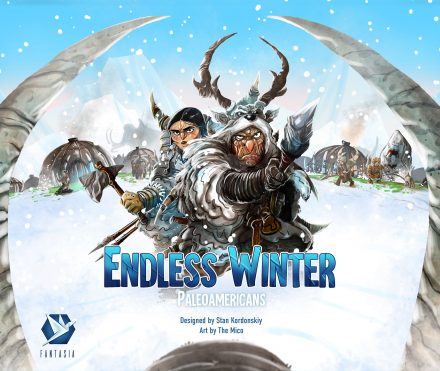
Endless Winter: Paleoamericans takes place in North America, around 10,000 BCE. Players guide the development of their tribes across several generations—from nomadic hunter-gatherers to prosperous tribal societies. Over the course of the game, tribes migrate and settle new lands, establish cultural traditions, hunt paleolithic megafauna, and build everlasting megalithic structures.

Endless Winter is a euro-style game that combines worker placement and deck building in an innovative way. Each round, players send their tribe members to various action spaces, and pay for the actions by playing cards and spending resources. Tribe cards grant additional labor, while Culture cards provide a variety of unique effects. As an alternative, cards can be saved for an end-of-round Eclipse phase, where they are simultaneously revealed to determine the new player order, and trigger various bonus actions.

The game features a novel blend of interwoven systems and mechanisms, such as multi-use cards, area influence, tile placement, and set collection. Plus, there are many viable paths to victory. After four brisk rounds, scores are tallied, and the tribe with the most points wins!

Endeavor: Age of Sail

In Endeavor: Age of Sail, players strive to earn glory for their empires. Sailing out from Europe and the Mediterranean, players will establish shipping routes and occupy cities the world over. As they do so, players will leverage their growing industry, culture, finance, and Influence, building their engine and extending their reach into the far-flung regions of the world.

In this second edition, players will experience:

  • Double-sided board to accommodate different player counts
  • Variable starting set ups with new buildings
  • Exploits to enhance the mechanisms and story of the different regions
  • Updated visuals by the original artist and graphic designer, Josh Cappel

Game Specifications:

  • 2 – 5 Players
  • 60 – 90 Minutes
  • Difficulty Weight 2.85

El Grande Big Box

In El Grande, players take on the roles of Grandes in medieval Spain. The king’s power is flagging, and these powerful lords are vying for control of the various regions. To that end, you draft caballeros (knights in the form of meeples) into your court and subsequently move them onto the board to help seize control of regions. After every third round, the regions are scored, and after the ninth round, the player with the most points is the winner.

In each of the nine rounds, you select one of your 13 power cards to determine turn order as well as the number of caballeros you get to move from the provinces (general supply) into your court (personal supply).

A turn then consists of selecting one of five action cards which allow variations to the rules and additional scoring opportunities in addition to determining how many caballeros to move from your court to one or more of the regions on the board (or into the castillo—a secretive tower). Normally, you may only place your caballeros into regions adjacent to the one containing the king’s pawn. The one hard and fast rule in El Grande is that nothing may move into or out of the king’s region. One of the five action cards that is always available each round allows you to move the king to a new region. The other four action cards vary from round to round.

The goal is to have a majority of caballeros in as many regions (and the castillo) as possible during a scoring round. Following the scoring of the castillo, you place any meeples you had stashed there into the region you had secretly indicated on your region dial. Each region is then scored individually according to a table printed in that region. Two-point bonuses are awarded for having sole majority in the region containing your Grande (large meeple) and in the region containing the king.

El Grande Big Box, the 20th anniversary edition of El Grande, includes all previously published expansions: Grand Inquisitor & ColoniesGrandissimoKing & IntrigantKing & Intrigant: Players’ Edition and King & Intrigant: Special Cards as well as something currently known only as the “Anniversary Extension”.

Game Mechanics:

[psot_tags]

Game Specifications:

  • 2 – 5 Players
  • ~90 Minutes
  • Difficulty Weight 2.80

Cyclades

In this latest collaboration between Bruno Cathala and Ludovic Maublanc, players must buy the favor of the gods in their race to be the first player to build two cities in the Ancient Greek island group known as the Cyclades.

Victory requires respect for all the gods – players cannot afford to sacrifice to only one god, but must pay homage to each of five gods in turn. Each turn, the players bid for the favors of the gods, as only one player can have the favor of each god per turn – and each player is also limited to the favor of a single god per turn.

  • Ares allows the movement of player armies and the building of Fortresses.
  • Poseidon allows players to move their navies and build Ports.
  • Zeus allows his followers to hire priests and build temples.
  • Athena provides her worshipers with philosophers and universities.
  • Apollo increases the income of his worshipers.

Game Mechanics:

  • Area Majority / Influence
  • Auction/Bidding
  • City Building
  • Civilization
  • Dice Rolling
  • Open Drafting
  • Set Collection

Game Specifications:

  • 2 – 5 Players
  • 60 – 90 Minutes
  • Difficulty Weight 2.82

Court of the Dead: Mourner’s Call

Everyone is already dead in the Underworld. It’s time to join the factions of Bone, Flesh and Spirit as they work to achieve the goal of the Underworld: to gather enough forces to take on the celestials of Heaven and Hell to end their ceaseless war. If the players work diplomatically in Court of the Dead: Mourners Call to maintain a balance, they can ensure the Underworld survives long enough for them to also complete their collective and hidden individual objectives. The player who best contributes to these goals will earn Death’s favor and a place among the elite of the Underworld.

You are a Mourner — an allegiant of Death — dedicated to realizing his noble ambition to end the celestial war and restore balance to the universe. However, Death’s purpose includes your own ulterior motives. You and your fellow Mourners must unite and rise, or fall together. But only one Mourner will achieve their particular vision of the Underworld united. Your task will not be easy. While the Underworld is united in its purpose, it is divided in its strategy to achieve that aim. There are three factions in the Land of the Dead: Bone, Flesh, Spirit. Each is a unique path to rise up against Heaven and Hell.

You will need to strategically manipulate your influence within these factions, their strongholds and guilds, and within the Court of the Dead if you wish to achieve your ends. But beware: The power within mortal souls — known as Etherea — is a perilous substance. Use it carelessly, and you risk invoking the Dreadsgrip – a destructive force within every Mourner that consumes all it touches, including its former master. Failing to satiate the celestials’ war need, or triggering the Dreadsgrip, has dire consequences for all Mourners. Are you strong enough to achieve your own ambitions and be the champion for the uniting force for which all Mourners Call?

Game Mechanics:

  • Area Majority / Influence
  • Auction / Bidding
  • Closed Drafting
  • Contracts
  • Hand Management
  • Open Drafting
  • Take That
  • Worker Placement

Game Specifications:

  • 2 – 5 Players
  • ~90 Minutes
  • Difficulty Weight 2.95

Council of Shadows

It’s the year 2200. We’re on the edge of the known universe, and a race for a seat on the mighty Council of Shadows is in full swing, with four civilizations vying for admission. Only those who provide more energy to the council each turn and outdo themselves will be successful.

In Council of Shadows, you take on the role of one of these four civilizations, secure the strongest actions, take control of important areas, and be the first to make three quantum leaps. This is how you win the race for planets and raw materials and become part of the Council of Shadows!

Game Mechanics:

  • Area Majority / Influence

Game Specifications:

  • 1 – 4 Players
  • 60 – 90 Minutes
  • Difficulty Weight 3.14

Cellulose: A Plant Cell Biology Game

Cellulose: A Plant Cell Biology Game is a worker placement game that puts 1-5 players inside a plant cell, where they will compete over limited resources in order to undergo photosynthesis, produce carbohydrates, and build the cell wall. With everyone vying for the same actions, players must time their use of proteins, hormones, and cell component cards in order to diversify their strategies and outplay the competition.

Cellulose is the standalone sequel to Cytosis (2017). It has some of the same DNA, but Cellulose expands familiar game systems, allowing players greater control over available resources, strategic paths, and even game length.

Game Mechanics:

  • Area Majority / Influence
  • Set Collection
  • Solo / Solitaire Play
  • Tech Trees / Tech Tracks
  • Worker Placement

Game Specifications:

  • 1 – 5 Players
  • 45 – 90 Minutes
  • Difficulty Weight 2.55

Blood Rage

“Life is Battle; Battle is Glory; Glory is ALL”

In Blood Rage, each player controls their own Viking clan’s warriors, leader, and ship. Ragnarök has come, and it’s the end of the world! It’s the Vikings’ last chance to go down in a blaze of glory and secure their place in Valhalla at Odin’s side! For a Viking there are many pathways to glory. You can invade and pillage the land for its rewards, crush your opponents in epic battles, fulfill quests, increase your clan’s stats, or even die gloriously either in battle or from Ragnarök, the ultimate inescapable doom.

Most player strategies are guided by the cards drafted at the beginning of each of the three game rounds (or Ages). These “Gods’ Gifts” grant you numerous boons for your clan including: increased Viking strength and devious battle strategies, upgrades to your clan, or even the aid of legendary creatures from Norse mythology. They may also include various quests, from dominating specific provinces, to having lots of your Vikings sent to Valhalla. Most of these cards are aligned with one of the Norse gods, hinting at the kind of strategy they support. For example, Thor gives more glory for victory in battle, Heimdall grants you foresight and surprises, Tyr strengthens you in battle, while the trickster Loki actually rewards you for losing battles, or punishes the winner.

Players must choose their strategies carefully during the draft phase, but also be ready to adapt and react to their opponents’ strategies as the action phase unfolds. Battles are decided not only by the strength of the figures involved, but also by cards played in secret. By observing your opponent’s actions and allegiances to specific gods, you may predict what card they are likely to play, and plan accordingly. Winning battles is not always the best course of action, as the right card can get you even more rewards by being crushed. The only losing strategy in Blood Rage is to shy away from battle and a glorious death!

Game Mechanics:

  • Area Majority / Influence
  • Closed Drafting
  • Hand Management
  • Memory
  • Open Drafting
  • Take That

Game Specifications:

  • 2 – 4 Players
  • 60 – 90 Minutes
  • Difficulty Weight 2.88

Beyond the Sun

Beyond the Sun is a space civilization game in which players collectively decide the technological progress of humankind at the dawn of the Spacefaring Era, while competing against each other to be the leading faction in economic development, science, and galactic influence.

The game is played over a variable number of rounds until a number of game-end achievements are collectively claimed by the players. The winner is the faction with the most victory points, which are obtained by researching technologies, improving their economy, controlling and colonizing systems, and completing various achievements and events throughout the game.

On a turn, a player moves their action pawn to an empty action space, then takes that action. They then conduct their production phase, either producing ore, growing their population, or trading one of those resources for another. Finally, they can claim up to one achievement, if possible.

As players take actions, they research new technologies that come in four levels. Each technology is one of four types (scientific, economic, military, commercial), and higher-level technologies must match one of the types of tech that lead into it. Thus, players create their own technology tree in each game, using these actions to increase their military strength, to jump to different habitable exoplanetary systems, to colonize those systems, to boost their resource production, to develop android tech that allows growth without population, and more.

Game Specifications:

  • 2 – 4 Players
  • 60 – 120 Minutes
  • Difficulty Weight 3.14

Ankh: Gods of Egypt 🟡

Play as a god of ancient Egypt, competing to survive as society begins to forget the old ways, so that only you and your followers remain.

Build caravans, summon monsters, and convert followers in your quest to reign supreme in Ankh: Gods of Egypt. Deities, monsters, and the people of ancient Egypt have been lovingly reimagined and interpreted in beautiful illustrations and detailed miniatures, and players will truly feel like gods as they shake the very foundations of Egypt. All gameplay in Ankh, including combat, is streamlined and non-random. Compete and win solely on your godly wits alone.

Game Specifications:

  • 2 – 5 Players
  • ~90 Minutes
  • Difficulty Weight 3.12