Tag: Grid Movement

Grid Movement is a game mechanic where game pieces move on a predetermined grid in various patterns.

Kingdom Builder: Big Box

Kingdom Builder: Big Box

Kingdom Builder: Big Box

In Kingdom Builder, the players create their own kingdoms by skillfully building their settlements, aiming to earn the most gold at the end of the game.

Nine different kinds of terrain are on the variable game board, including locations and castles. During his turn, a player plays his terrain card and builds three settlements on three hexes of this kind. If possible, a new settlement must be built next to one of that player’s existing settlements. When building next to a location, the player may seize an extra action tile that he may use from his next turn on. These extra actions allow extraordinary actions such as moving your settlements.

By building next to a castle, the player will earn gold at the end of the game, but the most gold will be earned by meeting the conditions of the three Kingdom Builder cards; these three cards (from a total of ten in the game) specify the conditions that must be met in order to earn the much-desired gold, such as earning gold for your settlements built next to water hexes or having the majority of settlements in a sector of the board.

Each game, players will use a random set of Kingdom Builder cards, special actions, and terrain sectors to build the map!

Game Mechanics:

  • Area Control
  • City Building
  • Grid Movement
  • Network Building

Game Specifications:

  • 2 – 5 Players
  • ~45 Minutes
  • Difficulty Weight 2.34

Juicy Fruits

Juicy Fruits

Juicy Fruits

Each player has their own small island paradise where they grow delicious fruit. To win, you must gain the most points by cleverly supplying ships and by adding the best businesses to your island.

Your turn in Juicy Fruits works like this: First, you slide one of your fruit collector tokens a number of unblocked spaces and collect that many fruits of the token’s type: banana, orange, lime, pomegranate, or mangosteen. Then you may either fulfill the order of a ship on your shores or claim a business from a shared display and place it onto your island (or do nothing). Clever planning and timing is vital because until you supply the ships on your shores, they block valuable island space which could be used to collect more fruit — but if you concentrate too much on the ships, the most promising businesses may get snatched by your opponents. Also, the sooner businesses are claimed, the quicker the game might end.

With each play, Juicy Fruits poses new puzzles of how to move your tokens efficiently and how to balance clearing your island with claiming businesses. The game also includes an additional “juice factory” mode and four modes of solo play.

Game Mechanics:

  • Area Movement
  • Economic
  • Grid Movement
  • Tile Placement

Game Specifications:

  • 1 – 4 Players
  • 20 – 50 Minutes
  • Difficulty Weight 2.00

Istanbul

Istanbul

Istanbul

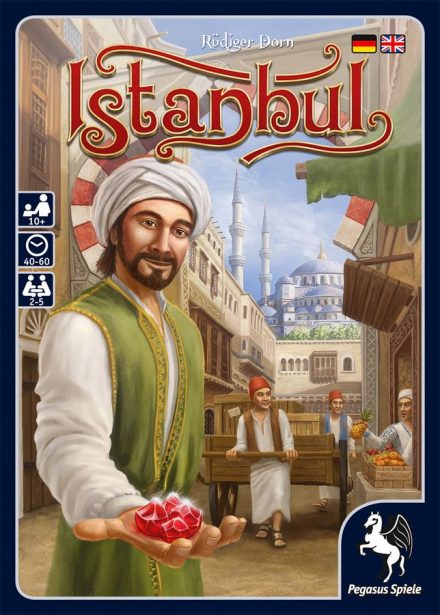
There’s hustle and bustle at Istanbul’s grand bazaar as merchants and their assistants rush through the narrow alleys in their attempt to be more successful than their competitors. Everything must be well organized: wheelbarrows must be filled with goods at the warehouses, then swiftly transported by the assistants to various destinations. Your goal? Be the first merchant to collect a certain number of rubies.

In Istanbul, you lead a group of one merchant and four assistants through 16 locations in the bazaar. At each such location, you can carry out a specific action. The challenge, though, is that to take an action, you must move your merchant and an assistant there, then leave the assistant behind (to handle all the details while you focus on larger matters). If you want to use that assistant again later, your merchant must return to that location to pick him up. Thus, you must plan ahead carefully to avoid being left with no assistants and thus unable to do anything…

In more detail, on a turn you move your merchant and his retinue of assistants one or two steps through the bazaar, either leave an assistant at that location or collect an assistant left earlier, then perform the action. If you meet other merchants or certain individuals at the location, you might be able to take a small extra action. Possible actions include:

  • Paying to increase your wheelbarrow capacity, which starts the game with a capacity of only two for each good.
  • Filling your wheelbarrow with a specified good to its limit.
  • Acquiring a special ability, and the earlier you come, the easier they are to collect.
  • Buying rubies or trading goods for rubies.
  • Selling special combinations of goods to make the money you need to do everything else.

When a merchant has collected five rubies in his wheelbarrow, players complete that round, then the game ends. If this player is the only one who’s reached this goal, he wins immediately; otherwise ties are broken by money in hand.

Game Mechanics:

  • Dice Rolling
  • Economic
  • Grid Movement
  • Network Building
  • Pick-Up and Deliver
  • Racing
  • Worker Placement

Game Specifications:

  • 2 – 5 Players
  • 40 – 60 Minutes
  • Difficulty Weight 2.59

Habitats

Habitats

Habitats

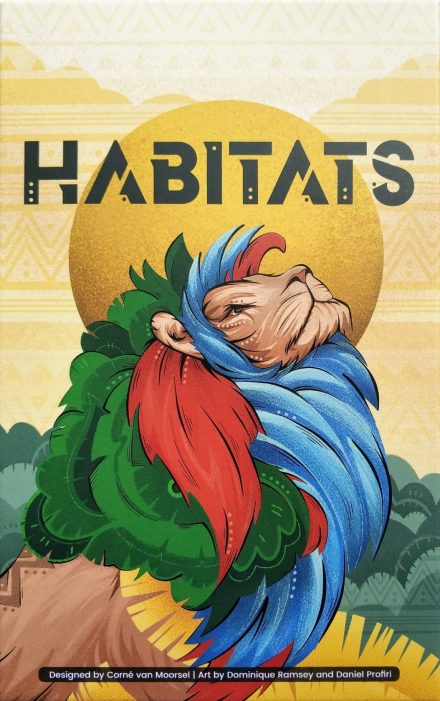
In Habitats, each player builds a big wildlife park without cages or fences. The animals in your park need their natural habitats: grassland, bush, rocks or lakes. The zebra needs a big area of grass and some water adjacent, for example, while a bat needs rocks and bush and water, a hart needs bush and grass, and a crocodile needs mainly water. There is a snake, baboon, bee, elephant, otter, lizard, turtle, eagle, meerkat, scorpio, hog, catfish, rhino, etc., each with its own landscape requirements — 68 different animals in total.

Each player starts their individual park with an entrance tile, and they are each represented in the marketplace of animal tiles by a ceramic figure (or a wooden ranger meeple in some editions). On a turn, a player takes the tile to their left, right or front; moves their figure to the space just vacated; then draws a tile to place where their figure started the turn.

When adding an animal tile in your park, you add its main landscape — the base space for the animal — to your park, too. While placing this new animal, its own piece of landscape can help to fulfill the requirements of your other animals’ requirements, e.g., the water on a hippo tile fulfilling the adjacent otter’s need for water. Thus, fulfilling every animal’s desire for land becomes a more and more difficult task with each tile you add.

Aside from expanding your park with different landscape types, flora and animals, you can improve its profitability by building extra entrance roads, trek spots, and watchtowers.

Habitats lasts three seasons, with each season giving each player 6-9 new tiles for their parks. Whoever has best met the goal of the season receives bonus points, with a smaller number of points for second and third place. At the end of the game, each player scores for each tile in their park based on whether that tile’s requirements are satisfied. Whoever scores the most points wins!

Game Mechanics:

  • Grid Movement
  • Open Drafting
  • Pattern Building
  • Puzzle
  • Tile Placement

Game Specifications:

  • 2 – 5 Players
  • 30 – 50 Minutes
  • Difficulty Weight 2.25

Gods Love Dinosaurs REDO TAGS TO HERE

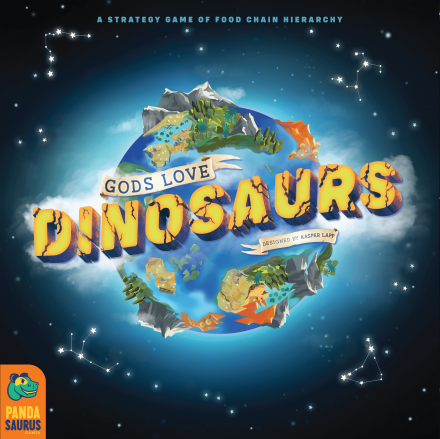
How do you make an ecosystem flourish with just enough of every life form in the chain to supply you with dinosaurs to dominate the lands? Resources are scarce, animals can go extinct in an area, and everyone must eat to survive — so moves must be cunning. Life hangs in the balance…

In Gods Love Dinosaurs, a cheeky, wild, and timeless take on the scientific tale as old as life itself, you are a god who has been tasked with designing an ecosystem with a sustainable food chain of predator and prey animals. But you just love dinosaurs, so all you really want to do is to make as many of them as possible!

Each turn, you’ll add one tile to your ecosystem, which will add new animals and give them room to grow. Every so often, your dinosaurs will tromp around your ecosystem eating all the animals. The more they eat, the more eggs they lay — and the more points you score! Just be careful not to overeat, or there won’t be enough food to keep your dinosaurs alive the next time.

Game Specifications:

  • 2 – 5 Players
  • 30 – 45 Minutes
  • Difficulty Weight 2.26

Arcadia Quest

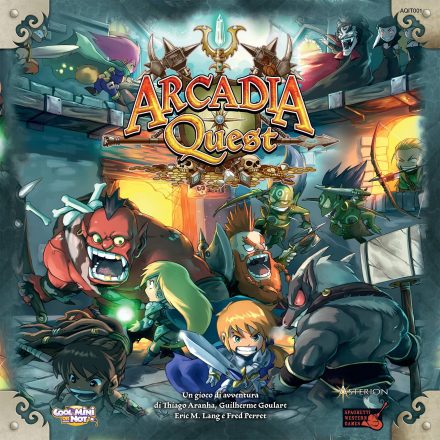
In Arcadia Quest, players lead guilds of intrepid heroes on an epic campaign to dethrone the vampire lord and reclaim the mighty Arcadia for their own. But only one guild may lead in the end, so players must battle against each other as well as against the monstrous occupying forces.

Arcadia Quest is a campaign-based game for 2 to 4 players, where each player controls a guild of three unique heroes, facing off against the other players and the various monsters controlled by the game. Players need to accomplish a series of quests in order to win each scenario and choose where to go next in the campaign.

Players are able to choose the path their campaign takes, navigating through six out of eleven available scenarios, so each time the campaign is played it can have a different configuration of scenarios. As the campaign progresses, the heroes are able to acquire new weapons, equipment and abilities that give them powerful options to tackle the obstacles ahead. Furthermore, by fulfilling specific quests in a scenario, players unlock exclusive features in subsequent scenarios.

Game Specifications:

  • 2 – 4 Players
  • ~60 Minutes
  • Difficulty Weight 2.53

Adventure Land 🟢

In Adventure Land, King Agamis rules from his castle. Rich cities, vast forests and rugged mountain ranges dominate the country. The large river is known to be lined with gold and the forests filled with medicinal herbs, but dangers lurk beneath the fog! Only the bravest adventurers dare to face the challenges. When you move your adventurer tactically and bravely fight the fog creatures, you’ll win the favor of the king. Illustrated by Franz Vohwinkel and designed by acclaimed duo Wolfgang Kramer and Michael Kiesling who between them have won the highly coveted Spiel des Jahres award 5 times.

Game Specifications:

  • 2 – 4 Players
  • ~45 Minutes
  • Difficulty Weight 1.84

Thrive

Thrive

Thrive

Thrive is a two-player abstract strategy game with incredibly simple rules that grows in complexity as you play.

You play as one of two lotus flowers, competing to control the pond. Be the first to capture all but one of your opponent’s seed pods and win this game of tactical decision making!

Each turn you move a piece, then add two additional pegs to any of your pieces, giving them more possibilities for movement on future turns.

Game Mechanics:

  • Abstract Strategy
  • Grid Movement

Game Specifications:

  • 2 Players
  • 20 – 30 Minutes
  • Difficulty Weight 1.56

Survive: Escape from Atlantis!

Survive: Escape from Atlantis!

Survive: Escape from Atlantis!

Survive is a cutthroat game where players seek to evacuate their pieces from an island that is breaking up, while remembering where their highest-valued pieces are located to maximize their score.

An island made up of 40 hex-tiles is slowly sinking into the ocean (as the tiles are removed from the board). Each player controls ten people (valued from 1 to 6) that they try and move towards the safety of the surrounding islands before the main island finally blows up. Players can either swim or use boats to travel but must avoid sea serpents, whales and sharks on their way to safety.

Game Mechanics:

  • Action Points
  • Bluffing
  • Dice Rolling
  • Grid Movement
  • Memory
  • Take That

Game Specifications:

  • 2 – 4 Players
  • 45 – 60 Minutes
  • Difficulty Weight 1.70

Scooby Doo! Betrayal at Mystery Mansion

Scooby Doo! Betrayal at Mystery Mansion

Scooby Doo! Betrayal at Mystery Mansion

Based on the award-winning Betrayal at House on the Hill board game, Betrayal at Mystery Mansion is the mash-up fans have been clamoring for!

Play as Scooby-Doo, Shaggy, Velma, Daphne, or Fred as you explore the mansion and its grounds, finding clues, encountering strange occurrences, and maybe even catching sight of a monster! When you find enough clues to learn what’s really going on, that’s when the haunt starts, and one player will switch sides to play the role of the monster! Will you be able to stop them before they carry out their sinister plan?

Betrayal at Mystery Mansion contains 25 new haunts based on popular episodes and movies from the Scooby-Doo oeuvre, with different monsters, items, events, and locations each time you play.

Game Mechanics:

  • Dice Rolling
  • Grid Movement
  • Role Playing
  • Storytelling
  • Team Based
  • Tile Placement

Game Specifications:

  • 3 – 5 Players
  • 25 – 50 Minutes
  • Difficulty Weight 1.80