Category: Beginner Games

Camel Up

In Camel Up, up to eight players bet on five racing camels, trying to suss out which will place first and second in a quick race around a pyramid. The earlier you place your bet, the more you can win — should you guess correctly, of course. Camels don’t run neatly, however, sometimes landing on top of another one and being carried toward the finish line. Who’s going to run when? That all depends on how the dice come out of the pyramid dice shaker, which releases one die at a time when players pause from their bets long enough to see who’s actually moving!

Game Mechanics:

  • Betting
  • Variable Set-up

Game Specifications:

  • 3 – 8 Players
  • 30 – 45 Minutes
  • Difficulty Weight 1.50

Blokus

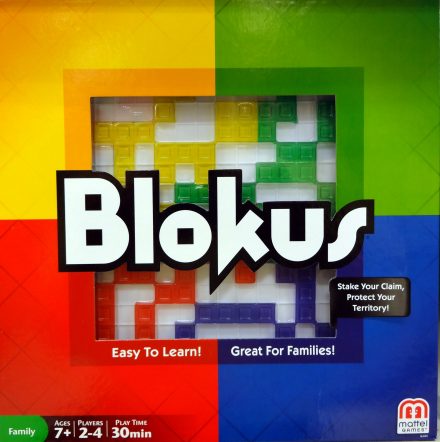
Blokus (officially pronounced “Block us”) is an abstract strategy game with transparent, Tetris-shaped, colored pieces that players are trying to play onto the board. The only caveat to placing a piece is that it may not lie adjacent to your other pieces, but instead must be placed touching at least one corner of your pieces already on the board.

There is a solitaire variation where one player tries to get rid of all the pieces in a single sitting.

Game Mechanics:

  • Hand Management
  • Tile Placement

Game Specifications:

  • 2 – 4 Players
  • ~20 Minutes
  • Difficulty Weight 1.74

Best Treehouse Ever: Forest of Fun

It’s time to build another treehouse!

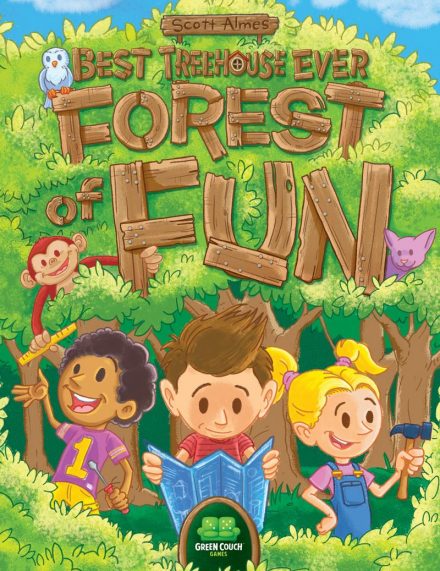
In the new stand alone sequel to the Golden Geek Nominated Best Treehouse Ever (Best Card Game, Best Family Game, 2015), Best Treehouse Ever: Forest of Fun, players compete to build their best treehouse, outfitting their treehouse with cool rooms, and creating fun habitats for their favorite furry and feathered friends, while also making sure that their tree doesn’t tip over and that their rooms are more impressive than all of their friends’ rooms at the end of the game.

In addition, our treehouse builders have leveled up their experience by visiting new locations in the forest that provide special abilities to help them in their new build.

Building takes place over three weeks/rounds, and in each round, players use card drafting and spatial reasoning to add five new rooms to their treehouse. Players must pay attention to the other treehouses being built since they take turns determining which types of rooms score for everyone at the end of each round.

At the end of the third week, the winner is the player with the best treehouse ever!

Game Specifications:

  • 1 – 4 Players
  • 20 – 30 Minutes
  • Difficulty Weight 1.50

Azul: Master Chocolatier TAGS, EXCERPT, POST TAGS

In the game Azul, players take turns drafting colored tiles from suppliers to their player board. Later in the round, players score points based on how they’ve placed their tiles to decorate the palace. Extra points are scored for specific patterns and completing sets; wasted supplies harm the player’s score. The player with the most points at the end of the game wins.

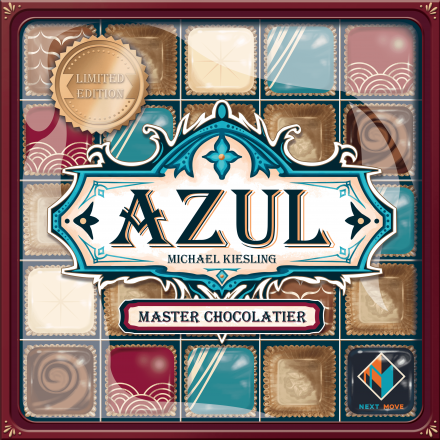
Azul: Master Chocolatier includes double-sided factory boards, with these tiles being placed on these boards at the start of each round. One side of the factories is blank, and when using this side the game plays exactly like Azul. The other side of each factory tile has a special effect on it that modifies play in one way or another, putting a twist on the normal game. Additionally, the tiles are modeled to look like chocolates and other treats, despite remaining as inedible as the tiles in the original game.

Game Specifications:

  • 2 – 4 Players
  • 30 – 45 Minutes
  • Difficulty Weight 1.79

Azul

Introduced by the Moors, azuleijos (originally white and blue ceramic tiles) were fully embraced by the Portuguese when their king Manuel I, on a visit to the Alhambra palace in Southern Spain, was mesmerized by the stunning beauty of the Moorish decorative tiles. The king, awestruck by the interior beauty of the Alhambra, immediately ordered that his own palace in Portugal be decorated with similar wall tiles. As a tile-laying artist, you have been challenged to embellish the walls of the Royal Palace of Evora.

In the game Azul, players take turns drafting colored tiles from suppliers to their player board. Later in the round, players score points based on how they’ve placed their tiles to decorate the palace. Extra points are scored for specific patterns and completing sets; wasted supplies harm the player’s score. The player with the most points at the end of the game wins.

Akropolis 🔵

The most talented architects in ancient Greece stand ready to achieve this goal. Build housing, temples, markets, gardens and barracks, so you can grow your city and ensure it triumphs over the others. Raise its prestige with harmonious planning that conforms to specific rules, and enhance it by building plazas.

Stone is an essential resource, so make sure you do not neglect it. You’ll need enough quarries so you can build higher up, making your city stretch towards the sky.

  1. Choose a tile from the construction site
  2. Arrange it in your city to unlock each district’s full potential
  3. Build on higher levels, increase the value of your districts and win the game

7 Wonders: Architects 🔵

In 7 Wonders: Architects, 2-7 players race to become a leader of the ancient world by completing an architectural wonder that will last through the ages.

Players receive an unconstructed wonder at the beginning of the game and must collect resources to build their society, develop military might to navigate conflicts, oversee resource management, research science improvements, and collect civil victory points as they race to leave their mark on world history.

Game Specifications:

  • 2 – 7 Players
  • ~25 Minutes
  • Difficulty Weight 1.40

5-Minute Mystery 🔵

5-Minute Mystery is a high-intensity, deductive, mystery game in which players work together to find a culprit hidden in a line-up of suspects.

Just moments before the Museum of Everything was set to unveil its newest exhibit, the priceless MacGuffin, some criminal snuck in and stole it! Now it’s up to you, a team of detectives, to crack the case, find the culprit, and recover the missing MacGuffin.

Start by searching for hidden symbols in each room of the museum and find the matching symbols on the codex. Once you’ve found all of the symbols in the room, you’ll unlock a clue about the culprit.

Match the barcode of the clue tile against the culprit tile to discover valuable information about the crook. Does the miscreant have an umbrella? No? Well, that eliminates the shifty Mr. Braxton, doesn’t it? Quickly sort through the suspect cards in your hand to narrow down who the criminal can be.

You’ll have to make it through as many rooms as it takes to figure out exactly who is responsible for stealing the MacGuffin, but remember, time is not on your side!

Case files change the rules to each time you play, making every game a new challenge.

Do you have what it takes to be the detective to crack the case and solve this five-minute mystery? Only time will tell!

Game Specifications:

  • 1 – 6 Players
  • 5 – 30 Minutes
  • Difficulty Weight 1.18

5-Minute Dungeon 🔵

5-­Minute Dungeon is a chaotic, co-­operative, real-­time card game in which players have only five minutes to escape the randomized dungeon. Communication and teamwork are critical to survival because there’s no time to form a carefully considered plan — and no predicting what dangers lie ahead.

In more detail, players assume the role of one of ten heroes, each with special cards and abilities. Once the five-minute timer starts, the race is on to defeat all the monsters inside the dungeon. In order to defeat a monster, players must match symbols from their hand with ones on the monster’s card. At the end of each dungeon is a powerful dungeon boss — and after the first boss is defeated, the campaign continues to the second boss. Each boss, and each randomized dungeon, gets harder until players reach the fifth and final boss.

18 Holes 🟦

A beautiful drive down the fairway is a satisfying feeling. And yet, beyond the trees, you spy an alternative. A short-cut to the green. Do you take the chance? Hit off-course on purpose in this golf-themed board game for 1 to 5 players. With some clever thinking, you’ll be able to turn bad luck into the perfect shot.

In 18 Holes, you’ll design and build the course, you’ll draft for clubs and you’ll compete on course to win. Every hole is an opportunity to outplay your opponents and reach the green first. Play solo or with two to five players either around the table or remote using our companion app.

Every game of 18 Holes plays on a new course. Design it together or go online to the 18 Holes Clubhouse and play a course created by another player. With 49 different double-sided tiles, course-adjustment tiles and eight different game modes (including solo and two player). 18 Holes lets you tailor the playing experience to suit your crowd.

Game Specifications:

  • 1 – 5 Players
  • 30 – 60 Minutes
  • Difficulty Weight 1.81