posts page

Blood on the Clocktower

In the quiet village of Ravenswood Bluff, ‌a demon walks amongst you…

During a hellish thunderstorm, on the stroke of midnight, there echoes a bone-chilling scream. The townsfolk rush to investigate and find the town storyteller murdered, their body impaled on the hands of the clocktower, blood dripping onto the cobblestones below. A Demon is on the loose, murdering by night and disguised in human form by day. Some have scraps of information. Others have abilities that fight the evil or protect the innocent. But the Demon and its evil minions are spreading lies to confuse and breed suspicion. Will the good townsfolk put the puzzle together in time to execute the true demon and save themselves? Or will evil overrun this once peaceful village?

Blood on the Clocktower is a bluffing game enjoyed by 5 to 20 players on opposing teams of Good and Evil, overseen by a Storyteller player who conducts the action and makes crucial decisions. The goal of the game is to successfully deduce and execute the demons before they outnumber the townfolk.

During a ‘day’ phase players socialize openly and whisper privately to trade knowledge or spread lies, culminating in a player’s execution if a majority suspects them of being Evil. Of a ‘night’ time, players close their eyes and are woken one at a time by the Storyteller to gather information, spread mischief, or kill.

The Storyteller uses the game’s intricate playing pieces to guide each game, leaving others free to play without a table or board. Players stay in the thick of the action to the very end even if their characters are killed, haunting Ravenswood Bluff as ghosts trying to win from beyond the grave.

If you arrive late to a game, you can enter after it’s started as a powerful Traveller character with unusual talents and questionable allegiances. Each character comes with their own special ability and no two players in a game are ever the same character.

Game Mechanics:

  • Bluffing
  • Deduction
  • Hidden Roles
  • Negotiation
  • Team-Based Game
  • Variable Player Powers
  • Voting

Game Specifications:

  • 6 – 21 Players
  • 30 – 120 Minutes
  • Difficulty Weight 3.03

The Big Book of Madness

The Big Book of Madness

The Big Book of Madness

So far your first year at the Elementary College has been slightly disappointing. They taught you to light a flickering flame at the tip of your finger, but other than that you’ve spent much more time reading books than learning powerful spells as future great wizards like you should.

So when you heard about the Big Book of Madness hidden in the great school library, you couldn’t help but to sneak in and peek in this intriguing tome in spite of your professors’ warnings. When you slowly lift the cover of the terrible book, dozens of dreadful creatures rush out, threatening to destroy the world itself! This was your mistake, and only you can fix it now! Learn from the library to fight back against the monsters, and try not to sink into insanity…

The Big Book of Madness is a challenging co-operative game in which the players are magic students who must act as a team to turn all the pages of the book, then shut it by defeating the terrible monsters they’ve just freed.

Each player has their own element deck that they build during the game and use for several purposes, such as learning or casting a spell, adding a new element to their deck, destroy or healing a curse. Spells allow you to support your playmates, improve your deck, draw cards, etc. — but the monsters from the book fight back. Each comes with terrible curses that are triggered every turn unless you dispel them in time. They will make you discard elements, add madness cards to your deck, or lose spells…

If you manage to turn six pages and defeat all of the monsters, you win the game!

Game Mechanics:

  • Cooperative
  • Deck Building
  • Hand Managment
  • Player Elimination

Game Specifications:

  • 2 – 5 Players
  • 60 – 90 Minutes
  • Difficulty Weight 2.68

Beyond the Sun

Beyond the Sun is a space civilization game in which players collectively decide the technological progress of humankind at the dawn of the Spacefaring Era, while competing against each other to be the leading faction in economic development, science, and galactic influence.

The game is played over a variable number of rounds until a number of game-end achievements are collectively claimed by the players. The winner is the faction with the most victory points, which are obtained by researching technologies, improving their economy, controlling and colonizing systems, and completing various achievements and events throughout the game.

On a turn, a player moves their action pawn to an empty action space, then takes that action. They then conduct their production phase, either producing ore, growing their population, or trading one of those resources for another. Finally, they can claim up to one achievement, if possible.

As players take actions, they research new technologies that come in four levels. Each technology is one of four types (scientific, economic, military, commercial), and higher-level technologies must match one of the types of tech that lead into it. Thus, players create their own technology tree in each game, using these actions to increase their military strength, to jump to different habitable exoplanetary systems, to colonize those systems, to boost their resource production, to develop android tech that allows growth without population, and more.

Game Mechanics:

  • Area Majority / Influence
  • Worker Placement

Game Specifications:

  • 2 – 4 Players
  • 60 – 120 Minutes
  • Difficulty Weight 3.14

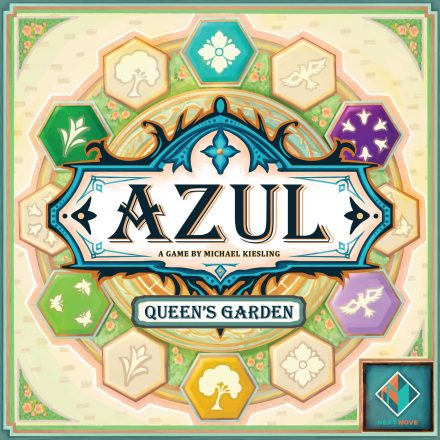
Azul: Queen’s Garden

Welcome back to the palace of Sintra! King Manuel I has commissioned the best garden designers of Portugal to construct the most extraordinary garden for his wife, Queen Maria of Aragon.

In Azul: Queen’s Garden, players are tasked with arranging a magnificent garden for the King’s lovely wife by arranging beautiful plants, trees, and ornamental features.

Using an innovative drafting mechanism, the signature of the Azul series, players must carefully select colorful tiles to decorate their garden. Only the most incredible garden designers will flourish and win the Queen’s blessing.

Game Mechanics:

  • Open Drafting
  • Pattern Building
  • Set Collection
  • Tile Placement

Game Specifications:

  • 2 – 4 Players
  • 45 – 60 Minutes
  • Difficulty Weight 2.94

Axis & Allies

Axis and Allies is the most successful of Milton Bradley’s Gamemaster series.

It depicts WWII on a grand scale, full global level. Up to five players can play on two different teams. The Axis which has Germany and Japan, and the Allies which has the USA, the United Kingdom, and the USSR. A full map of the world is provided, broken up in various chunks similar to Risk. The game comes with gobs of plastic miniatures that represent various military units during WWII. Players have at their disposal infantry, armor, fighters, bombers, battleships, aircraft carriers, submarines, troop transports, anti-air guns, and factories. All of the units perform differently, and many have special functions. Players have to work together with their teammates in order to coordinate offenses and decide how best to utilize their production points. Players also have the option of risking production resources on the possibility of developing a super technology that might turn the tide of war.

Game Mechanics:

  • Area Movement
  • Dice Rolling
  • Economic
  • Team Based
  • Wargame

Game Specifications:

  • 2 – 5 Players
  • ~180 Minutes
  • Difficulty Weight 3.04

Atiwa

The Atiwa Range is a region of southeastern Ghana in Africa consisting of steep-sided hills with rather flat summits. A large portion of the range comprises an evergreen forest reserve, which is home to many endangered species. However, logging and hunting for bushmeat, as well as mining for gold and bauxite, are putting the reserve under a lot of pressure.

Meanwhile, in the nearby town of Kibi, the mayor is causing a stir by giving shelter to a large number of fruit bats in his own garden. This man has recognized the great value the animals have in deforested regions of our planet: Fruit bats sleep during the day and take off at sunset in search of food, looking for suitable fruit trees up to sixty miles away. They excrete the seeds of the consumed fruit, disseminating them across large areas as they fly home. A single colony of 150,000 fruit bats can reforest an area of up to two thousand acres a year.

Just like that mayor, in Atiwa, you know that fruit bats — once scorned and hunted as mere fruit thieves — are in fact incredibly useful animals, spreading seeds over large areas of the country. By doing so, they help to reforest fallow land and, in the medium term, improve harvests. This realization has led to a symbiotic co-operation between fruit bats and fruit farmers. The animals are kept as “pets” to increase the size of fruit farms more quickly. Tall trees are left as roosts, providing shelter for them rather than hunting them for their scant meat. However, if you have a lot of fruit bats, you need a lot of space…

In the game, you will develop a small community near the Atiwa Range, creating housing for new families and sharing your newly gained knowledge on the negative effects of mining and the importance that the fruit bats have for the environment. You must acquire new land, manage your animals and resources, and make your community prosper. The player who best balances the needs of their community and the environment wins.

Game Mechanics:

  • Economic
  • Worker Placement

Game Specifications:

  • 1 – 4 Players
  • 30 – 120 Minutes
  • Difficulty Weight 2.75

Anno 1800 🟡

In Anno 1800, a board game based on the popular PC game from Ubisoft, you continuously build up your own industry to develop your home island.

Ship fleets allow for lively trade and the development of new islands in the Old and New World. You have to fulfill the wishes of your own population. While the inhabitants are initially satisfied with bread and clothing, they soon demand valuable luxury goods. You must plan production chains sensibly and keep an eye on the specialization of your population. The goal: A wise distribution of farmers, workers, craftsmen, engineers, and investors — but the competition never sleeps and can snatch the new achievements from under your nose at any time! Who can create the most prosperous island?

Game Mechanics:

  • End Game Bonuses
  • Hand Management
  • Race
  • Tech Trees / Tech Tracks
  • Variable Set-up
  • Worker Placement

Game Specifications:

  • 2 – 4 Players
  • ~120 Minutes
  • Difficulty Weight 3.12

Ankh: Gods of Egypt 🟡

Play as a god of ancient Egypt, competing to survive as society begins to forget the old ways, so that only you and your followers remain.

Build caravans, summon monsters, and convert followers in your quest to reign supreme in Ankh: Gods of Egypt. Deities, monsters, and the people of ancient Egypt have been lovingly reimagined and interpreted in beautiful illustrations and detailed miniatures, and players will truly feel like gods as they shake the very foundations of Egypt. All gameplay in Ankh, including combat, is streamlined and non-random. Compete and win solely on your godly wits alone.

Game Mechanics:

  • Area Majority / Influence
  • Auction: Sealed Bid
  • Grid Movement
  • Player Elimination
  • Race
  • Variable Player Powers

Game Specifications:

  • 2 – 5 Players
  • ~90 Minutes
  • Difficulty Weight 3.12

The Ancient World

The Ancient World

The Ancient World

In an ancient world forgotten by time, enormous titans terrorize the land. Five tribes have been fleeing from the titans for centuries, but things are about to change. Growing city-states pledge to end the reign of terror, determined to take on the titans and make the world a safer place for all. Each city-state competes to attract the tribes, eager for the strength of the combined peoples, who are now leaving behind old traditions with the hope that the titans can be defeated once and for all.

In The Ancient World, players compete to grow the largest and most influential city-state by managing citizens, treasury, and military and by defeating titans. Players take turns sending citizens to take special actions or using military cards to attack titans. One of the actions a citizen can perform is to build Empire cards, which give more citizens, money, and abilities.

A city-state’s influence in the world is measured by sets of tribe banners that it owns. Each Empire card has one or more tribe banners, and tribe banners can also be gained by defeating titans. Players gain victory points (VPs) for sets of tribe banners. After six rounds, the player with the most VPs from sets of tribe banners wins.

Game Mechanics:

  • Civilization
  • Dice Rolling
  • Open Drafting
  • Set Collection
  • Worker Placement

Game Specifications:

  • 2 – 4 Players
  • ~90 Minutes
  • Difficulty Weight 2.72

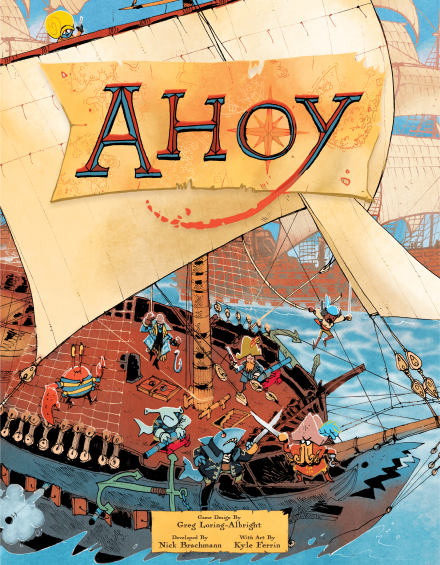
Ahoy 🟡

Ahoy is a lightly asymmetrical game where two to four players take the roles of swashbucklers and soldiers seeking Fame on the high seas.

One player controls the Bluefin Squadron, a company of sharks and their toothy friends, who patrol these waters and keep order with shot and sword. Another player controls the Mollusk Union, an alliance of undersea creatures and their comrades-in-arms, who fight to reclaim their ancestral home. In games with more people, some players control Smugglers, maverick captains who run blockades to smuggle luxuries and essentials, delivering them to those with the most need—or the most coin. Explore the seas. As you play, you’ll make a unique map full of treasure troves, dangerous wreckage, and mighty sea currents, using deluxe double-layer region tiles.

Game Mechanics:

  • Area Control
  • Pick-Up and Deliver
  • Tile Placement
  • Worker Placement

Game Specifications:

  • 2 – 4 Players
  • 45 – 75 Minutes
  • Difficulty Weight 2.86