Tag: Modular Board

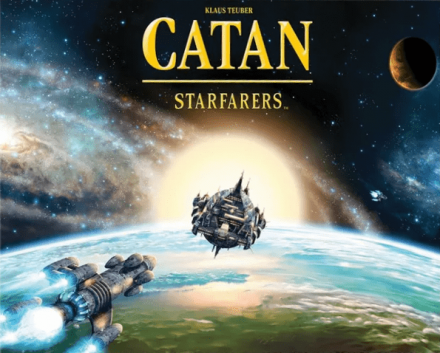
CATAN

In CATAN (formerly The Settlers of Catan), players try to be the dominant force on the island of Catan by building settlements, cities, and roads. On each turn dice are rolled to determine what resources the island produces. Players build by spending resources (sheep, wheat, wood, brick and ore) that are depicted by these resource cards; each land type, with the exception of the unproductive desert, produces a specific resource: hills produce brick, forests produce wood, mountains produce ore, fields produce wheat, and pastures produce sheep.

Setup includes randomly placing large hexagonal tiles (each showing a resource or the desert) in a honeycomb shape and surrounding them with water tiles, some of which contain ports of exchange. Number disks, which will correspond to die rolls (two 6-sided dice are used), are placed on each resource tile. Each player is given two settlements (think: houses) and roads (sticks) which are, in turn, placed on intersections and borders of the resource tiles. Players collect a hand of resource cards based on which hex tiles their last-placed house is adjacent to. A robber pawn is placed on the desert tile.

A turn consists of possibly playing a development card, rolling the dice, everyone (perhaps) collecting resource cards based on the roll and position of houses (or upgraded cities—think: hotels) unless a 7 is rolled, turning in resource cards (if possible and desired) for improvements, trading cards at a port, and trading resource cards with other players. If a 7 is rolled, the active player moves the robber to a new hex tile and steals resource cards from other players who have built structures adjacent to that tile.

Points are accumulated by building settlements and cities, having the longest road and the largest army (from some of the development cards), and gathering certain development cards that simply award victory points. When a player has gathered 10 points (some of which may be held in secret), he announces his total and claims the win.

Game Mechanics:

  • Hand Management
  • Income
  • Modular Board
  • Network and Route Building
  • Trading
  • Variable Set-up

Game Specifications:

  • 3 – 6 Players
  • 60 – 120 Minutes
  • Difficulty Weight 2.29

Betrayal at House on the Hill

Betrayal at House on the Hill quickly builds suspense and excitement as players explore a haunted mansion of their own design, encountering spirits and frightening omens that foretell their fate. With an estimated one hour playing time, Betrayal at House on the Hill is ideal for parties, family gatherings or casual fun with friends.

Betrayal at House on the Hill is a tile game that allows players to build their own haunted house room by room, tile by tile, creating a new thrilling game board every time. The game is designed for three to six people, each of whom plays one of six possible characters.

Secretly, one of the characters betrays the rest of the party, and the innocent members of the party must defeat the traitor in their midst before it’s too late! Betrayal at House on the Hill will appeal to any game player who enjoys a fun, suspenseful, and strategic game.

Betrayal at House on the Hill includes detailed game pieces, including character cards, pre-painted plastic figures, and special tokens, all of which help create a spooky atmosphere and streamline game play.

Game Specifications:

  • 3 – 6 Players
  • ~60 Minutes
  • Difficulty Weight 2.40

Betrayal at Baldur’s Gate

The shadow of Bhaal has come over Baldur’s Gate, summoning monsters and other horrors from the darkness!

As you build and explore the iconic city’s dark alleys and deadly catacombs, you must work with your fellow adventurers to survive the terrors ahead. That is, until some horrific evil turns one — or possibly more — of you against each other. Was it a mind flayer’s psionic blast or the whisperings of a deranged ghost that caused your allies to turn traitor? You have no choice but to keep your enemies close!

Based on the award-winning Betrayal at House on the Hill board game, in Betrayal at Baldur’s Gate you’ll return to Baldur’s Gate again and again thanks to the fifty included scenarios only to discover it’s never the same game twice.

Can you and your party survive the madness, or will you succumb to the mayhem and split (or slaughter!) the party?

Game Specifications:

  • 3 – 6 Players
  • ~60 Minutes
  • Difficulty Weight 2.56

Garum

Garum was a fermented fish sauce used as a condiment in the old ages; its manufacture and export was an element of prosperity and perhaps an impetus for the Roman penetration of Lusitanian and Hispanian coastal regions.

Garum from today’s Portugal and Spain was highly prized in Rome and has now inpired a versatile strategy boardgame for the whole family, ages 8 and up, that plays 2 to 4 players. Garum is a tile-laying game, which plays in about 30 minutes, it is language independent and features endless replayability, due to its board system, that ensures no two games are alike.

In Garum, each player represents a master in the preparation of a specific type of fish sauce and receives a set of 16 Cetarian Tiles; each one has 4 spaces filled by 4 colors in different proportions, though the color that the player is defending is the predominant one.

The goal of the game is to play Cetarian Tiles strategically, in order to get a huge number of his own colour symbols in selected rows or columns – the greater the influence, the higher the reward! While placing the tiles, players may apply to score, collect some bonuses and also block their opponent’s intents. Whoever scores most points is the winner.

Game Specifications:

  • 2 – 4 Players
  • 30 – 40 Minutes
  • Difficulty Weight 1.62

Forbidden Island

Dare to discover Forbidden Island! Join a team of fearless adventurers on a do-or-die mission to capture four sacred treasures from the ruins of this perilous paradise. Your team will have to work together and make some pulse-pounding maneuvers, as the island will sink beneath every step! Race to collect the treasures and make a triumphant escape before you are swallowed into the watery abyss!

Flamme Rouge

The excitement in the air is electric as the leaders round the last corner and head for the finish line. Each team has used cunning and skill to position their sprinter for this moment, but only one has done enough to pull off the win!

Will your team lead from the front and risk exhaustion? Should you play it safe in the middle of the pack? Could you surprise everyone by striking from the back? Can you time your move perfectly?

Anyone can race, few become champions!

Flamme Rouge is a fast-paced, tactical bicycle racing game where each player controls a team of two riders: a Rouleur and a Sprinteur. The players’ goal is to be the first to cross the finish line with one of their riders. Players move their riders forward by drawing and playing cards from that riders specific deck, depleting it as they go. Use slipstreams to avoid exhaustion and position your team for a well timed sprint for the win.

Game Specifications:

  • 2 – 4 Players
  • 30 – 45 Minutes
  • Difficulty Weight 1.70

Fjords

Explore a landscape so stunning that even a Viking would hold their breath in awe…

Fjords is a tile-laying game that takes place in two phases. The first one invites the players to explore the fjords around them by laying hexagonal landscape tiles, creating a map that serves as the gameboard. In the second phase, players begin from the longhouses they placed during phase one and will walk the landscape, claiming as much of the plains and cliffs as possible.

The winner of the game will be the player who has claimed the most land. Savvy placements and the ability to plan ahead yet act tactically will be your most important tools.

This new edition of Fjords differs from the original release in the following ways:

  • The game now plays up to four players.
  • The game contains five new variants/modules designed by Phil Walker-Harding. These add optional variety and flavor to the game.

Game Specifications:

  • 2 – 4 Players
  • 30 – 45 Minutes
  • Difficulty Weight 1.53