Tag: Memory

Memory board games require players to remember information after seeing it for a short period of time.

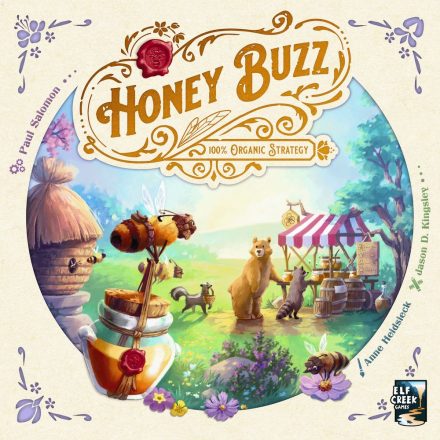
Honey Buzz

The bees have discovered economics. The queens believe that if they sell honey to the bears, badgers, and woodland creatures, they will find peace and prosperity. Spring has arrived and it’s time to build the hive, find nectar, make honey, and, for the first time ever, set up shop.

Honey Buzz is a worker bee placement game where players expand a personal beehive by drafting various honeycomb tiles that grant actions that are triggered throughout the game. Each tile represents a different action. Whenever a tile is laid so that it completes a certain pattern, a ring of actions is triggered in whatever order the player chooses. A tile drafted on turn one could be triggered up to three times at any point during the game. It all depends on how the player places their beeples (bee+meeple) and builds their hive. After all, in the honey business, efficiency is queen.

As you continually expand your hive, you’ll forage for nectar and pollen, make honey, sell different varieties at the bear market, host honey tastings, and attend to the queen and her court. There’s only so much nectar to go around, and finding it won’t be easy. Players will have to scout out the nectar field and pay attention to other players searches to try to deduce the location of the nectar they need for themselves.

Game Specifications:

  • 1 – 4 Players
  • 45 – 90 Minutes
  • Difficulty Weight 2.75

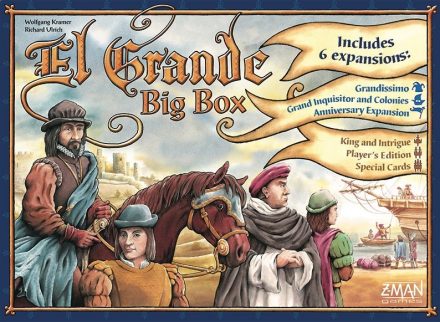
El Grande Big Box

In El Grande, players take on the roles of Grandes in medieval Spain. The king’s power is flagging, and these powerful lords are vying for control of the various regions. To that end, you draft caballeros (knights in the form of meeples) into your court and subsequently move them onto the board to help seize control of regions. After every third round, the regions are scored, and after the ninth round, the player with the most points is the winner.

In each of the nine rounds, you select one of your 13 power cards to determine turn order as well as the number of caballeros you get to move from the provinces (general supply) into your court (personal supply).

A turn then consists of selecting one of five action cards which allow variations to the rules and additional scoring opportunities in addition to determining how many caballeros to move from your court to one or more of the regions on the board (or into the castillo—a secretive tower). Normally, you may only place your caballeros into regions adjacent to the one containing the king’s pawn. The one hard and fast rule in El Grande is that nothing may move into or out of the king’s region. One of the five action cards that is always available each round allows you to move the king to a new region. The other four action cards vary from round to round.

The goal is to have a majority of caballeros in as many regions (and the castillo) as possible during a scoring round. Following the scoring of the castillo, you place any meeples you had stashed there into the region you had secretly indicated on your region dial. Each region is then scored individually according to a table printed in that region. Two-point bonuses are awarded for having sole majority in the region containing your Grande (large meeple) and in the region containing the king.

El Grande Big Box, the 20th anniversary edition of El Grande, includes all previously published expansions: Grand Inquisitor & ColoniesGrandissimoKing & IntrigantKing & Intrigant: Players’ Edition and King & Intrigant: Special Cards as well as something currently known only as the “Anniversary Extension”.

Game Mechanics:

[psot_tags]

Game Specifications:

  • 2 – 5 Players
  • ~90 Minutes
  • Difficulty Weight 2.80

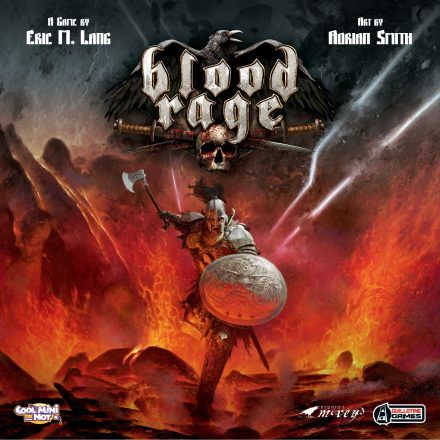
Blood Rage

“Life is Battle; Battle is Glory; Glory is ALL”

In Blood Rage, each player controls their own Viking clan’s warriors, leader, and ship. Ragnarök has come, and it’s the end of the world! It’s the Vikings’ last chance to go down in a blaze of glory and secure their place in Valhalla at Odin’s side! For a Viking there are many pathways to glory. You can invade and pillage the land for its rewards, crush your opponents in epic battles, fulfill quests, increase your clan’s stats, or even die gloriously either in battle or from Ragnarök, the ultimate inescapable doom.

Most player strategies are guided by the cards drafted at the beginning of each of the three game rounds (or Ages). These “Gods’ Gifts” grant you numerous boons for your clan including: increased Viking strength and devious battle strategies, upgrades to your clan, or even the aid of legendary creatures from Norse mythology. They may also include various quests, from dominating specific provinces, to having lots of your Vikings sent to Valhalla. Most of these cards are aligned with one of the Norse gods, hinting at the kind of strategy they support. For example, Thor gives more glory for victory in battle, Heimdall grants you foresight and surprises, Tyr strengthens you in battle, while the trickster Loki actually rewards you for losing battles, or punishes the winner.

Players must choose their strategies carefully during the draft phase, but also be ready to adapt and react to their opponents’ strategies as the action phase unfolds. Battles are decided not only by the strength of the figures involved, but also by cards played in secret. By observing your opponent’s actions and allegiances to specific gods, you may predict what card they are likely to play, and plan accordingly. Winning battles is not always the best course of action, as the right card can get you even more rewards by being crushed. The only losing strategy in Blood Rage is to shy away from battle and a glorious death!

Game Mechanics:

  • Area Majority / Influence
  • Closed Drafting
  • Hand Management
  • Memory
  • Open Drafting
  • Take That

Game Specifications:

  • 2 – 4 Players
  • 60 – 90 Minutes
  • Difficulty Weight 2.88

Whitehall Mystery

Whitehall Mystery

Whitehall Mystery

October 1888: During the construction of the Metropolitan Police headquarters near Whitehall, which would later be known as Scotland Yard, the remains of a body were found. In September, a severed arm had already been discovered in the muddy shore of the River Thames.

There is another murderer roaming the streets of London in Whitehall, amusing himself by spreading the pieces of a poor woman around Whitehall, like some kind of macabre treasure hunt. The identity of this monster and his unfortunate victim are a mystery, the Whitehall Mystery.

Game Mechanics:

  • Bluffing
  • Deduction
  • Hidden Movement
  • Memory
  • Team Based

Game Specifications:

  • 2 – 4 Players
  • 45 – 60 Minutes
  • Difficulty Weight 2.11

Stratego

Stratego

Stratego

The gameboard is your battlefield. You have an army of men at your disposal and six bombs. Your mission–protect your flag and capture your opponent’s flag.

Secretly place your men, bombs, and flag on the gameboard with these objectives in mind. But remember your opponent is doing the same thing, so you must plan a defense as well as an offense.

Once the armies are in place, advance your men. When you’re one space away from an enemy, attack. You and your opponent declare ranks. The lower-ranking man is captured and out of play.

You control your pieces and risk your men in battles where the strength of your enemy is unknown. The suspense builds as your men move deeper into enemy territory. Move with caution and courage. The next piece you attack could be a bomb. And when attacked, it could “blast” your man off the board and out of play.

The first to capture an enemy flag is the winner!

Game Mechanics:

  • Abstract Strategy
  • Bluffing
  • Deduction
  • Grid Movement
  • Memory

Game Specifications:

  • 2 Players
  • ~45 Minutes
  • Difficulty Weight 2.00

Spy Club

Spy Club

Spy Club

“We could start a Spy Club,” suggested Beatrice. “You know — search for clues and try to find mysteries to solve!”

In Spy Club, players work together as young detectives to solve neighborhood mysteries. It includes a replayable campaign format, with variable unlocking content, for playing a series of 5 games connected together to tell a larger story. Throughout the campaign, you’ll unlock new modules with additional rules and story elements. With 40 new modules and 174 cards in the campaign deck, you can reset everything and play multiple campaigns — with a different story and gameplay experience emerging each time.

In the standard game, each player has double-sided clue cards in front of them. On your turn, you use actions to flip, draw, and trade clue cards, gain ideas, and confirm clue cards as evidence. Confirm 5 clues of the same type to solve part of the case. As you discover more and more of the solution, a story starts to emerge: your Neighbor stole something from the ice cream shop, but what? And why? To crack the case, you must find the solution to all 5 parts before the suspect escapes or you run out of clues.

You can always play a single, standalone game of Spy Club, but the campaign mode is the recommended way to play:

  • Each game plays in 45 minutes, and each campaign consists of 5 games.
  • Some elements from each game carry forward and affect future games, with new rules and story elements are unlocked each play.
  • The sequence of content isn’t scripted, so each campaign will unfold differently.
  • Everything can be fully reset and replayed.
  • You only unlock a small portion of the total content in one campaign (just 4 of the 40 modules), so you can play multiple campaigns and continue unlocking new content each time!

Game Mechanics:

  • Action Points
  • Deduction
  • Memory
  • Set Collection

Game Specifications:

  • 2 – 4 Players
  • ~45 Minutes
  • Difficulty Weight 2.16

Picture Perfect

Picture Perfect

Picture Perfect

How do you take the perfect picture of a group of people if you only have one try? Each character has different wishes. Some want to be at the front of the picture; some want to stand next to another; and some really don’t want to be next to that one particular person by any means. Do your best to make everyone happy – even if you don’t actually know all the characters’ preferences…

In Picture Perfect, first released as Der Perfekte Moment, you need to arrange fourteen characters to take the perfect photograph. Each of them has three specific desires that you want to fulfill. Unfortunately, these desires are hidden in envelopes.

During the game, the players try to take a look inside these envelopes to figure out how to place the characters correctly. To do so, they trade their information with others — or maybe try to hide it…

Whoever earns the most points at the end of the game has fulfilled the most desires and becomes the master photographer.

Game Mechanics:

  • Auction/Bidding
  • Deduction
  • Memory
  • Negotiation
  • Puzzle
  • Tile Placement

Game Specifications:

  • 2 – 6 Players
  • 50 – 90 Minutes
  • Difficulty Weight 1.86

Last Friday

Last Friday

Last Friday

Last Friday is a hidden movement, hunting and deduction board game, inspired by the popular “slasher” horror movie genre. In the role of young campers, the players are challenged to survive a long weekend of terror – while one of them takes the role of the undying psychopath hiding in the shadows of the forest. In general, the murderer’s goal is to remain hidden and to kill off each of the campers, while the campers are trying to fight back and kill the murderer before they are all killed.

The game is played over four chapters — Arrival at the Camp, The Chase, The Massacre, and The Final Chapter — and each chapter plays out differently as the hunter becomes the prey, then comes back from the dead looking for revenge.

Game Mechanics:

  • Campaign
  • Deduction
  • Hidden Movement
  • Memory
  • Team Based

Game Specifications:

  • 2 – 6 Players
  • 30 – 120 Minutes
  • Difficulty Weight 2.26

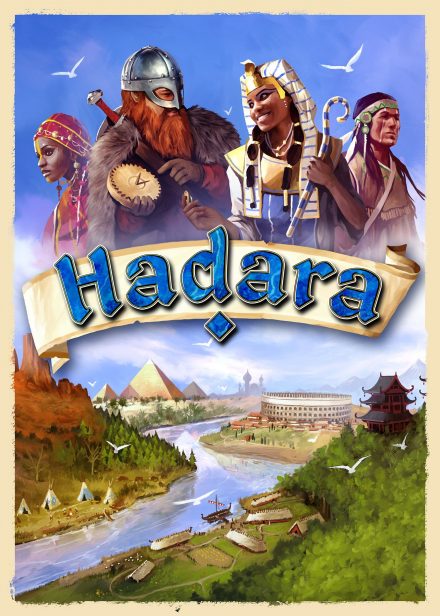
Hadara

Hadara carries you off into the world of cultures and countries of this earth. Over three epochs, you will experience the transformation of your new world from a small settlement to a high culture. You want to populate this world with people who come from different cultures and continents as well as different ages. To bring glory and honor to your world, you should choose the persons and accomplishments skillfully. But you should not ignore agriculture, culture, and military power, otherwise one of your competitors might get bigger and more successful than you. Who will succeed first in creating a new flourishing high culture?

Game Specifications:

  • 2 – 5 Players
  • 45 – 60 Minutes
  • Difficulty Weight 2.20

Abyss 🟢

The Abyss power is once again vacant, so the time has come to get your hands on the throne and its privileges. Use all of your cunning to win or buy votes in the Council. Recruit the most influential Lords and abuse their powers to take control of the most strategic territories. Finally, impose yourself as the only one able to rule the Abyssal people!

Abyss is a game of development, combination and collection in which players try to take control of strategic locations in an underwater city. To achieve this, players must develop on three levels: first by collecting allies, then using them to recruit Lords of the Abyss, who will then grant access to different parts of the city. Players acquire cards through a draft of sorts, and the Lords of the Abyss acquired on those cards grant special powers to the cardholder — but once you use the cards to acquire a location, that power is shut off, so players need to time their land grabs well in order to put themselves in the best position for when the game ends.

Game Specifications:

  • 2 – 4 Players
  • 30 – 60 Minutes
  • Difficulty Weight 2.34