Tag: Grid Movement

Grid Movement is a game mechanic where game pieces move on a predetermined grid in various patterns.

The Pirate Republic

The Pirate Republic

The Pirate Republic

The year is 1713. A rare peace comes to the Spanish Main, but peace has its consequences. With thousands of demobilized sailors, piracy explodes in the West Indies where the port city of Nassau serves as its headquarters. This is the sunrise of the Golden Age of Piracy. It’s a time of conquest and riches, indomitable spirit and fat treasure galleons, pirate utopias and watery graves.

The Pirate Republic is a modular fully cooperative to fully competitive thematic deck building, open-world adventure game for 1–5 players. You are an infamous pirate captain working towards completing mission objectives over three rounds of play. Your mission: Forge the ultimate empire, The Pirate Republic.

– Players can cooperatively work to complete Flying Gang mission objectives to forge the ultimate democracy, the Pirate Republic
– Players who enjoy Hidden Traitor mechanics can add optional Captain Missions that make some captains wily saboteurs who are secretly attempting to sink other players’ ambitions
– Competitive mode creates a race to amass the most Swagger (Victory Points) through daring feats and plunder on the high seas

Devastate merchant shipping lanes, commandeer new ships, raid and conquer heavily defended towns, and plunder New World riches one seaport at a time. Attack, strike fear, and duel your way across the high seas with custom action dice and a deck of unique captain cards. Pillage treasure fleets, squash mutinies, sack forts, recruit crew, duel pirate hunters, and seal your notoriety among the greatest captains. Along the way, battle and bring an end to Spanish, British, Dutch, French, and Danish imperial powers infesting your waters. The Pirate Republic brings the piracy story to life in this swashbuckling blend of adventure and strategy. Even across the centuries, it reminds that if denied the chance to live in freedom, best to go ahead and make your own.

Game Mechanics:

  • Area Movement
  • Cooperative
  • Deck Building
  • Dice Rolling
  • Grid Movement
  • Hand Management
  • Open Drafting
  • Tableau Building
  • Team Based

Game Specifications:

  • 1 – 5 Players
  • 60 – 90 Minutes
  • Difficulty Weight 2.93

Mind MGMT

Mind MGMT

Mind MGMT

Working from the shadows, Mind MGMT once used its psychically-powered agents to put a stop to global crises. However, absolute power corrupts absolutely, and Mind MGMT is now rotting from the inside. To tighten its iron grip on the world stage, Mind MGMT deploys covert operatives around the world to recruit other psychically-attuned individuals to their side. How can this enigmatic organization, hell bent on global domination, be defeated?

Thankfully, a few renegade agents have figured out that Mind MGMT has been compromised and have defected, turning their backs on the syndicate. They now use their own psychic abilities to prevent Mind MGMT from achieving its nefarious goals.

In Mind MGMT: The Psychic Espionage “Game.”, one player controls Mind MGMT and must scour the city for new recruits. They move around on a secret map, trying to visit locations that match one of their three randomly drawn feature cards. They can also use their four Immortals to protect locations from being exposed.

All other players control the rogue agents who must try to stop Mind MGMT before it’s too late! They ask questions to the Recruiter and deduce their whereabouts from the answers they receive. Rogue agents can use dry-erase “mental notes” to track all the information they’re given.

Mind MGMT wins by either collecting twelve recruits or surviving sixteen turns. The rogue agents can win only by capturing Mind MGMT, which they do when they believe they’re on the same block as Mind MGMT.

Game Mechanics:

  • Deduction
  • Grid Movement
  • Hidden Movement
  • Paper and Pencil
  • Team Based

Game Specifications:

  • 1 – 5 Players
  • 45 – 75 Minutes
  • Difficulty Weight 2.84

Ierusalem: Anno Domini

Ierusalem: Anno Domini

Ierusalem: Anno Domini

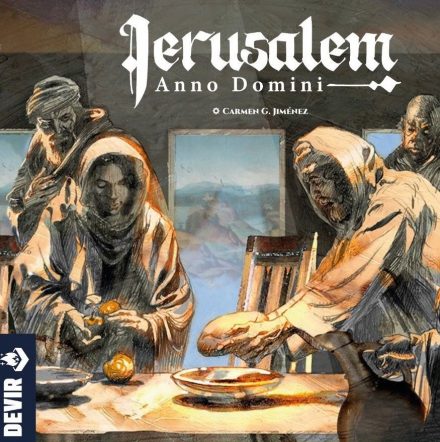
Jerusalem, spring 33 AD: A crowd gathers at the city gates to welcome Jesus of Nazareth as he prepares to celebrate the Passover seder with his apostles and followers. With a revolutionary message, he has garnered supporters everywhere but also looks of suspicion among religious authorities. The Last Supper will soon be celebrated, and the fate of one of the most influential characters in human history will be sealed.

In Ierusalem: Anno Domini, we represent one of the communities of followers of Jesus of Nazareth who, coming to Jerusalem from nearby towns and villages, want to approach the place of the Last Supper and position ourselves as close as possible to the seats of Jesus and his apostles. The closer we are, the more points we earn at game’s end. We also score for offering tokens and parable tiles we’ve accumulated.

Different locations are shown on the board: the market, the desert, the mountain, the lake, and the temple. After sending our followers to one of these locations, we obtain stones, bread, and fish, as well as denarii or cards that allow us to do more than one action. Among these actions, players can choose between listening to a parable, going to the table, changing seats, or doing a favor, among other things. All this happens while the patience of the Sanhedrin runs out. When this happens, as symbolized by a tile moving in a marker, the endgame is triggered.

However, the main element of the game is the cards. Each card has a symbol corresponding to one of five key locations in the game. As we play them, we form combinations that allow us to bring the apostles to the table of the Last Supper. The optimal placement of our followers around Jesus and the apostles will also be done through the management of letters, as well as various resources at our disposal.

Behind a very immersive theme, Ierusalem: Anno Domini will not disappoint lovers of good challenges. Players have a wide range of possibilities at their fingertips and multiple ways to earn points. Preparing the best strategies to get the most out of your followers will be one of the keys to victory. Devout gamers don’t need to look further: Here is your game!

Game Mechanics:

  • Deck Building
  • Gird Coverage
  • Grid Movement
  • Hand Management
  • Set Collection
  • Worker Placement

Game Specifications:

  • 1 – 4 Players
  • ~90 Minutes
  • Difficulty Weight 3.10

Honey Buzz

Honey Buzz

Honey Buzz

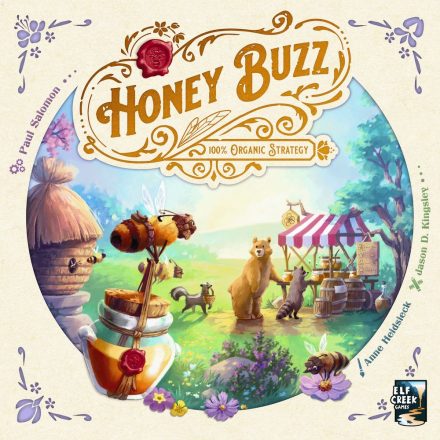
The bees have discovered economics. The queens believe that if they sell honey to the bears, badgers, and woodland creatures, they will find peace and prosperity. Spring has arrived and it’s time to build the hive, find nectar, make honey, and, for the first time ever, set up shop.

Honey Buzz is a worker bee placement game where players expand a personal beehive by drafting various honeycomb tiles that grant actions that are triggered throughout the game. Each tile represents a different action. Whenever a tile is laid so that it completes a certain pattern, a ring of actions is triggered in whatever order the player chooses. A tile drafted on turn one could be triggered up to three times at any point during the game. It all depends on how the player places their beeples (bee+meeple) and builds their hive. After all, in the honey business, efficiency is queen.

As you continually expand your hive, you’ll forage for nectar and pollen, make honey, sell different varieties at the bear market, host honey tastings, and attend to the queen and her court. There’s only so much nectar to go around, and finding it won’t be easy. Players will have to scout out the nectar field and pay attention to other players searches to try to deduce the location of the nectar they need for themselves.

Game Mechanics:

  • Economic
  • Grid Movement
  • Memory
  • Open Drafting
  • Pattern Building
  • Tile Placement
  • Worker Placement

Game Specifications:

  • 1 – 4 Players
  • 45 – 90 Minutes
  • Difficulty Weight 2.75

Chess 4

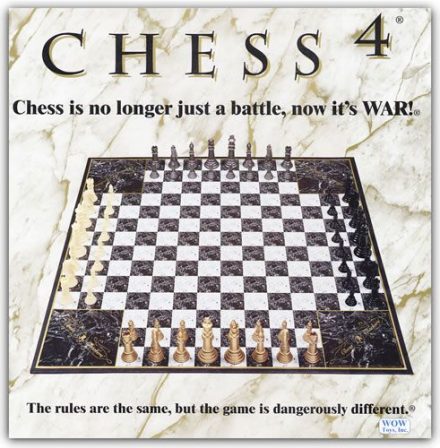
Four-Player Chess (Four-handed chess, Chess-4, and 4-Chess) is often credited to Capt Charles Verney, who was the first known to have documented the game in England in 1881. Four-player versions of chess probably have existed for hundreds of years prior to Verney in one form or another. Verney’s four-player board consists of three rows added to each side of a standard 2-player board, and four complete sets of chessmen in four different colors. Modern four-player boards and colored pieces are available from several manufacturers.

In Verney’s version (1881), 4 player chess was a partnership game, and the object was to checkmate both opposing partners at the same time. In modern variants, four player games can range from partners, to cutthroat (every player for himself), to temporary alliances at will.

Starting configuration affects fairness (bias). The standard 2-player configuration of queen facing queen is biased in four player chess because there is only one axis of symmetry. Four player chess requires two axes of symmetry to be fair (unbiased). To avoid bias, Verney recommended a staring configuration of all queens on light (or all on dark) squares. Another unbiased starting configuration is all queens on the right (or all on the left) of the king.

For the most part, four player chess follows (or can follow) all the normal rules of two-player chess. Verney had special rules for partnership playing, disallowed castling, and pawns had to make it to the enemies last rank in order to be exchanged for another piece. Pawns could also march up and back down the board. Verney also had checkmate as the ultimate move.

In modern variations of four-player chess, partnering may not be required, but allowable, castling can be allowed, and actual capturing of a king a required move to eliminate a player. The Chess Federation does not recognize four-player chess in any form, and there are no official rules, so players are free to experiment with variations and make their own rules.

Game Mechanics:

  • Abstract Strategy
  • Grid Movement
  • Player Elimination

Game Specifications:

  • 2 – 4 Players
  • ~45 Minutes
  • Difficulty Weight 2.89

Ankh: Gods of Egypt 🟡

Play as a god of ancient Egypt, competing to survive as society begins to forget the old ways, so that only you and your followers remain.

Build caravans, summon monsters, and convert followers in your quest to reign supreme in Ankh: Gods of Egypt. Deities, monsters, and the people of ancient Egypt have been lovingly reimagined and interpreted in beautiful illustrations and detailed miniatures, and players will truly feel like gods as they shake the very foundations of Egypt. All gameplay in Ankh, including combat, is streamlined and non-random. Compete and win solely on your godly wits alone.

Game Specifications:

  • 2 – 5 Players
  • ~90 Minutes
  • Difficulty Weight 3.12

Zombie 15′

Zombie 15′

Zombie 15′

In an apocalyptic world in which everyone over the age of 18 has turned into a bloodthirsty, flesh-hungry zombie and most youngsters have been served as meat to quell their elders’ appetite, a small team of kids and teenagers tries to survive on their own. As part of that small group of survivors, you must unite to escape the relentless horde of undead. Run across town to find shelter or food, hold a strategic position, meet with new survivors, and discover the truth about this terrible and mysterious disease!

Zombie 15′ is a frantic, scenario-based survival game in which time is scarce and cooperation is key. The game features easy rules but real choices to be made as quickly as possible if you don’t want to get overwhelmed by zombies!

Zombie 15′ features a team of 15-year-old teenagers; a 15-minute soundtrack to give each game its tempo; a 15-scenario, progressive campaign; and much more than just 15 zombies…

Game Mechanics:

  • Action Points
  • Cooperative
  • Grid Movement

Game Specifications:

  • 2 – 4 Players
  • ~15 Minutes
  • Difficulty Weight 2.22

Zombicide

Zombicide

Zombicide

Zombicide is a collaborative game in which players take the role of a survivor – each with unique abilities – and harness both their skills and the power of teamwork against the hordes of unthinking undead! Zombies are predictable, stupid but deadly, controlled by simple rules and a deck of cards. Unfortunately for you, there are a LOT more zombies than you have bullets.

Find weapons, kill zombies. The more zombies you kill, the more skilled you get; the more skilled you get, the more zombies appear. The only way out is zombicide!

Play ten scenarios on different maps made from the included modular map tiles, download new scenarios from the designer’s website, or create your own!

Game Mechanics:

  • Action Points
  • Campaign
  • Cooperative
  • Dice Rolling
  • Grid Movement
  • Hand Managment
  • Player Elimination

Game Specifications:

  • 1 – 6 Players
  • ~60 Minutes
  • Difficulty Weight 2.54

Windward

Windward

Windward

You are a captain flying your Ship on the skies of the gaseous planet Celus. Gain the most notoriety by sailing the skies, hunting crestors, fighting opponents. Whichever player has the most notoriety points at the end of the game is the winner. To gain notoriety, you can trade in Crestor teeth and gas at the trading post.

Players take turns to move their ships, take actions, use supply cards, and battle other players.

Game Mechanics:

  • Area Movement
  • Cooperative
  • Dice Rolling
  • Grid Movement
  • Hand Management
  • Pick-Up and Deliver
  • Trading
  • Worker Placement

Game Specifications:

  • 1 – 5 Players
  • 30 – 90 Minutes
  • Difficulty Weight 2.29

War Chest

War Chest

War Chest

War Chest is an all-new bag-building war game! At the start of the game, raise your banner call (drafting) several various units into your army, which you then use to capture key points on the board. To succeed in War Chest, you must successfully manage not only your armies on the battlefield, but those that are waiting to be deployed.

Each round you draw three unit coins from your bag, then take turns using them to perform actions. Each coin shows a military unit on one side and can be used for one of several actions. The game ends when one player — or one team in the case of a four-player game — has placed all of their control markers. That player or team wins!

Game Mechanics:

  • Abstract Strategy
  • Area Control
  • Deck Building
  • Grid Movement
  • Hand Management
  • Team Based
  • Wargame

Game Specifications:

  • 2 – 4 Players
  • ~30 Minutes
  • Difficulty Weight 2.32