Tag: Deduction

In Deduction games, players rely on their logic and reasoning skills to attempt to find the correct solution to a problem.

Fog of Love

Fog of Love is a game for two players. You will create and play two vivid characters who meet, fall in love and face the challenge of making an unusual relationship work.

Playing Fog of Love is like being in a romantic comedy: roller-coaster rides, awkward situations, lots of laughs and plenty of difficult compromises to make.

Much as in a real relationship, goals might be at odds. You can try to change, keep being relentless or even secretly decide to be a Heartbreaker. It’s your choice.

The happily ever after won’t be certain, but whatever way your zigzag romance unfolds, you’ll always end up with a story full of surprises – guaranteed to raise a smile!

Game Specifications:

  • 2 Players
  • 60 – 120 Minutes
  • Difficulty Weight 2.24

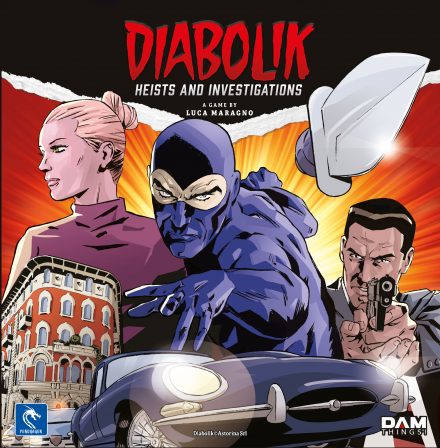
Diabolik: Heists and Investigations

In Diabolik: Heists and Investigations, players will experience in first person the “impossible thefts” that are told every month in the comic books, both from the side of Diabolik and Eva Kant, and from Inspector Ginko and the police.

The mechanics are that of hidden movement, but with the exception that when discovered, the criminals will be forced to flee on the main board, visible to all cops. Thanks to the cards, every turn offers different situations.

The Criminals will have to complete two heists out of the three available to win the game and to do so they will have to move hidden in the shadows, leaving traces of their path that the Police will have to find to ruin the plans of the Criminals.

The Police will have the hard job of investigating the traces of Diabolik and Eva, but they are not alone, in fact they will have the opportunity to call four total Police Officers to help, to keep every corner of the city under observation. To win the game, the cops will have to raise the Danger Level to the maximum on the Danger Track. Usually, solving a Clue increases the Danger Level by 1 point, but that’s not the only way to do it. On the other hand, if Eva or DIabolik complete a Heist, the Danger Luevel is lowered.

In their turn, each player can perform a maximum of 3 individual actions. The only exception is for drawing, discarding or playing cards, which is a repeatable action.

Game Mechanics:

  • Action Points
  • Contracts
  • Deduction
  • Roles with Asymmetric Information
  • Targeted Clues
  • Team-Based Game
  • Variable Set-up

Game Specifications:

  • 2 – 4 Players
  • 60 – 90 Minutes
  • Difficulty Weight 2.25

Detective: A Modern Crime Board Game – Season One

Detective: A Modern Crime Board Game – Season One, a.k.a. Detective: Season One, is a fully co-operative, deeply immersive board game in which 1-5 players take on the roles of investigators trying to solve a crime.

Detective: Season One is a new product in the award-winning Detective line, one with a shorter playing time that’s tailored for a mystery game night with simpler family-friendly rules. The game consists of three standalone cases, and each of them can be played in around 90 minutes. Each of the cases challenges players with different settings and styles. The cases are:

• Blood, Ink, and Tears moves the action to Great Britain, where players visit an old mansion and discover family secrets from the past that lead them to clues behind the mysterious death of the family patron. Fans of Agatha Christie’s novels will find themselves at home in this rather funny case!

• Solid Alibi throws players in the middle of a bloody conflict between gangs and criminals in the Italian district. Players have to not only solve the crime and discover who killed Robert Parkson, but also witness growing tension in the district and find out who to trust in the spiral of violence and mutual accusations!

• Natural Causes takes players to a university campus in the U.S. Professor Calvin Higgs is found dead in his lab at the Biology Institute of Virginia University. Players need to find out whether his death is from natural causes, or perhaps there’s someone in his surroundings responsible for this horrible crime. But what could be the motive?

Game Mechanics:

  • Cooperative
  • Deduction
  • Solo / Solitaire Game
  • Storytelling

Game Specifications:

  • 1 – 5 Players
  • 90 – 120 Minutes
  • Difficulty Weight 2.03

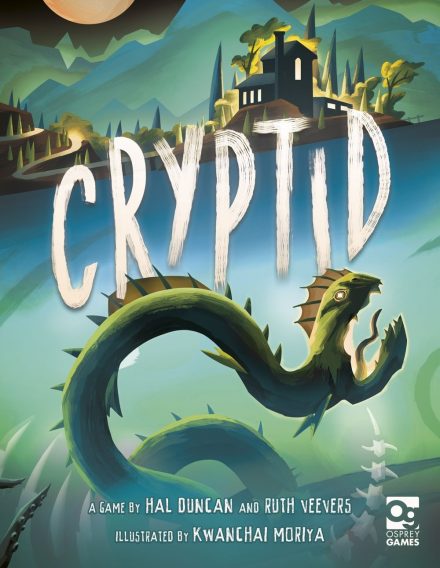
Cryptid

You’ve studied the footage, connected the dots, and gathered what meager evidence you could. You’re close — soon the whole world will know the truth behind the Cryptid. A group of like-minded cryptozoologists have come together to finally uncover the elusive creature, but the glory of discovery is too rich to share. Without giving away some of what you know you will never succeed in locating the beast, but reveal too much and your name will be long forgotten!

Cryptid is a unique deduction game of honest misdirection in which players must try to uncover information about their opponents’ clues while throwing them off the scent of their own. Each player holds one piece of evidence to help them find the creature, and on their turn they can try to gain more information from their opponents. Be warned; give too much away and your opponents might beat you to the mysterious animal and claim the glory for themselves!

The game includes a modular board, five clue books, and a deck of set-up cards with hundreds of possible set-ups across two difficulty levels. It is also supported by an entirely optional digital companion, allowing for faster game set-up and a near-infinite range of puzzles.

Game Mechanics:

  • Deduction
  • Pattern Recognition

Game Specifications:

  • 3 – 5 Players
  • 30 – 50 Minutes
  • Difficulty Weight 2.26

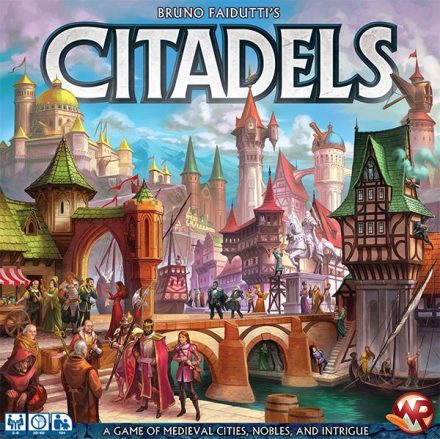
Citadels

In Citadels, players take on new roles each round to represent characters they hire in order to help them acquire gold and erect buildings. The game ends at the close of a round in which a player erects their seventh building. Players then tally their points, and the player with the highest score wins.

Players start the game with a number of building cards in their hand; buildings come in five colors, with the purple buildings typically having a special ability and the other colored buildings providing a benefit when you play particular characters. At the start of each round, the player who was king the previous round discards one of the eight character cards at random, chooses one, then passes the cards to the next player, etc. until each player has secretly chosen a character. Each character has a special ability, and the usefulness of any character depends upon your situation, and that of your opponents. The characters then carry out their actions in numerical order: the assassin eliminating another character for the round, the thief stealing all gold from another character, the wizard swapping building cards with another player, the warlord optionally destroys a building in play, and so on.

On a turn, a player earns two or more gold (or draws two building cards then discards one), then optionally constructs one building (or up to three if playing the architect this round). Buildings cost gold equal to the number of symbols on them, and each building is worth a certain number of points. In addition to points from buildings, at the end of the game a player scores bonus points for having eight buildings or buildings of all five colors.

The 2016 edition of Citadels includes twenty-seven characters — eight from the original Citadels, ten from the Dark City expansion, and nine new ones — along with thirty unique building districts, and the rulebook includes six preset lists of characters and districts beyond the starter list, each crafted to encourage a different style and intensity of gameplay.

Game Mechanics:

  • Bluffing
  • City Building
  • Deduction
  • Set Collection
  • Take That
  • Variable Player Powers
  • Variable Set-up

Game Specifications:

  • 2 – 8 Players
  • 30 – 60 Minutes
  • Difficulty Weight 2.07

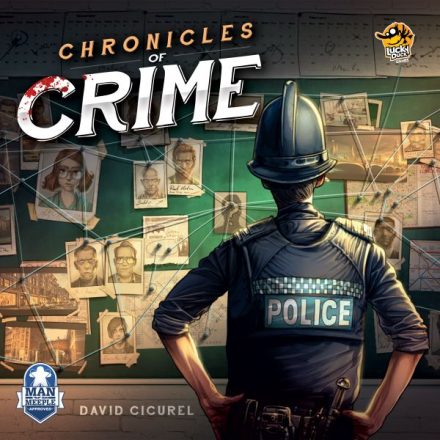
Chronicles of Crime

Chronicles of Crime is a cooperative game of crime investigation, mixing an app, a board game and a touch of Virtual Reality.

With the same physical components (board, locations, characters and items), players will be able to play plenty of different scenarios and solve as many different crime stories.

Players start the app, choose the scenario they want to play, and follow the story. The goal being to catch the killer of the current case in the shortest time possible.

Using the Scan&Play technology, each component (locations, characters, items, etc.) has a unique QR code, which, depending on the scenario selected, will activate and trigger different clues and stories. That means players will be able to get new stories way after the game is released simply by downloading the app’s updates, without any shipping of new physical components involved.

The VR experience only requires a mobile phone. Players simply put the VR glasses (optional buy) onto their mobile device, and put the VR glasses on their nose, holding their mobile device in front of their eyes, to immerse themselves in the game’s universe and search for clues in a virtual world.

The game comes with 1 tutorial and 5 scenarios, but more can be downloaded directly inside the app!
Each session last around 1h to 1h30 minutes and many scenarios are connected to each other in order to tell a much bigger story.


Game Mechanics:

  • Cooperative
  • Deduction
  • Scenario / Mission / Campaign Game
  • Solo / Solitaire Game
  • Storytelling

Game Specifications:

  • 1 – 4 Players
  • 60 – 90 Minutes
  • Difficulty Weight 2.06

Captain Sonar

At the bottom of the ocean, no one will hear you scream!

In Captain Sonar, you and your teammates control a state-of-the-art submarine and are trying to locate an enemy submarine in order to blow it out of the water before they can do the same to you. Every role is important, and the confrontation is merciless. Be organized and communicate because a captain is nothing without his crew: the Chief Mate, the Radio Operator, and the Engineer.

All the members of a team sit on one side of the table, and they each take a particular role on the submarine, with the division of labor for these roles being dependent on the number of players in the game: One player might be the captain, who is responsible for moving the submarine and announcing some details of this movement; another player is manning the sonar in order to listen to the opposing captain’s orders and try to decipher where that sub might be in the water; a third player might be working in the munitions room to prepare torpedoes, mines and other devices that will allow for combat.

Captain Sonar can be played in two modes: turn-by-turn or simultaneous. In the latter set-up, all the members of a team take their actions simultaneously while trying to track what the opponents are doing, too. When a captain is ready to launch an attack, the action pauses for a moment to see whether a hit has been recorded — then play resumes with the target having snuck away while the attacker paused or with bits of metal now scattered across the ocean floor.

Multiple maps are included with varying levels of difficulty.

Game Mechanics:

  • Deduction
  • Hidden Movement
  • Line Drawing
  • Role Playing
  • Team Based

Game Specifications:

  • 2 – 8 Players
  • 45 – 60 Minutes
  • Difficulty Weight 2.21

3000 Scoundrels 🟢

“The Traveler brought much change to our small frontier town in the last five years. He showed us marvels beyond imagination and taught us how to use his strange machines. Now that the Traveler has vanished, a storm is coming. Who will control the destiny of the American Frontier?”

In 3000 Scoundrels, players assume the roles of rival leaders attempting to steal precious technology left behind by the Traveler. By overlaying clear cards, you create unique scoundrels and use them to outsmart your foes. In short, hire scoundrels to build powerful combos, steal technology, and outsmart your foes.

Each turn, you play a poker card from your hand face down in front of your player board, then use all abilities matching your claimed number. You don’t need to tell the truth when claiming a number, but if an opponent catches you bluffing, it will damage your reputation and decrease your odds of winning the game.

Each leader has a unique perspective and motivation in the conflict of Graystone Gulch. Are you driven by money, fame, or the deep-seated desire to improve the world? Advanced rules add unique strategies to each leader that reflect their unique strengths and cunning tricks.

Game Mechanics:

Game Specifications:

  • 2 – 4 Players
  • 60 – 90 Minutes
  • Difficulty Weight 2.18

Unsolved Case Files: Harmony Ashcroft Case

Unsolved Case Files: Harmony Ashcroft Case

Be a real detective in Unsolved Case Files: Case 1 Harmony Ashcroft as you find clues and evidence in the case file to solve three objectives that lead you to convict the killer!

Specially-designed online answer keys check whether you have found the correct evidence to solve each objective. Includes realistic themed elements, including newspaper clippings, crime scene photographs, and much more!

The unique play pattern allows for solo play, or a crime-solving game party!

Game Mechanics:

  • Cooperative
  • Deduction
  • Party Game

Game Specifications:

  • 1 – 8 Players
  • 30 – 120 Minutes
  • Difficulty Weight 1.75

Ultimate Werewolf: Deluxe Edition

Ultimate Werewolf: Deluxe Edition

Ultimate Werewolf: Deluxe Edition

Ultimate Werewolf is an interactive game of deduction for two teams: Villagers and Werewolves. The Villagers don’t know who the Werewolves are, and the Werewolves are trying to remain undiscovered while they slowly eliminate the Villagers one at a time. A Moderator (who isn’t on a team) runs the game.

Ultimate Werewolf takes place over a series of game days and nights. Each day, the players discuss who among them is a Werewolf and vote out a player. Each night, the Werewolves choose a player to eliminate, while the Seer learns whether one player is a Werewolf or not. The game is over when either all the Villagers or all the Werewolves are eliminated.

Ultimate Werewolf: Deluxe Edition features all new artwork, a great new design, totally rewritten and more comprehensive rules, and an even better moderator scorepad. What’s more, it supports more players than ever: 75 of your closest friends can converge on one or more villages using the components in this box.

Game Mechanics:

  • Bluffing
  • Deduction
  • Negotiation
  • Party Game
  • Player Elimination
  • Role Playing
  • Team Based

Game Specifications:

  • 5 – 75 Players
  • ~30 Minutes
  • Difficulty Weight 1.47