

Lizard Wizard
Auction and Bidding games typically have players place bids on in-game items and advantages to improve their position within the game.
Astoria is a land pulsing with magic and intrigue! A handful of Arch-Mages are vying for the loyalty of wizards across the land so that they can wield ultimate power.
Lizard Wizard is a game from the team that brought you Raccoon Tycoon. Aspects of gameplay will be familiar to fans of RT, and will add a bit of extra depth and strategy.
In Lizard Wizard, players compete to recruit wizards from seven unique schools of magic, build mystical towers, research powerful spells, summon helpful familiars, and search dark dungeons for gold and items of power. Only one Arch-Mage will rise above the rest and control the land. Will it be you?
Game Mechanics:
Game Specifications:

Get the full load (minus 4 expansions) of the modern classic tile-laying game with the Isle of Skye Big Box! The Big Box contains the award-winning Isle of Skye base game (Kennerspiel des Jahres 2016), the Druids expansion, and additional scoring and tunnel tiles. A new addition is the mini-expansion Randgebiete.
In the game, you embody one leader of each of the five traditional Scottish clans. You create your own small empire in order to gain the necessary victory points. But in each game only four of the included 24 score cards are in play. This makes each game different and requires different tactics and strategies.
In each round you can buy one of the tiles of a fellow player. Face down, all players simultaneously set the prices of the pieces they offer. A high price can lead to prosperity and much needed money. However, if no buyer can be found, the seller must add the tile to his empire himself and give up the money he has invested. In the end, the player who has scored the most victory points wins.
Game Mechanics:
Game Specifications:
Get the full load (minus 4 expansions) of the modern classic tile-laying game with the Isle of Skye Big Box! The Big Box contains the award-winning Isle of Skye base game (Kennerspiel des Jahres 2016), the Druids expansion, and additional scoring and tunnel tiles. A new addition is the mini-expansion Randgebiete.
In the game, you embody one leader of each of the five traditional Scottish clans. You create your own small empire in order to gain the necessary victory points. But in each game only four of the included 24 score cards are in play. This makes each game different and requires different tactics and strategies.
In each round you can buy one of the tiles of a fellow player. Face down, all players simultaneously set the prices of the pieces they offer. A high price can lead to prosperity and much needed money. However, if no buyer can be found, the seller must add the tile to his empire himself and give up the money he has invested. In the end, the player who has scored the most victory points wins.
—description from the publisher (translated)
Game Specifications:

Furnace is an engine-building Eurogame in which players take on the roles of 19th-century capitalists building their industrial corporations and aspiring to make as much money as they can by purchasing companies, extracting resources, and processing them in the best combinations possible.
Each player starts the game with a random start-up card, the resources depicted at the top of that card, and four colored discs valued 1-4.
The game is played over four rounds, and each round consists of two phases: Auction and Production. During the auction, 6-8 company cards are laid out with their basic sides face up. Players take turns placing one of their discs on one of these cards, but you cannot place a disc on a card if a disc of the same value or color is already present. Thus, you’ll place discs on four cards.
Once all the discs are placed, the cards are resolved from left to right. Whoever placed the highest-valued disc will claim this card, but first anyone with a lower-valued disc on this card will gain compensation, either the resources depicted multiplied by the value of their disc or a processing ability (exchange X for Y) up to as many times as the value of their disc.
Once all the cards have been claimed or discarded, players enter the production phase, using their cards in the order of their choice. Each company card has one action — either production or processing — on its basic side and two actions on its upgraded side. During the production phase, you can use each of your cards once to gain resources, process those resources into other resources or money, and upgrade your cards.
At the end of four rounds, whoever has the most money wins.
Furnace also includes capitalist cards that contain unique effects, and if you want, you can choose to deal one out to each player at the start of the game. For an additional challenge, you can require players to create a “production chain”, with each newly acquired company card being placed somewhere in that chain and locked in position for the remainder of the game.
Game Mechanics:
Game Specifications:

Welcome to Dog Park, a mid-weight, competitive set-collection and point-to-point movement game in which players take on the role of dog walkers who recruit, walk, and care for their dogs over four rounds. Each round is split into four phases:
Players must choose their routes and dogs carefully to earn the best reputation and prove they are the most accomplished walker of them all. At the end of the game, the player with the most reputation wins.
Game Mechanics:
Game Specifications:
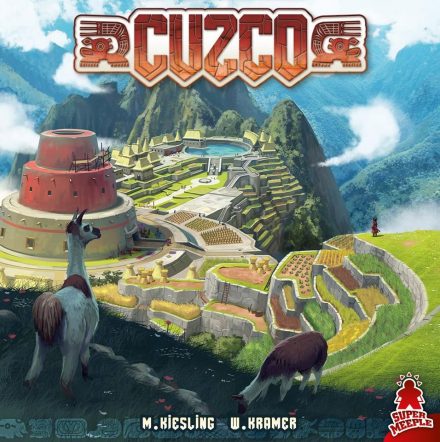
Cuzco is a new 2018 edition of Java from French publisher Super Meeple that moves the action to South America, which is in line with the other titles in the Mask Trilogy as well as the authors’ original plans for the design.
Game Mechanics:
Game Specifications:
Designed by Bruno Cathala and Ludovic Maublanc, Cleopatra and the Society of Architects is a fun and engaging game that includes a three-dimensional palace that players compete to build. Players strive to become the wealthiest of Cleopatra’s architects by constructing the most magnificent and valuable parts of her palace.
Players, however, will be tempted to trade in materials of dubious origins in order to build faster. While these corrupt practices might allow an architect to stay a step ahead of the rest, they come with a high price: the cursed corruption amulets honoring Sobek, the crocodile-god. When Cleopatra finally reaches her new palace at the end of the game, she punishes the most corrupted architects (i.e., the ones with the most amulets), depriving them of riches or giving them as a sacrifice to her crocodile! The wealthiest architect from among those still alive wins.
This new edition of Cleopatra and the Society of Architects has a new graphic design by Miguel Coimbra, a free-standing 3D palace, and rulebook updated by the designers for simplicity and fluidity, which incorporates these gameplay changes:
Game Mechanics:
Game Specifications:
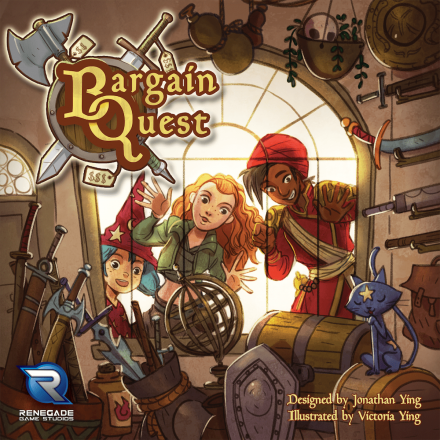
Bargain Quest is a game of adventure and capitalism for 2-6 players. Players will take the role of shopkeepers in an adventuring town plagued by monsters. Players must draft items and then secretly choose which items to place in their windows to attract wealthy heroes to their shops.
Once all heroes have been equipped, they venture out to battle against monstrous threats, earning money and prestige for the shop they represent. Throughout the game players will encounter new heroes and monsters while upgrading their shops and hiring employees. Once the third monster is defeated the player who has earned the most gold and prestige is the winner.
Game Specifications:
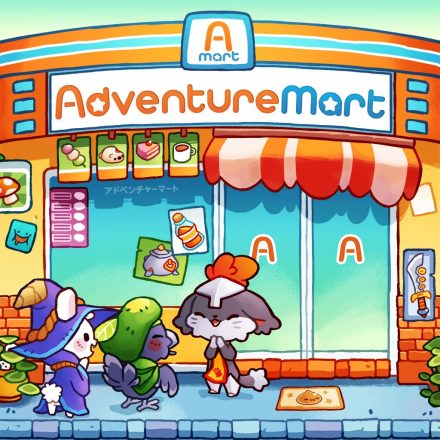
From dank dungeon entrances to magical market squares, Adventure Marts magically pop into existence wherever they are needed. Busier locations require more than one store, and each one needs a manager — that’s where you come in!
Outsmart your competition and serve a fantastical array of adventurers as you battle to make more gold than your opponents! Adventure Mart is a fresh new take on deck-building games with added twists and plenty of player interaction.
The life of a store manager is brief, but glorious. Can you become “Manager of the Week”? Or will you be banished to the abyss?
Game Mechanics:
Game Specifications:

The Abyss power is once again vacant, so the time has come to get your hands on the throne and its privileges. Use all of your cunning to win or buy votes in the Council. Recruit the most influential Lords and abuse their powers to take control of the most strategic territories. Finally, impose yourself as the only one able to rule the Abyssal people!
Abyss is a game of development, combination and collection in which players try to take control of strategic locations in an underwater city. To achieve this, players must develop on three levels: first by collecting allies, then using them to recruit Lords of the Abyss, who will then grant access to different parts of the city. Players acquire cards through a draft of sorts, and the Lords of the Abyss acquired on those cards grant special powers to the cardholder — but once you use the cards to acquire a location, that power is shut off, so players need to time their land grabs well in order to put themselves in the best position for when the game ends.
Game Specifications: