The spark of life is about to jump from your hands to spread out in the world. Deploy your mountain ranges and your deserts, spread out your oceans and your glaciers. Handle wisely your continents to form environments suitable for the apparition of animal life and maybe you’ll manage to create the most densely populated planet!
In Planet, each player receives a planet core without anything on it. Each turn, players choose a tile with mountain/ice/forest/desert on it and place it on the planet. Then the player who fulfills the most conditions for the appearance of certain animals gains its card.
Lost Ones is a “Choose Your Own Path” story utilizing map tile exploration. Each player takes on the role of a Lost One, a kidnapped youth taken to the Otherworld, home of the Fae. Thankfully, a conflict between warring Fae factions has created enough distraction for the Lost Ones to escape. Now you must explore this magical realm of dreams and nightmares and hopefully discover a way home while the remaining Fae hunt you down. Each player takes between 1 and 3 actions in a round. Once a player completes their action, any player who hasn’t taken their turn can take their actions. Repeat taking rounds until the game ends.
The harvest is in, and the artisans are hard at work preparing for the upcoming festival. Decorate the palace lake with floating lanterns and compete to become the most honored artisan when the festival begins.
In Lanterns: The Harvest Festival, players have a hand of tiles depicting various color arrangements of floating lanterns, as well as an inventory of individual lantern cards of specific colors. When you place a tile, all players (you and your opponents) receive a lantern card corresponding to the color on the side of the tile facing them. Place carefully to earn cards and other bonuses for yourself, while also looking to deny your opponents. Players gain honor by dedicating sets of lantern cards — three pairs, for example, or all seven colors — and the player with the most honor at the end of the game wins.
Part puzzle, part game. Play as either Land or Sea (or the Cartographer in a 3 player game). Each player plays with 2 double-sided hex tiles containing a mix of land and sea shapes. They take turns placing a tile each to make a map together. Land places tiles trying to complete land areas, and Sea places tiles trying to complete sea areas. Completed areas score a point per tile; land areas for Land, sea areas for Sea. Some tiles score bonus points for whoever completes the area they are in. So players may decide to strategically complete rival’s areas to gain their bonus points. Other tiles allow players to play their second tile, or steal a player’s tile – but not their last one!
Kohaku is a peaceful koi-pond-building, tile-laying game. Each turn, players will draft both a Koi and Feature tile from the central pond board to place into their personal koi pond.
Score points by surrounding flowers with koi containing matching colors, placing frogs next to koi tiles that have dragonflies, and ensuring that baby koi have a safe place to hide by placing them near rocks.
Butterflies score based on line of sight, so make sure to line them up with similar-colored koi. Turtles and statues bring a sense of balance to your pond and score points more easily, but sometimes aren’t as valuable as some of the other features.
You must carefully plan the placement of your tiles, because once they are in your pond, they can’t be moved! With no restrictions on the shape of your pond, you can build a unique layout to maximize your koi pond’s appeal.
After there are no koi tiles available to refill the central pond board, the game ends. Players will total the points scored by each feature in their pond. The player with the most points wins.
Many moons have come and gone since your boats departed on the journey to Karuba. Once you arrive on the island, each player will lead an expedition team of four adventurers. Now you just have to navigate your way through the dense jungle to make it to the temples. “Just” may be something of an understatement; the ancient jungle trails have to be found and uncovered first! Hurry up and be the first to reach the temples to collect the most valuable treasures. Many paths have dead ends and you need to be patient to find the right/best way (through the jungle). Look! A gold nugget! You can pick it up and collect it, same applies to the shiny crystals along the paths.
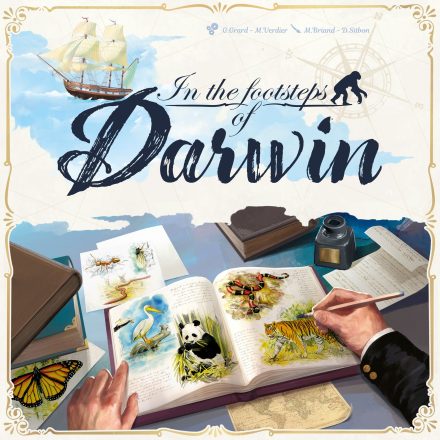
Twenty years after his expedition around the world, Charles Darwin is writing On the Origins of Species. He wants to gather new information about animal life, particularly about continents he hardly explored. Who other than young naturalists, eager for discovery, could help the renowned scholar finish writing his most famous work?
In In the Footsteps of Darwin, players are junior naturalists who have just arrived aboard the Beagle to help Charles Darwin finish his book On the Origin of Species. During this journey, you will study animals, carry out cartographic surveys, publish your findings, and develop theories. Starting with the naturalist controlling the Darwin token, naturalists take turns in clockwise order, performing these two steps in order:
Study an animal or take inspiration from a character: Choose one of the three tiles facing the Beagle and place it onto your naturalist’s notebook. It may be either an animal to study or a character from the Beagle’s previous journey who will inspire you. Gain the bonuses depicted or any additional scoring bonuses triggered by the tile’s placement.
Voyage of the Beagle: After placing a tile on your notebook, move the Beagle as many spaces forward as the distance between the Beagle and the tile you just selected (1-3 spaces), then draw a new tile to replace the empty space on the journey board.
Your goal is to score more points than your opponents to determine who contributed the most to On the Origin of Species.
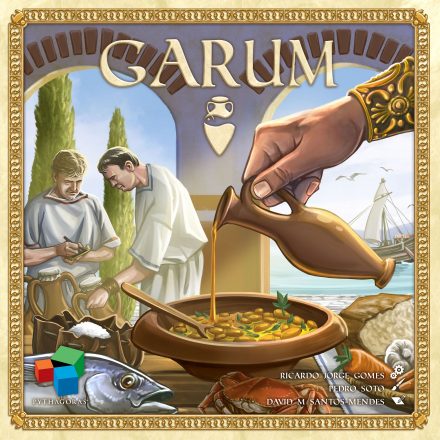
Garum was a fermented fish sauce used as a condiment in the old ages; its manufacture and export was an element of prosperity and perhaps an impetus for the Roman penetration of Lusitanian and Hispanian coastal regions.
Garum from today’s Portugal and Spain was highly prized in Rome and has now inpired a versatile strategy boardgame for the whole family, ages 8 and up, that plays 2 to 4 players. Garum is a tile-laying game, which plays in about 30 minutes, it is language independent and features endless replayability, due to its board system, that ensures no two games are alike.
In Garum, each player represents a master in the preparation of a specific type of fish sauce and receives a set of 16 Cetarian Tiles; each one has 4 spaces filled by 4 colors in different proportions, though the color that the player is defending is the predominant one.
The goal of the game is to play Cetarian Tiles strategically, in order to get a huge number of his own colour symbols in selected rows or columns – the greater the influence, the higher the reward! While placing the tiles, players may apply to score, collect some bonuses and also block their opponent’s intents. Whoever scores most points is the winner.
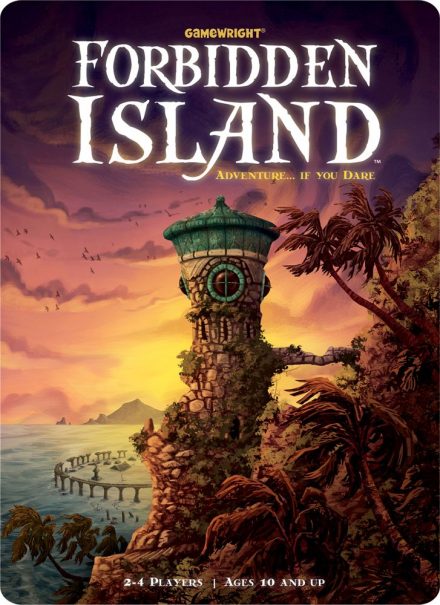
Dare to discover Forbidden Island! Join a team of fearless adventurers on a do-or-die mission to capture four sacred treasures from the ruins of this perilous paradise. Your team will have to work together and make some pulse-pounding maneuvers, as the island will sink beneath every step! Race to collect the treasures and make a triumphant escape before you are swallowed into the watery abyss!
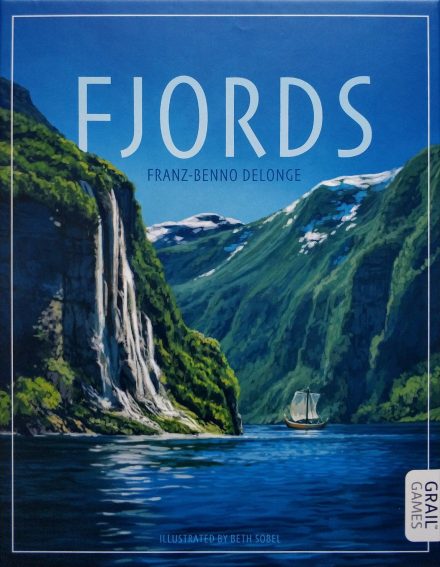
Explore a landscape so stunning that even a Viking would hold their breath in awe…
Fjords is a tile-laying game that takes place in two phases. The first one invites the players to explore the fjords around them by laying hexagonal landscape tiles, creating a map that serves as the gameboard. In the second phase, players begin from the longhouses they placed during phase one and will walk the landscape, claiming as much of the plains and cliffs as possible.
The winner of the game will be the player who has claimed the most land. Savvy placements and the ability to plan ahead yet act tactically will be your most important tools.
This new edition of Fjords differs from the original release in the following ways:
The game now plays up to four players.
The game contains five new variants/modules designed by Phil Walker-Harding. These add optional variety and flavor to the game.