

Risk
In games with Player Elimination mechanics, players can be removed from the game by various means. Players removed the game are no longer able to participate.
Possibly the most popular, mass market war game. The goal is conquest of the world.
Each player’s turn consists of:
– gaining reinforcements through number of territories held, control of every territory on each continent, and turning sets of bonus cards.
– Attacking other players using a simple combat rule of comparing the highest dice rolled for each side. Players may attack as often as desired. If one enemy territory is successfully taken, the player is awarded with a bonus card.
– Moving a group of armies to another adjacent territory.
Game Mechanics:
Game Specifications:

In JAWS, one player takes on the role of the killer shark off Amity Island, while the other 1-3 players take on the roles of Brody, Hooper and Quint to hunt the shark. Character and event cards define player abilities and create game actions for humans and the shark. Gameplay is divided into two acts — Amity Island and The Orca — played on a double-sided board to replicate the film’s story:
If humans kill the shark, they win; if the shark attack on the Orca succeeds, the great white shark wins.
Game Mechanics:
Game Specifications:
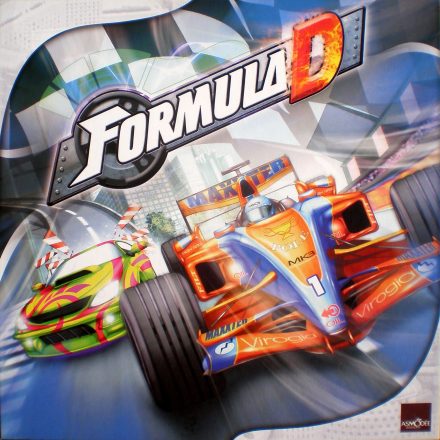
Formula D is a high stakes Formula One type racing game where the players race simulated cars with the hope of crossing the finish line first. This is a re-release of Formula Dé with several changes from the original format. Whilst old tracks can be used with the updated Formula D rules, the new game features boards that have an F1 track and a Street Track on the other side. These street tracks each have a novel inclusion or two to add greater theme –
The game mechanisms are a simple race, get to the finish line first! However, players have to use a significant amount of planning, and rely on quite a bit of luck. Each player manages when to shift gears, with each gear providing a different speed. (For example, 4th gear is a die that rolls random numbers from 7 to 12 for spaces moved.) Each turn, players may move up one gear, stay in that gear, or move down gears. This forces players to match possible rolls with the optimum distance for that turn, and hopefully plan ahead. However, speed is not the only issue! Corners have a “stop” rule that requires players to stop once, twice, or three times on that corner in consecutive turns or face a penalty. This creates an effective speed limit to the corners.
Of course, things do not always go as planned! Players take penalties if they miss their roll, bump into another car, are blocked by other cars, have to brake heavily, or have to downshift several gears. These are taken off of a car’s attributes (Tire health, Brake wear, Transmission Gears, Body, engine, and Suspension). Losing the maximum in any of these categories will result in elimination, or a severe setback for that car. This requires that players manage their car’s health, plan for their best path, and have good luck on their rolls. This high amount of luck gives the game its family appeal, and lets weaker players have a chance at winning once in a while.
However, the fun does not end with a single race! The rules include the ability to customize your cars, use a pre-generated character, add Slipstreaming (Drafting) rules and road debris, and change tire types to modify your distance rolls. There are also variations for a single lap race, or multiple laps with pit stops to repair some of your damage points. In addition, numerous expansion tracks can be purchased to vary the demands on each driver and car. Each track may also have weather effects (rain) that change car handling and die rolls due to skidding on wet track. This opens up the game for rally rules giving championship points over a number of races.
Formula D adds a few items that are not in the original Formula De: There is the added excitement of illegal racing in the streets of big cities – anything goes! This adds custom cars, nitro acceleration, drifting in the curves, dirty tricks, gun battles, and trash on the road to add more variation. A basic change is the use of a “Dashboard” with movable pegs to manage your car’s attributes instead of the paper forms from Formula De. There are also two sets of pre-painted cars; a Formula 1 set and the Street Race set of stock cars. The street cars come with “Character” profiles to give a bit of role-playing to the game. Finally, the old category of “Fuel” for the car has been renamed Transmission Wear to give a better thematic fit to the effect of multiple downshifting.
Game Mechanics:
Game Specifications:
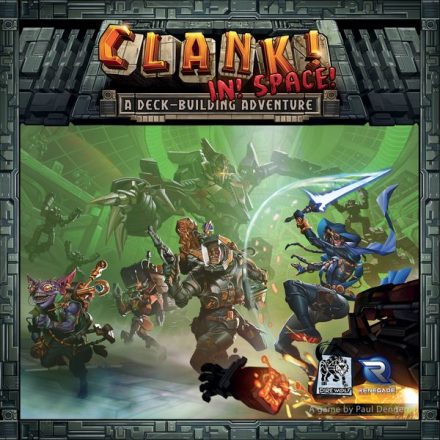
The evil Lord Eradikus has all but conquered the galaxy and is now on a victory lap across the sector in his flagship, Eradikus Prime. He may rule with an iron grip, but his most prized artifacts are about to slip through his cyborg claws. You and your fellow thieves have challenged each other to sneak aboard his ship, hack your way into its command module, and steal from him.
Along the way, you’ll recruit allies and snatch up extra loot. But one false step and — Clank! Careless noise draws the attention of Lord Eradikus. Hacking into his command module and stealing his artifacts increases his rage. You’d better hope your friends are louder than you are if you want to make it to an escape pod and get out alive…
Clank! In! Space! is built on the same game system as Clank!: A Deck-Building Adventure, with players building a personal deck of cards throughout the course of the game, with the cards allowing them to move through the spaceship, attack things, acquire new cards, and — oh yeah — make noise to attract Lord Eradikus and potentially seal their own doom.
Game Mechanics:
Game Specifications:
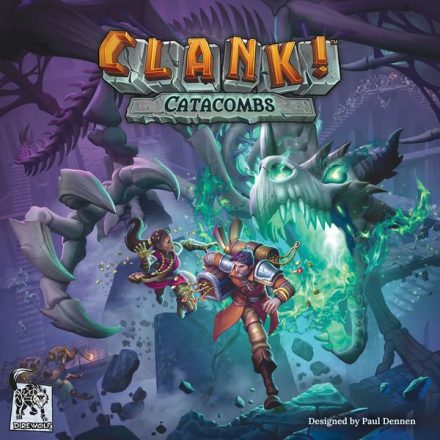
The catacombs of the skeletal dragon Umbrok Vessna are mysterious and dangerous. Portals transport you all around the dungeon depths. Wayshrines offer vast riches to intrepid explorers. Prisoners are counting on you to free them. Ghosts, once disturbed, may haunt you to death. Despite all that, it’s time to leave the board behind with Clank! Catacombs, a standalone deck-building adventure.
Each trip into the catacombs is unique since you lay tiles to create the dungeon. You can play using only the all-new dungeon deck, or you can include cards from previous Clank! expansions.
Find your fortune (and escape the dragon!) in Clank! Catacombs.
Game Mechanics:
Game Specifications:
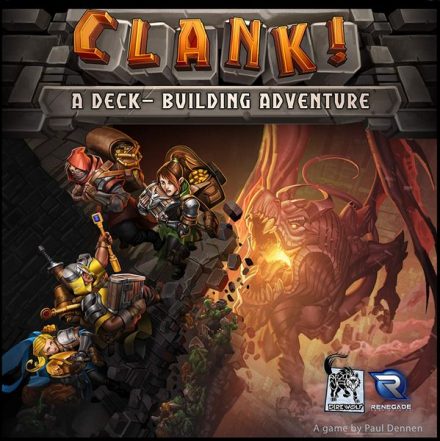
Burgle your way to adventure in the deck-building board game Clank! Sneak into an angry dragon’s mountain lair to steal precious artifacts. Delve deeper to find more valuable loot. Acquire cards for your deck and watch your thievish abilities grow.
Be quick and be quiet. One false step and CLANK! Each careless sound draws the attention of the dragon, and each artifact stolen increases its rage. You can enjoy your plunder only if you make it out of the depths alive!
Clank! is a deck-building game. Each player has their own deck, and building yours up is part of playing the game. You start each of your turns with five cards in your hand, and you’ll play them all in any order you choose. Most cards will generate resources, of which there are three different kinds:
Every time you acquire a new card, you put it face up in your discard pile. Whenever you need to draw a card and find your deck empty, you shuffle your discard pile and turn it face down to form a new deck. With each shuffle, your newest cards become part of a bigger and better deck! Each player starts with the same cards in their deck, but they’ll acquire different cards during their turns. Because cards can do many different things, each player’s deck (and strategy) will become more and more different as the game unfolds.
During the game, you have two goals:
Game Mechanics:
Game Specifications:

Betrayal at House on the Hill quickly builds suspense and excitement as players explore a haunted mansion of their own design, encountering spirits and frightening omens that foretell their fate. With an estimated one hour playing time, Betrayal at House on the Hill is ideal for parties, family gatherings or casual fun with friends.
Betrayal at House on the Hill is a tile game that allows players to build their own haunted house room by room, tile by tile, creating a new thrilling game board every time. The game is designed for three to six people, each of whom plays one of six possible characters.
Secretly, one of the characters betrays the rest of the party, and the innocent members of the party must defeat the traitor in their midst before it’s too late! Betrayal at House on the Hill will appeal to any game player who enjoys a fun, suspenseful, and strategic game.
Betrayal at House on the Hill includes detailed game pieces, including character cards, pre-painted plastic figures, and special tokens, all of which help create a spooky atmosphere and streamline game play.
Game Specifications:

The shadow of Bhaal has come over Baldur’s Gate, summoning monsters and other horrors from the darkness!
As you build and explore the iconic city’s dark alleys and deadly catacombs, you must work with your fellow adventurers to survive the terrors ahead. That is, until some horrific evil turns one — or possibly more — of you against each other. Was it a mind flayer’s psionic blast or the whisperings of a deranged ghost that caused your allies to turn traitor? You have no choice but to keep your enemies close!
Based on the award-winning Betrayal at House on the Hill board game, in Betrayal at Baldur’s Gate you’ll return to Baldur’s Gate again and again thanks to the fifty included scenarios only to discover it’s never the same game twice.
Can you and your party survive the madness, or will you succumb to the mayhem and split (or slaughter!) the party?
Game Specifications:

Decode the ancient secrets of R’lyeh by forming words with the letters you find in this sanity-sapping letter game. The more angles that appear in the words, the greater their mystical value, but beware! For each word that is created, you must roll a sanity check against its value to see if the word’s power drives you mad!
Game Mechanics:
Game Specifications:

Ultimate Werewolf is an interactive game of deduction for two teams: Villagers and Werewolves. The Villagers don’t know who the Werewolves are, and the Werewolves are trying to remain undiscovered while they slowly eliminate the Villagers one at a time. A Moderator (who isn’t on a team) runs the game.
Ultimate Werewolf takes place over a series of game days and nights. Each day, the players discuss who among them is a Werewolf and vote out a player. Each night, the Werewolves choose a player to eliminate, while the Seer learns whether one player is a Werewolf or not. The game is over when either all the Villagers or all the Werewolves are eliminated.
Ultimate Werewolf: Deluxe Edition features all new artwork, a great new design, totally rewritten and more comprehensive rules, and an even better moderator scorepad. What’s more, it supports more players than ever: 75 of your closest friends can converge on one or more villages using the components in this box.
Game Mechanics:
Game Specifications: