
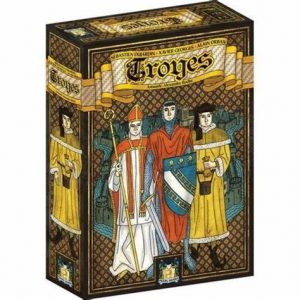
Troyes
In Troyes (pronounced “troah”), players recreate four centuries of history of this famous city of the Champagne region of France. Each player manages their segment of the population (represented by a horde of dice) and their hand of cards, which represent the three primary domains of the city: religious, military, and civil. Players can also offer cash to their opponents’ populace in order to get a little moonlighting out of them — anything for more fame!
Game Mechanics:
Game Specifications:

You are an adept of the mysterious art of alchemy, seeking a way to become the successor of the greatest alchemist ever living — Hermes Trismegistus. In order to do so you will be transmuting mere metals into pure gold, performing experiments, and inventing artifacts to finally achieve everlasting greatness.
Trismegistus: The Ultimate Formula is played over three rounds during which you will draft exactly three dice. By expertly utilizing the potency of your drafted die, you will be able to transmute precious materials, collect alchemical essences, purchase and activate artifacts, and perform experiments that will progress you along four mastery tracks. You will also build a secret hand of publication cards which — together with the value of your experiments, the completed formulas of your Philosopher’s Stone, and your collected gold — will determine your final score in victory points and, perhaps, make you the greatest alchemist, someone able to rival Hermes Trismegistus himself!
The game features custom dice, the sides of which represent alchemical materials. At the beginning of each round, the dice are rolled and grouped by their respective types. On your turn, you must either draft a new die or utilize the untapped potency of a previously drafted die. Based on the material associated with your chosen die, you will be able to collect certain essences in addition to the material to which the die is keyed. Additionally, the color of the die will determine which types of transmutations you can perform, refining raw materials and increasing your mastery of the elements.
Acquire precious artifacts in order to maximize the effects of your transmutations. Conduct experiments. Increase your knowledge and expertise and discover the ultimate formula!
The game includes a solo mode by Dávid Turczi and Nick Shaw.
Game Mechanics:
Game Specifications:

Set in ancient Rome, Trajan is a development game in which players try to increase their influence and power in various areas of Roman life such as political influence, trading, military dominion and other important parts of Roman culture.
The central mechanism of the game uses a system similar to that in Mancala or pit-and-pebbles games. In Trajan, a player has six possible actions: building, trading, taking tiles from the forum, using the military, influencing the Senate, and placing Trajan tiles on his tableau.
At the start of the game, each player has two differently colored pieces in each of the six sections (bowls) of his tableau. On a turn, the player picks up all the pieces in one bowl and distributes them one-by-one in bowls in a clockwise order. Wherever the final piece is placed, the player takes the action associated with that bowl; in addition, if the colored pieces in that bowl match the colors shown on a Trajan tile next to the bowl (with tiles being placed at the start of the game and through later actions), then the player takes the additional action shown on that tile.
What are you trying to do with these actions? Acquire victory points (VPs) in whatever ways are available to you – and since this is a Feld design, you try to avoid being punished, too. At the Forum you try to anticipate the demands of the public so that you can supply them what they want and not suffer a penalty. In the Senate you acquire influence which translates into votes on VP-related laws, ideally snagging a law that fits your long-term plans. With the military, you take control of regions in Europe, earning more points for those regions far from Rome.
All game components are language neutral, and the playing time is 30 minutes per player.
Game Mechanics:
Game Specifications:

Regarded by many as Reiner Knizia’s masterpiece, Tigris & Euphrates is set in the ancient fertile crescent with players building civilizations through tile placement. Players are given four different leaders: farming, trading, religion, and government. The leaders are used to collect victory points in these same categories. However, your score at the end of the game is the number of points in your weakest category, which encourages players not to get overly specialized. Conflict arises when civilizations connect on the board, i.e., external conflicts, with only one leader of each type surviving such a conflict. Leaders can also be replaced within a civilization through internal conflicts.
Starting in the Mayfair edition from 2008, Tigris & Euphrates included a double-sided game board and extra components for playing an advanced version of the game. This “ziggurat expansion”, initially released as a separate item in Germany for those who already owned the base game, is a special monument that extends across five spaces of the board. The monument can be built if a player has a cross of five civilization tokens of the same color by discarding those five tokens and replacing them with the ziggurat markers, placing a ziggurat tower upon the middle tile. The five ziggurat markers cannot be destroyed. All rules regarding monuments apply to the ziggurat monument as well. If your king is inside the kingdom of the ziggurat, you will get one victory point in a color of your choice at the end of your turn.
Game Mechanics:
Game Specifications:
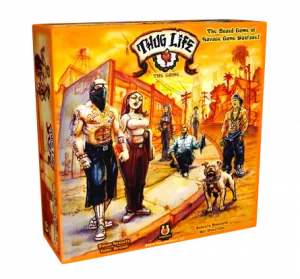
Thug Life is a miniatures combat board game for 2 to 5 players and takes 40 minutes to play.
Players takes on the role of a Boss controlling a gang of Thugs who commit crimes and fight for control of the Streets. Each turn Bosses must measure the risk/reward of upgrading their gang, committing crimes and fighting with their rivals for money, power and respect. The success or failure of these decisions determine how many points of respect a Boss earns each turn. The first Boss to earn 13 respect wins the game.
Game Mechanics:
Game Specifications:

Through the Ages is a civilization building game. Each player attempts to build the best civilization through careful resource management, discovering new technologies, electing the right leaders, building wonders and maintaining a strong military. Weakness in any area can be exploited by your opponents. The game takes place throughout the ages beginning in the age of antiquity and ending in the modern age.
One of the primary mechanisms in TTA is card drafting. Technologies, wonders, and leaders come into play and become easier to draft the longer they are in play. In order to use a technology you will need enough science to discover it, enough food to create a population to man it and enough resources (ore) to build the building to use it. While balancing the resources needed to advance your technology you also need to build a military. Military is built in the same way as civilian buildings. Players that have a weak military will be preyed upon by other players. There is no map in the game so you cannot lose territory, but players with higher military will steal resources, science, kill leaders, take population or culture. It is very difficult to win with a large military, but it is very easy to lose because of a weak one.
Victory is achieved by the player whose nation has the most culture at the end of the modern age.
Game Mechanics:
Game Specifications:
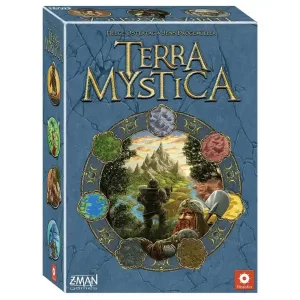
In the land of Terra Mystica dwell 14 different peoples in seven landscapes, and each group is bound to its own home environment, so to develop and grow, they must terraform neighboring landscapes into their home environments in competition with the other groups.
Terra Mystica is a full information game, without any luck, that rewards strategic planning. Each player governs one of the 14 groups. With subtlety and craft, the player must attempt to rule as great an area as possible and to develop that group’s skills. There are also four religious cults in which you can progress. To do all that, each group has special skills and abilities.
Taking turns, the players execute their actions on the resources they have at their disposal. Different buildings allow players to develop different resources. Dwellings allow for more workers. Trading houses allow players to make money. Strongholds unlock a group’s special ability, and temples allow you to develop religion and your terraforming and seafaring skills. Buildings can be upgraded: Dwellings can be developed into trading houses; trading houses can be developed into strongholds or temples; one temple can be upgraded to become a sanctuary. Each group must also develop its terraforming skill and its skill with boats to use the rivers. The groups in question, along with their home landscape, are:
Proximity to other groups is a double-edged sword in Terra Mystica. Being close to other groups gives you extra power, but it also means that expanding is more difficult…
Game Mechanics:
Game Specifications:

The great Sapa Inca Pachacuti turned to his offspring and ordered them to worship Inti, the Sun God, and to expand the Inca Empire as far as the llamas roam. With Chinchaysuyu, Antisuyu, Qullasuyu, and Kuntisuyu — the four regions of the new empire — now ripe for conquest, the time has come for Pachacuti’s true successor to arise.
Gather your people from the villages below and use their unique abilities to strategically place them where they can perform the greatest tasks for you. Climb the steps of the Sun Temple, reaping the rewards of your piety. Build structures that both nourish your people and provide you with benefits no other has at their disposal. Muster an army and conquer villages in the four realms of Tawantinsuyu. Prove yourself a worthy successor to Pachacuti and lead the Inca to glory!
During Tawantinsuyu: The Inca Empire, players place workers onto various locations on the game board, performing actions, collecting resources (potatoes, corn, stone, and gold), constructing buildings and stairs, sculpt statues, expanding their military strength, and collecting weavings.
The game board features a hill located within the old Inca capital of Cusco, the sides of which are terraced and divided into five sections. Atop the hill sits the Coricancha, The Golden Temple, the most important temple of the Inca Empire. Within the Coricancha, each player has a High Priest. On the terraced sections below exist a variety of worker placement locations, interconnected by paths and individually marked by symbols. On your turn, you must either place a worker onto a location outside the Coricancha OR choose two of the following:
When placing a worker, you must first discard a god card with a matching symbol or pay one gold. Once placed, the worker remains on the game board for the rest of the game! Each worker placement location is connected to exactly three action spaces. You must always perform at least one of these actions. However, for each adjacent worker (i.e., connected to your worker’s location via direct path through one of the action spaces) that matches the type of worker just placed, you receive one additional action!
While some locations will result in you being able to perform multiple actions, other actions and placements may be more desirable, especially since each of the five types of workers has a unique ability:
All god cards feature one of the different symbols found on the worker placement locations. Before placing a worker, you must either discard a god card with a matching symbol or pay valuable gold resources. God cards also depict special abilities that can be activated only if you have previously built a matching statue!
Army cards allow you to send one or more units to conquer villages in nearby regions. You must compete against the other players for control of each region as well as for valuable rewards that can be gained as a result of military conquest.
The position of your High Priest within the Coricancha has a significant impact on your overall strategy, affecting your access to powerful actions and determining any potential resource costs when placing your workers. More specifically, when placing a worker, you must pay additional resources the farther your worker is from your High Priest, from nothing all the way up to eight potatoes or corn!
Additionally, when moving your High Priest, you can activate powerful actions available only within the Coricancha:
Throughout the game, you score victory points whenever you construct stairs or sculpt statues. Gain bonus victory points whenever another player makes use of the stairs you have constructed. Score victory points from temple advancements and control of the four regions.
The game ends when the worker pool has become exhausted, symbolizing the full incorporation of nearby regions and villages into the newly risen Inca Empire. You then score bonus victory points from reaching the top of the temple, from your woven tapestries, and from various buildings and resources you have accumulated.
Game Mechanics:
Game Specifications:

Star Wars: Rebellion is a board game of epic conflict between the Galactic Empire and Rebel Alliance for two to four players.
Experience the Galactic Civil War like never before. In Rebellion, you control the entire Galactic Empire or the fledgling Rebel Alliance. You must command starships, account for troop movements, and rally systems to your cause. Given the differences between the Empire and Rebel Alliance, each side has different win conditions, and you’ll need to adjust your play style depending on who you represent:
Featuring more than 150 plastic miniatures and two game boards that account for thirty-two of the Star Wars galaxy’s most notable systems, Rebellion features a scope that is as large and sweeping as any Star Wars game before it.
Yet for all its grandiosity, Rebellion remains intensely personal, cinematic, and heroic. As much as your success depends upon the strength of your starships, vehicles, and troops, it depends upon the individual efforts of such notable characters as Leia Organa, Mon Mothma, Grand Moff Tarkin, and Emperor Palpatine. As civil war spreads throughout the galaxy, these leaders are invaluable to your efforts, and the secret missions they attempt will evoke many of the most inspiring moments from the classic trilogy. You might send Luke Skywalker to receive Jedi training on Dagobah or have Darth Vader spring a trap that freezes Han Solo in carbonite!
Game Mechanics:
Game Specifications:
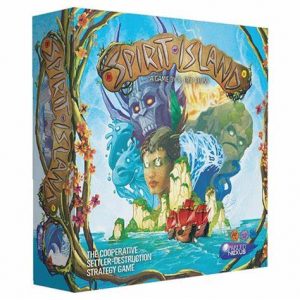
In the most distant reaches of the world, magic still exists, embodied by spirits of the land, of the sky, and of every natural thing. As the great powers of Europe stretch their colonial empires further and further, they will inevitably lay claim to a place where spirits still hold power – and when they do, the land itself will fight back alongside the islanders who live there.
Spirit Island is a complex and thematic cooperative game about defending your island home from colonizing Invaders. Players are different spirits of the land, each with its own unique elemental powers. Every turn, players simultaneously choose which of their power cards to play, paying energy to do so. Using combinations of power cards that match a spirit’s elemental affinities can grant free bonus effects. Faster powers take effect immediately, before the Invaders spread and ravage, but other magics are slower, requiring forethought and planning to use effectively. In the Spirit phase, spirits gain energy, and choose how / whether to Grow: to reclaim used power cards, to seek for new power, or to spread presence into new areas of the island.
The Invaders expand across the island map in a semi-predictable fashion. Each turn they explore into some lands (portions of the island); the next turn, they build in those lands, forming settlements and cities. The turn after that, they ravage there, bringing blight to the land and attacking any native islanders present. The islanders fight back against the Invaders when attacked, and lend the spirits some other aid, but may not always do so exactly as you’d hoped. Some Powers work through the islanders, helping them (eg) drive out the Invaders or clean the land of blight.
The game escalates as it progresses: spirits spread their presence to new parts of the island and seek out new and more potent powers, while the Invaders step up their colonization efforts. Each turn represents 1-3 years of alternate-history. At game start, winning requires destroying every last settlement and city on the board – but as you frighten the Invaders more and more, victory becomes easier: they’ll run away even if some number of settlements or cities remain. Defeat comes if any spirit is destroyed, if the island is overrun by blight, or if the Invader deck is depleted before achieving victory.
The game includes different adversaries to fight against (eg: a Swedish Mining Colony, or a Remote British Colony). Each changes play in different ways, and offers a different path of difficulty boosts to keep the game challenging as you gain skill.
Game Mechanics:
Game Specifications: