posts page

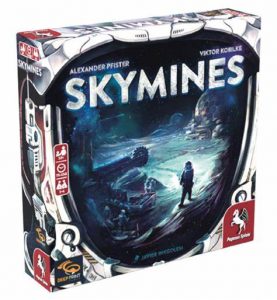
Skymines

Skymines

Skymines

Fifty years ago, humanity began mining the Moon and the asteroids, and for decades that task was firmly kept in the hands of the World Government. But the turmoils of recent years have caused this enterprise to collapse. Now, adventurous companies and private investors take to the sky to revive this mining network.

As investors, you try to earn the most CrypCoin over the course of seven rounds. You do this by investing mined resources in companies and by spreading their outposts. You can improve your earnings by supporting your scientists’ research and by having them collect precious helium-3.

The heart of Skymines is a unique card programming and hand management system that requires careful and clever planning. It provides deep player interaction by letting you invest in any of the four companies as you see fit.

And as the combination of company abilities changes each game, there are endless synergies and strategies to explore.

Game Mechanics:

  • Area Control
  • Campaign
  • Deck Building
  • Economic
  • Hand Management
  • Open Drafting
  • Stock Holding
  • Worker Placement

Game Specifications:

  • 1 – 4 Players
  • 75 – 150 Minutes
  • Difficulty Weight 3.71

Sidereal Confluence

Sidereal Confluence

Sidereal Confluence

Sidereal Confluence: Trading and Negotiation in the Elysian Quadrant is a singularly unique trading and negotiation game for 4-9 players. Over the course of the game, each race must trade and negotiate with the rest to acquire the resource cubes necessary to fund their economy and allow it to produce goods for the next turn. Scheming, dealing, and mutually beneficial agreements are key to success. While technically a competitive game, Sidereal Confluence has a cooperative feel during the trading phase as no race has the ability to thrive on its own. Trade well, and you’ll develop technologies and colonize planets to form a civilization that is the envy of the galaxy.

Each player chooses one of the nine unique and asymmetrical alien races that have come together to form a trade federation in their quadrant. Each race has its own deck of cards representing all the existing and future technologies it might research. Some races also have other cards related to unique features of their culture. These cards represent portions of the culture’s economy and require spending some number of cubes to use, resulting in an output of more cubes, ships, and possibly victory points. Since each culture’s outputs rarely match their inputs, players need to trade goods with one another to run their converters to create the resources they truly need to run their society most efficiently and have an effective economy. Almost everything is negotiable, including colonies, ships, and all kinds of resources.

Each game round contains an open trading phase in which all players can negotiate and execute deals for cubes, ships, colonies, even the temporary use of technologies! Players with enough resources can also research technologies, upgrade colonies, and spend resources on their race’s special cards during this phase. Once complete, all players simultaneously run their economies, spending resources to gain more resources. The Confluence follows, starting with players sharing newly researched technologies with all other races and following with bidding to acquire new colonies and research teams. Researching a new technology grants many victory points for the prestige of helping galactic society advance. When one race builds a new technology, it is shared with everyone else. Technologies can be upgraded when combined with other technologies.

The ultimate goal is victory points, which are acquired by researching technologies, using your economy to convert resources to goods, and converting your leftover goods into points at the end of the game.

The game is almost all simultaneous play.

Game Mechanics:

  • Auction/Bidding
  • Economic
  • Negotiation
  • Trading

Game Specifications:

  • 4 – 9 Players
  • 120 – 180 Minutes
  • Difficulty Weight 3.55

Scythe

Scythe

Scythe

It is a time of unrest in 1920s Europa. The ashes from the first great war still darken the snow. The capitalistic city-state known simply as “The Factory”, which fueled the war with heavily armored mechs, has closed its doors, drawing the attention of several nearby countries.

Scythe is an engine-building game set in an alternate-history 1920s period. It is a time of farming and war, broken hearts and rusted gears, innovation and valor. In Scythe, each player represents a character from one of five factions of Eastern Europe who are attempting to earn their fortune and claim their faction’s stake in the land around the mysterious Factory. Players conquer territory, enlist new recruits, reap resources, gain villagers, build structures, and activate monstrous mechs.

Each player begins the game with different resources (power, coins, combat acumen, and popularity), a different starting location, and a hidden goal. Starting positions are specially calibrated to contribute to each faction’s uniqueness and the asymmetrical nature of the game (each faction always starts in the same place).

Scythe gives players almost complete control over their fate. Other than each player’s individual hidden objective card, the only elements of luck or variability are “encounter” cards that players will draw as they interact with the citizens of newly explored lands. Each encounter card provides the player with several options, allowing them to mitigate the luck of the draw through their selection. Combat is also driven by choices, not luck or randomness.

Scythe uses a streamlined action-selection mechanism (no rounds or phases) to keep gameplay moving at a brisk pace and reduce downtime between turns. While there is plenty of direct conflict for players who seek it, there is no player elimination.

Every part of Scythe has an aspect of engine-building to it. Players can upgrade actions to become more efficient, build structures that improve their position on the map, enlist new recruits to enhance character abilities, activate mechs to deter opponents from invading, and expand their borders to reap greater types and quantities of resources. These engine-building aspects create a sense of momentum and progress throughout the game. The order in which players improve their engine adds to the unique feel of each game, even when playing one faction multiple times.

Game Mechanics:

  • Action Points
  • Area Control
  • Economic
  • Grid Movement
  • Tableau Building
  • Take That

Game Specifications:

  • 1 – 5 Players
  • 90 – 115 Minutes
  • Difficulty Weight 3.43

Sabika

Sabika

Sabika

On the hill of Al-Sabika in Granada, the Nasrid dynasty created one of the most impressive constructions in history, the Alhambra.

In Sabika, you play the role of one of the Nasrid nobles who contributed to the construction of the towers, gardens, and palaces of this ancient monument. In addition to this honorable task, you have to establish trade routes through Europe and the Maghreb. These routes will provide you with sufficient income to be able to take on the demanding tribute that has been commanded by the Catholic Monarchs. In exchange for your work, you will receive military protection against the various conflicts of the Taifas Kingdom.

Sabika implements a novel mechanism that integrates three interrelated rondels. Each rondel focuses on a different scenario: the construction of the Alhambra, the carving of poems in its halls, and the export of goods along the trade routes. All of this takes place over five eras (rounds), and at the end of the fifth round, the player who has accumulated the most prestige points takes the victory.

Game Mechanics:

  • Rondel

Game Specifications:

  • 1 – 4 Players
  • 60 – 120 Minutes
  • Difficulty Weight 3.91

Root

Root

Root

Root is a game of adventure and war in which 2 to 4 (1 to 6 with the ‘Riverfolk’ expansion) players battle for control of a vast wilderness.

The nefarious Marquise de Cat has seized the great woodland, intent on harvesting its riches. Under her rule, the many creatures of the forest have banded together. This Alliance will seek to strengthen its resources and subvert the rule of Cats. In this effort, the Alliance may enlist the help of the wandering Vagabonds who are able to move through the more dangerous woodland paths. Though some may sympathize with the Alliance’s hopes and dreams, these wanderers are old enough to remember the great birds of prey who once controlled the woods.

Meanwhile, at the edge of the region, the proud, squabbling Eyrie have found a new commander who they hope will lead their faction to resume their ancient birthright. The stage is set for a contest that will decide the fate of the great woodland. It is up to the players to decide which group will ultimately take root.

Root represents the next step in our development of asymmetric design. Like Vast: The Crystal Caverns, each player in Root has unique capabilities and a different victory condition. Now, with the aid of gorgeous, multi-use cards, a truly asymmetric design has never been more accessible.

The Cats play a game of engine building and logistics while attempting to police the vast wilderness. By collecting Wood, they are able to produce workshops, lumber mills, and barracks. They win by building new buildings and crafts.

The Eyrie musters their hawks to take back the Woods. They must capture as much territory as possible and build roosts before they collapse back into squabbling.

The Alliance hides in the shadows, recruiting forces and hatching conspiracies. They begin slowly and build towards a dramatic late-game presence–but only if they can manage to keep the other players in check.

Meanwhile, the Vagabond plays all sides of the conflict for their own gain, while hiding a mysterious quest. Explore the board, fight other factions, and work towards achieving your hidden goal.

In Root, players drive the narrative, and the differences between each role create an unparalleled level of interaction and replayability. Leder Games invites you and your family to explore the fantastic world of Root!

Game Mechanics:

  • Area Control
  • Area Movement
  • Dice Rolling
  • Hand Management
  • Racing
  • Wargame

Game Specifications:

  • 2 – 4 Players
  • 60 – 90 Minutes
  • Difficulty Weight 3.74

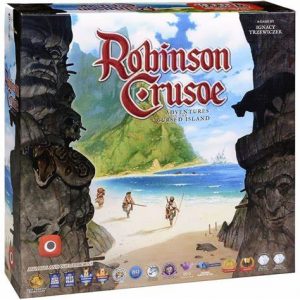
Robinson Crusoe: Adventures on the Cursed Island

Robinson Crusoe: Adventures on the Cursed Island

Robinson Crusoe: Adventures on the Cursed Island

Robinson Crusoe: Adventures on the Cursed Island is a game created by Ignacy Trzewiczek, the author of Stronghold. This time Trzewiczek takes the players to a deserted island, where they’ll play the parts of shipwreck survivors confronted by an extraordinary adventure. They’ll be faced with the challenges of building a shelter, finding food, fighting wild beasts, and protecting themselves from weather changes. Building walls around their homes, animal domestication, constructing weapons and tools from what they find, and much more await them on the island. The players decide in which direction the game will unfold and – after several in-game weeks of hard work – how their settlement will look. Will they manage to discover the secret of the island in the meantime? Will they find a pirate treasure, or an abandoned village? Will they discover an underground city or a cursed temple at the bottom of a volcano? Answers to these questions lie in hundreds of event cards and hundreds of object and structure cards that can be used during the game…

Robinson Crusoe: Adventures on the Cursed Island is an epic game from Portal. You will build a shelter, palisade, weapons, you will create tools like axes, knives, sacks, you will do everything you can to… to survive. You will have to find food, fight wild beasts, protect yourself from weather changes…

Take the role of one of four characters from the ship crew (cook, carpenter, explorer, or soldier) and face the adventure. Use your determination skills to help your teammates, discuss with them your plan, and put it into practice. Debate, discuss, and work on the best plan you all can make.

Search for treasures. Discover mysteries. Follow goals of six different, engaging scenarios. Start by building a big pile of wood and setting it on fire to call for help, and then start new adventures. Become an exorcist on cursed Island. Become a treasure hunter on Volcano Island. Become a rescue team for a young lady who’s stuck on rock island…

Let the adventure live!

Game Mechanics:

  • Action Points
  • Area Movement
  • Campaign
  • Cooperative
  • Dice Rolling
  • Narrative Choice
  • Tile Placement
  • Worker Placement

Game Specifications:

  • 1 – 4 Players
  • 60 – 120 Minutes
  • Difficulty Weight 3.80

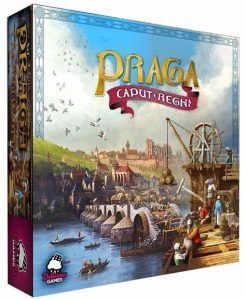
Praga Caput Regni

Praga Caput Regni

Praga Caput Regni

Charles IV has been crowned King of Bohemia and ruler of the Holy Roman Empire. From his castle in Prague, he oversees construction of new fortifications: a bridge across the Vltava River, a university, and a cathedral rising within the walls of the castle itself. Prague is already among the largest cities in Europe. King Charles will make it the capital of an empire!

In Praga Caput Regni, players take the role of wealthy citizens who are organizing various building projects in medieval Prague. By expanding their wealth and joining in the construction, they gain favor with the king. Players choose from six actions on the game board — the “action crane” — that are always available, but which are weighted with a constantly shifting array of costs and benefits. By using these actions, you can increase your resources, improve the strength of your chosen actions, and build “New Prague City”, the Charles Bridge, or city walls. You can possibly gain additional actions or even participate in the construction of St. Vitus Cathedral.

Clever players will discover synergies between carefully timed actions and the rewards from constructing civic projects as all of the mechanisms mesh together. At the end of the game, the player who most impressed King Charles wins.

Game Mechanics:

  • Area Control
  • City Building
  • Puzzle
  • Tile Placement

Game Specifications:

  • 1 – 4 Players
  • 45 – 150 Minutes
  • Difficulty Weight 3.74

Polis

Polis

Polis

Polis is a two-player civ-lite game set in the beginning of the conflict between the two major poleis of the 5th century B.C: Athens and the Delian League against Sparta and the Peloponnesian League. The winner will be the Empire with more population and prestige at the end of the game.

Both players must secure their supplies and the routes to five markets to trade with them. Every turn you get goods from a territory where you have population supporting your Empire, but you should feed them.

You can fight to control the territories and siege other polis or you might use your diplomacy to convince a polis to join your league. But polis are proud of their independence so you will have to create some projects to gain prestige needed for your military manoeuvres.

This new edition of Polis has updated revised rules and new art that will enhance your game experience.

Game Mechanics:

  • Area Control
  • Area Movement
  • Dice Rolling
  • Economic
  • Wargame

Game Specifications:

  • 2 Players
  • 60 – 120 Minutes
  • Difficulty Weight 3.86

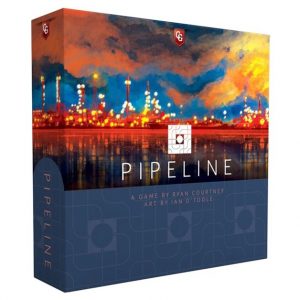
Pipeline

Pipeline

Pipeline

The refinement of oil has long been part of the government-controlled energy sector. Amassed with an incredibly complex and inefficient system of refineries, the government has felt the severe pressures of worldwide demand and the ever-increasing global standards for refinement. Unable to keep up with demand, the government has only one option: privatizing the oil industry.

This is where you come in. Seeking to capitalize on this new opportunity, in Pipeline you start a company in the oil business. You will focus on building a much more efficient pipeline network in your refinery, hiring experts that provide valuable benefits over your competitors, and managing the logistics of purchasing and selling your refined oil in the various markets. You will need more than strong economic skills – carefully crafting an interweaving network of pipelines just might ensure your victory!

Game Mechanics:

  • Action Drafting
  • Economic
  • Network Building
  • Tile Placement

Game Specifications:

  • 2 – 4 Players
  • 60 – 120 Minutes
  • Difficulty Weight 3.89

Pax Pamir

Pax Pamir

Pax Pamir

In Pax Pamir, players assume the role of nineteenth century Afghan leaders attempting to forge a new state after the collapse of the Durrani Empire. Western histories often call this period “The Great Game” because of the role played by the Europeans who attempted to use central Asia as a theater for their own rivalries. In this game, those empires are viewed strictly from the perspective of the Afghans who sought to manipulate the interloping ferengi (foreigners) for their own purposes.

In terms of game play, Pax Pamir is a pretty straightforward tableau builder. Players spend most of their turns purchasing cards from a central market, then playing those cards in front of them in a single row called a court. Playing cards adds units to the game’s map and grants access to additional actions that can be taken to disrupt other players and influence the course of the game. That last point is worth emphasizing. Though everyone is building their own row of cards, the game offers many ways for players to interfere with each other directly and indirectly.

To survive, players will organize into coalitions. Throughout the game, the dominance of the different coalitions will be evaluated by the players when a special card, called a “Dominance Check”, is resolved. If a single coalition has a commanding lead during one of these checks, those players loyal to that coalition will receive victory points based on their influence in their coalition. However, if Afghanistan remains fragmented during one of these checks, players instead will receive victory points based on their personal power base.

After each Dominance Check, victory is checked and the game will be partially reset, offering players a fresh attempt to realize their ambitions. The game ends when a single player is able to achieve a lead of four or more victory points or after the fourth and final Dominance Check is resolved.

Game Mechanics:

  • Action Points
  • Area Control
  • Area Movement
  • Economic
  • Hand Management
  • Negotiation
  • Open Drafting
  • Tableau Building

Game Specifications:

  • 1 – 5 Players
  • 45 – 120 Minutes
  • Difficulty Weight 3.83