posts page

Bloody Inn, The

France 1831: In a remote corner of Ardèche, the little village of Peyrebeille sees numerous travelers pass through. A family of greedy rural farmers is determined to make its fortune and has devised a diabolical stratagem to achieve this goal: Invest in an inn so they can rob traveling guests, getting rich without arousing the suspicions of the police! Whether or not their plan will work out, one thing is certain: Not every guest will leave this inn alive.

The Bloody Inn is a card game in which you play one member of a family of greedy, murderous innkeepers. At the start of each round, cards are placed face up to fill the inn with guests. Each card carries a cost representing how many cards a player must discard from her hand in order to take an action related to that card. Certain guests have an affinity for particular actions, so those cards return to a player’s hand after being discarded. Cards also show how much money, in francs, each guest possesses. A round has two phases in which players take one action each, in turn order. Players choose one of the following actions:

  • bribe a guest into becoming an accomplice (take a card from the inn to their hand)
  • build an annex (move a card from their hand to their player area; it now represents a structure under which a victim may be buried)
  • kill a guest (move a card from the inn to their player area, awaiting burial)
  • bury a victim (place an unburied victim card under an annex card and take the money from the victim’s pockets)
  • launder money (players may only have a certain amount of cash on hand; excess must be converted to 10F checks by the local notary)

At the end of the round, if any room of the inn contains one of the police, then they conduct an investigation; if a player has any unburied victims, then he must pay 10F per victim to the local gravedigger to hurriedly — and quietly — bury the bodies! Lastly in the round, any cards (accomplices) in each player’s hand must be paid 1F each. After the guest deck has been depleted the second time, players take a final round, then tally their francs. The player with the most money wins!

Game Mechanics:

  • Hand Management
  • Open Drafting
  • Solo / Solitaire Game

Game Specifications:

  • 1 – 4 Players
  • 30 – 60 Minutes
  • Difficulty Weight 2.36

Block and Key

In Block and Key, adventurers place 3D clay blocks in a centralized raised playing area, with the goal of completing their own request cards. The challenge is made more interesting as each player is limited to their “2D” viewpoint.

Each turn adventurers may either draw new blocks from the supply, or place ONE block into the shared space. They may then check to see if they have completed any request cards before filling their hand.

The first adventure to complete the number of request cards required by the player count ends the game. Scores will be tallied and one player named the victor.

Game Mechanics:

  • Open Drafting
  • Pattern Building
  • Stacking and Balancing

Game Specifications:

  • 1 – 4 Players
  • 20 – 40 Minutes
  • Difficulty Weight 1.69

Blitzkrieg!: World War Two in 20 Minutes

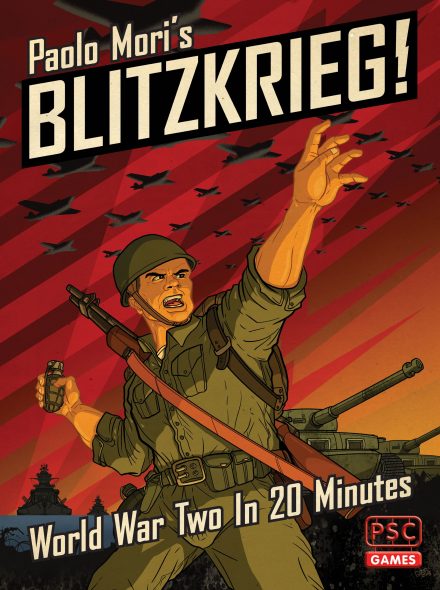
Recreate World War Two in 20 minutes! The perfect wargame for non-wargamers, Blitzkrieg! allows two players to battle across the War’s most iconic theatres, winning key campaigns and building military might.

Players draw army tokens from a bag to determine their starting forces and to replenish their losses. Rather than ‘fighting’ battles with dice or cards, players allocate their military resources to each theatre’s campaigns, winning victory points, further resources, special weapons, and strategic advantages as they play. Refight World War Two several times in one evening!

Includes Solo mode by Dávid Turczi.

Game Mechanics:

  • Area Majority / Influence
  • Deck Building
  • Hand Management
  • Race
  • Solo / Solitaire Game
  • Take That
  • Worker Placement

Game Specifications:

  • 1 – 2 Players
  • 20 – 45 Minutes
  • Difficulty Weight 1.92

Black Forest

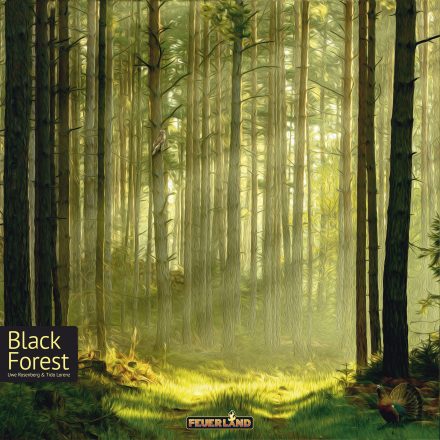
In Black Forest, you start out with a small domain in need of new buildings and livestock. You’ll travel from village to village, to enlist the aid of the best specialists. Exploiting the abilities of these specialists lets you collect resources, lay out new landscape tiles (e.g. ponds and fields), and build a variety of buildings, which come in four types. Choose the right buildings, place landscapes, fire up your glass production, and expand your domain.

Uwe Rosenberg’s resource wheels, made famous in Glass Road (2013), return in Black Forest. Two resource wheels on your tableau help you keep track of your resources and production. Black Forest continues the story – as the name suggests — in the Black Forest. Among others, the main difference between the two games is the use of worker placement in Black Forest instead of simultaneous action selection.

A wide selection of buildings and their different effects offer many different paths to victory.

Game Mechanics:

  • Set Collection
  • Solo / Solitaire Game
  • Tile Placement
  • Variable Set-up
  • Worker Placement

Game Specifications:

  • 1 – 4 Players
  • 60 – 120 Minutes
  • Difficulty Weight 3.23

Biohack

Dr. Johann Maischberger caused a stir in the scientific academia for playing god with his experiments. The young researchers involved in his experiments were all expelled from the academia due to this unethical work.
This incident was known as the “Biohack Incident.”

And then, twenty years later.

Dr. Maischberger’s daughter is trying to bring back the experiment back to life once again. However, the blueprints left behind by her father were incomprehensible to ordinary people. Thus, they called upon the “mad scientists,” namely those who were expelled from the academia.

Biohack is a medium-complexity game for 1-4 players. Each players will use workers called “Noman” to procure funds and DNAs, then create new creatures. The scientists, who are the players’ avatars, have various abilities. In addition, the creatures created by the experiments will also bring various beneficial effects. The game ends after the designated number of rounds or if a player able to creates 7 creatures. The players will tally all of their Evaluation Points and the player who has the most Evaluation Points wins the game.

Game Mechanics:

  • Open Drafting
  • Set Collection
  • Solo / Solitaire Game
  • Worker Placement

Game Specifications:

  • 1 – 4 Players
  • 60 – 90 Minutes
  • Difficulty Weight 2.73

Bigfoot vs. Yeti

A battle is brewing between the undisputed king of the cryptids Bigfoot and his stone cold cousin the Yeti, who is sick of playing second fiddle.

In Bigfoot vs. Yeti, you are an up and coming cryptozoologist mounting expeditions in the hopes of proving the existence of unknown creatures such as Bigfoot, Yeti, The Loch Ness Monster, the Jersey Devil or Extraterrestrials. Your ultimate goal is to gain fame and fortune by being the first cryptozoologist credited with the actual discovery of a new species, making you world famous. Somehow you have landed yourself smack dab in the middle of feud between Bigfoot and Yeti so it’s time to choose your side as it will help shape the fate of your research and ultimately your success!

During each turn in the game, players draw from either the Unknown (deck) or from the top of Tabloids (discard pile). Each player mounts or joins expeditions for the various cryptids in the hope of reaching ten or more points in play. If ten or greater points is achieved that expedition would be considered to have found enough proof for science to take notice, thereby doubling that expedition’s score. Also during each turn a single Action card may be played which can do things like strengthen the value of an expedition in play, retrieve cards from the Tabloids or manipulate other facets of the game. Each cryptid has an ability that will help you in some way and is triggered when you play them. At the end of a round, cards in the Tabloids that match expeditions in play discredit that expedition. The game also has a shutout rule involving Extraterrestrials that, if achieved, prevents all other players from scoring that round.

Game Mechanics:

  • Hand Management
  • Set Collection

Game Specifications:

  • 2 – 4 Players
  • 30 – 60 Minutes
  • Difficulty Weight 2.00

Big Book of Madness, The

So far your first year at the Elementary College has been slightly disappointing. They taught you to light a flickering flame at the tip of your finger, but other than that you’ve spent much more time reading books than learning powerful spells as future great wizards like you should.

So when you heard about the Big Book of Madness hidden in the great school library, you couldn’t help but to sneak in and peek in this intriguing tome in spite of your professors’ warnings. When you slowly lift the cover of the terrible book, dozens of dreadful creatures rush out, threatening to destroy the world itself! This was your mistake, and only you can fix it now! Learn from the library to fight back against the monsters, and try not to sink into insanity…

The Big Book of Madness is a challenging co-operative game in which the players are magic students who must act as a team to turn all the pages of the book, then shut it by defeating the terrible monsters they’ve just freed.

Each player has their own element deck that they build during the game and use for several purposes, such as learning or casting a spell, adding a new element to their deck, destroy or healing a curse. Spells allow you to support your playmates, improve your deck, draw cards, etc. — but the monsters from the book fight back. Each comes with terrible curses that are triggered every turn unless you dispel them in time. They will make you discard elements, add madness cards to your deck, or lose spells…

If you manage to turn six pages and defeat all of the monsters, you win the game!

Game Mechanics:

  • Cooperative Game
  • Hand Management
  • Player Elimination
  • Variable Player Powers

Game Specifications:

  • 2 – 5 Players
  • 30 – 60 Minutes
  • Difficulty Weight 2.68

Biblios: Quill and Parchment

A “roll and write” version of the popular Biblios.

The life of a monastic scribe is not easy. Every day you spend long hours in the monastery copying books, praying, and performing tasks. Through hard work and prayer, earn the abbot’s trust and display your dedication to the pious life.

The object of the game is to score the most piety points. The game consists of 8 days (i.e., rounds). In the first 4 days, players simultaneously roll their own dice (that show various book types, abbot influence and travel points) and may do so up to 3 times. After each roll, the players have 3 options: (1) to keep the dice as shown, (2) to reroll exactly one die or (3) to roll all the dice.

Most of the dice are resource dice showing books monks are copying, but there are also abbot influence dice (abbot influences is accrued in the first half, but spent in the second half of the game), and a travel die (allowing a player’s novice to go out into towns to do good works and find more books).

In the last 4 rounds, players use their abbot influence to bid for a priority of tasks.

This is a rare (if not unique) “roll + write” game that includes auctions and, unlike many roll + write game; it is highly interactive.

After 8 days, the game ends and the players calculate scores. As in the original Biblios, the relative value of books changes during the game, so players are unsure of which books will be most valuable until the end of the game.

Game Mechanics:

  • Action Drafting
  • Push Your Luck
  • Set Collection

Game Specifications:

  • 1 – 4 Players
  • ~40 Minutes
  • Difficulty Weight 2.08

Beyond the Horizon

Beyond the Horizon is a civilization game in which players compete to become the most influential society in history through exploration and expansion, development and production, research and technological advancement.

The game is played over a variable number of rounds until enough goals have been achieved to signal the end of the game. Along the way, players will earn points for exploring new lands, settling and building new cities, advancing technologically, and increasing their cultural and economic development. The player with the most points at the end of the game wins.

Game Mechanics:

  • Area Majority / Influence
  • Tile Placement
  • Worker Placement

Game Specifications:

  • 2 – 4 Players
  • 90 – 120 Minutes
  • Difficulty Weight 3.42

AQUA: Biodiversity in the Ocean

In AQUA, your starting point is a hot spot that gradually becomes surrounded by expanding coral formations. These corals serve as habitats for small marine animals. By fostering biodiverse habitats, you can then create ideal conditions for attracting the largest marine animals.

AQUA plays over 17 rounds. On your turn, you must take a new coral tile from the market and add it to your reef, then you may also attract animals to your ecosystem if you create the correct patterns of coral.

At the end of the game, the player who grew the best coral formations and attracted the most large and small sea animals will score the most points and win.

AQUA invites you to dive into the beauty and wonder of the ocean, delivering an incredible variety of gameplay experiences for the whole family.

Game Mechanics:

  • Open Drafting
  • Pattern Building
  • Tile Placement
  • Variable Set-up

Game Specifications:

  • 1 – 4 Players
  • 30 – 45 Minutes
  • Difficulty Weight 2.08