Tag: Bluffing

Bluffing board games typically require players to lie to each other to gain a competitive advantage.

The Court of Miracles

The Court of Miracles

The Court of Miracles

In The Court of Miracles, lead a guild of beggars, plot, use trickery and opportunism to build your renown and take over the old 16th century Paris.

Your goal is to establish your renown in Paris or to be the most influential when the Penniless King would have reached the end of his path…

At your turn, you may play a plot card, you have to place one of your (3) Rogue tokens, face down (secret ability), on any available spot in a neighborhood, and benefit from the effect of your spot (receive coins, draw plot cards or move the Penniless King forward along his path). You may then perform the action of the neighborhood.

When a neighborhood is fully occupied, settle a standoff revealing each player’s Rogue(s) token to know which player takes control of the neighborhood. Controlling a neighborhood will reward you each time another player performs its action.

You will be allowed to buy a 4th Rogue, cards or move the Penniless King Forward at the Renown Square.

Unless the Penniless King reaches the last space of his path before, the first player to place their 6th Renown token wins. Otherwise, the player with the most Renown tokens placed on the board wins the game.

Game Mechanics:

  • Area Control
  • Bluffing
  • Worker Placement

Game Specifications:

  • 2 – 5 Players
  • ~40 Minutes
  • Difficulty Weight 2.22

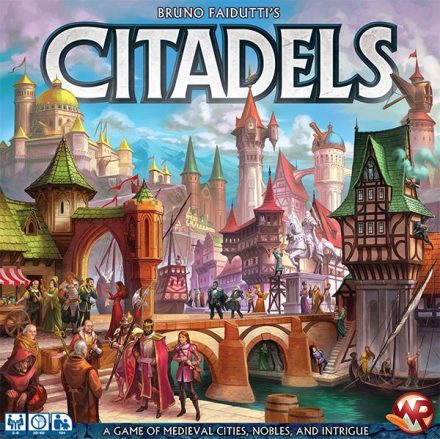
Citadels

In Citadels, players take on new roles each round to represent characters they hire in order to help them acquire gold and erect buildings. The game ends at the close of a round in which a player erects their seventh building. Players then tally their points, and the player with the highest score wins.

Players start the game with a number of building cards in their hand; buildings come in five colors, with the purple buildings typically having a special ability and the other colored buildings providing a benefit when you play particular characters. At the start of each round, the player who was king the previous round discards one of the eight character cards at random, chooses one, then passes the cards to the next player, etc. until each player has secretly chosen a character. Each character has a special ability, and the usefulness of any character depends upon your situation, and that of your opponents. The characters then carry out their actions in numerical order: the assassin eliminating another character for the round, the thief stealing all gold from another character, the wizard swapping building cards with another player, the warlord optionally destroys a building in play, and so on.

On a turn, a player earns two or more gold (or draws two building cards then discards one), then optionally constructs one building (or up to three if playing the architect this round). Buildings cost gold equal to the number of symbols on them, and each building is worth a certain number of points. In addition to points from buildings, at the end of the game a player scores bonus points for having eight buildings or buildings of all five colors.

The 2016 edition of Citadels includes twenty-seven characters — eight from the original Citadels, ten from the Dark City expansion, and nine new ones — along with thirty unique building districts, and the rulebook includes six preset lists of characters and districts beyond the starter list, each crafted to encourage a different style and intensity of gameplay.

Game Mechanics:

  • Bluffing
  • City Building
  • Deduction
  • Set Collection
  • Take That
  • Variable Player Powers
  • Variable Set-up

Game Specifications:

  • 2 – 8 Players
  • 30 – 60 Minutes
  • Difficulty Weight 2.07

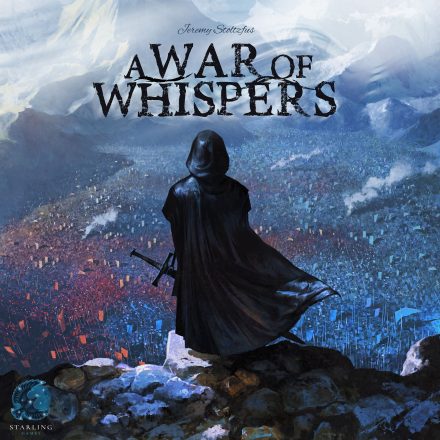
A War of Whispers 🟢

A War of Whispers is a competitive board game for 2 to 4 players. Five mighty empires are at war for the world, but you are no mighty ruler. Instead, you play a secret society that is betting on the results of this war while pulling strings to rig the results and ensure their bets pay off. A War of Whispers is a game of deep strategy, hidden agendas, and shifting loyalties.

You start the game with five loyalty tokens, each corresponding to one of the five different empires, bet randomly on a loyalty value. Your primary goal is to ensure that when the game ends, the empires you are most loyal to control the most cities across the globe. Gameplay consists of turns broken down into four phases:

  1. Deploy agents phase: In player order (starting with the first player and proceeding clockwise), each player removes, then deploys agents to empire councils, the positions on the board marked Sheriff, Steward, Marshall, and Chancellor.
  2. Empire turns phase: Each council position on each empire council will take an action. If a player has acquired cards, they may play them during this phase.
  3. Cleanup phase: Add the turn marker to the next space on the turn tracker, then each player discards down to the hand limit of five cards.
  4. Swap phase: In player order, each player may swap two of their unrevealed loyalty tokens. If you choose to do so, you must reveal both of the swapped loyalty tokens. They remain revealed for the rest of the game.

Gameplay repeats itself in this order four times. When the last space on the turn track is filled, the game ends immediately and scoring commences. The player with the most points based off their empire loyalties and the cities they control wins.

Game Mechanics:

  • Area Control
  • Bluffing
  • Take That
  • Wargame
  • Worker Placement

Game Specifications:

  • 2 – 4 Players
  • 30 – 60 Minutes
  • Difficulty Weight 2.57

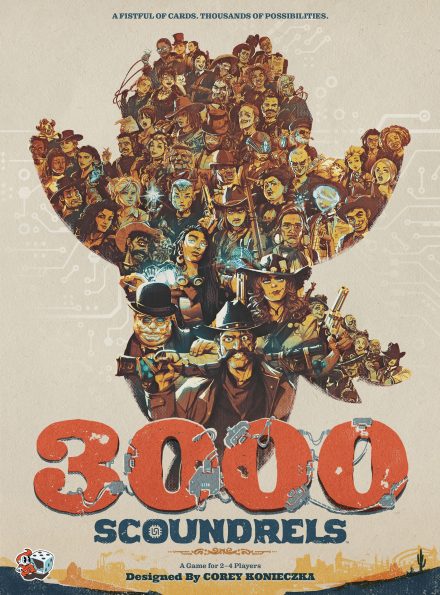
3000 Scoundrels 🟢

“The Traveler brought much change to our small frontier town in the last five years. He showed us marvels beyond imagination and taught us how to use his strange machines. Now that the Traveler has vanished, a storm is coming. Who will control the destiny of the American Frontier?”

In 3000 Scoundrels, players assume the roles of rival leaders attempting to steal precious technology left behind by the Traveler. By overlaying clear cards, you create unique scoundrels and use them to outsmart your foes. In short, hire scoundrels to build powerful combos, steal technology, and outsmart your foes.

Each turn, you play a poker card from your hand face down in front of your player board, then use all abilities matching your claimed number. You don’t need to tell the truth when claiming a number, but if an opponent catches you bluffing, it will damage your reputation and decrease your odds of winning the game.

Each leader has a unique perspective and motivation in the conflict of Graystone Gulch. Are you driven by money, fame, or the deep-seated desire to improve the world? Advanced rules add unique strategies to each leader that reflect their unique strengths and cunning tricks.

Game Mechanics:

  • Deduction
  • Open Drafting

Game Specifications:

  • 2 – 4 Players
  • 60 – 90 Minutes
  • Difficulty Weight 2.18

Wits & Wagers Family

Wits & Wagers Family

Wits & Wagers Family

Wits & Wagers Family is the family version of the most award winning party game in history.
This edition is more simple, has less down time, and is more portable than the original Wits & Wagers. It also removes the “gambling” element and has questions that are appropriate for kids and the whole family. Most importantly, Wits & Wagers Family makes use of the beloved Meeple playing piece!

Game Mechanics:

  • Bluffing
  • Paper and Pencil
  • Party Game
  • Trivia

Game Specifications:

  • 3 – 10 Players
  • ~20 Minutes
  • Difficulty Weight 1.10

Ultimate Werewolf: Deluxe Edition

Ultimate Werewolf: Deluxe Edition

Ultimate Werewolf: Deluxe Edition

Ultimate Werewolf is an interactive game of deduction for two teams: Villagers and Werewolves. The Villagers don’t know who the Werewolves are, and the Werewolves are trying to remain undiscovered while they slowly eliminate the Villagers one at a time. A Moderator (who isn’t on a team) runs the game.

Ultimate Werewolf takes place over a series of game days and nights. Each day, the players discuss who among them is a Werewolf and vote out a player. Each night, the Werewolves choose a player to eliminate, while the Seer learns whether one player is a Werewolf or not. The game is over when either all the Villagers or all the Werewolves are eliminated.

Ultimate Werewolf: Deluxe Edition features all new artwork, a great new design, totally rewritten and more comprehensive rules, and an even better moderator scorepad. What’s more, it supports more players than ever: 75 of your closest friends can converge on one or more villages using the components in this box.

Game Mechanics:

  • Bluffing
  • Deduction
  • Negotiation
  • Party Game
  • Player Elimination
  • Role Playing
  • Team Based

Game Specifications:

  • 5 – 75 Players
  • ~30 Minutes
  • Difficulty Weight 1.47

Timeline Challenge

Timeline Challenge

Timeline Challenge

Timeline is a card game played using 110 cards. Each card depicts a historical event on both sides, with the year in which that event occurred on only one side. Players take turns placing a card from their hand in a row on the table. After placing the card, the player reveals the date on it. If the card was placed correctly with the date in chronological order with all other cards on the table, the card stays in place; otherwise, the card is removed from play and the player takes another card from the deck.

The first player to get rid of all his cards by placing them correctly wins. If multiple players go out in the same round, then everyone else is eliminated from play and each of those players are dealt one more card for another round of play. If only one player has no cards after a bonus round, he wins; otherwise play continues until a single player goes out.

Timeline Challenge incorporates the original mechanic of the series into progressive game track, of which players can move between 0-4 spaces per turn. Players will have to make use of pre-determined time periods and guess where the incident depicted on the card occurred. There are four different challenges, and they are played depending on the color of the game space of the lead player. Additionally, there are two further challenges which allow the two players at the back of the pack to catch up. Although the game comes with its own cards, it can be integrated with any or all of the previous sets.

Game Mechanics:

  • Bluffing
  • Trivia

Game Specifications:

  • 2 – 10 Players
  • ~30 Minutes
  • Difficulty Weight 1.31

Survive: Escape from Atlantis!

Survive: Escape from Atlantis!

Survive: Escape from Atlantis!

Survive is a cutthroat game where players seek to evacuate their pieces from an island that is breaking up, while remembering where their highest-valued pieces are located to maximize their score.

An island made up of 40 hex-tiles is slowly sinking into the ocean (as the tiles are removed from the board). Each player controls ten people (valued from 1 to 6) that they try and move towards the safety of the surrounding islands before the main island finally blows up. Players can either swim or use boats to travel but must avoid sea serpents, whales and sharks on their way to safety.

Game Mechanics:

  • Action Points
  • Bluffing
  • Dice Rolling
  • Grid Movement
  • Memory
  • Take That

Game Specifications:

  • 2 – 4 Players
  • 45 – 60 Minutes
  • Difficulty Weight 1.70

Super Mario: Level Up!

Super Mario: Level Up!

Super Mario: Level Up!

In Super Mario Level Up! join Mario and his pals as you advance them up the Mushroom Kingdom while challenging other players to gather the most coins and reach the castle at the top.

Each player starts with a unique line-up of characters that they are trying to score the most points with. Players take turns moving any character up the board until a character gets to the top.

Once a character is advanced to the top board, players vote to see if the character stays or is kicked off the Mushroom Kingdom. It takes only one NO vote to get them off the board. And players should use the NO votes wisely as each player only has two NO votes in their hand. The round ends when the character is unanimously voted to stay at the top.

Score up your points and play another round. Game ends after three rounds.

Game Mechanics:

  • Bluffing
  • Deduction
  • Racing

Game Specifications:

  • 3 – 6 Players
  • 10 – 30 Minutes
  • Difficulty Weight 1.25

Sunken Sailor

Sunken Sailor

Sunken Sailor

Sunken Sailor is a game of deceit, sailor stories and skillful drawing. Each player is a sailor, but only one is the Sunken Sailor – can you figure out who? Sailors collectively draw an object that recounts a rowdy adventure you all shared. BUT there is a sailor among you that cannot recall the adventure and doesn’t know what is being drawn – that is the Sunken Sailor. The Sunken Sailor wants to keep their identity from the other sailors and to try to piece together what everyone is drawing. Sailors win if they can figure out who the Sunken Sailor is. The Sunken Sailor wins if he or she can go undetected or figure out what is being drawn.

Game Mechanics:

  • Bluffing
  • Deduction
  • Line Drawing
  • Party Game

Game Specifications:

  • 3 – 8 Players
  • 20 – 40 Minutes
  • Difficulty Weight 1.00