posts page

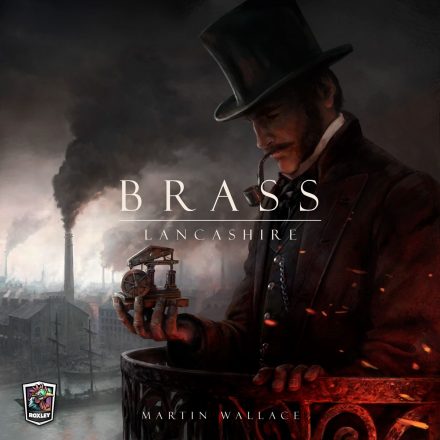
Brass: Lancashire

Brass: Lancashire — first published as Brass — is an economic strategy game that tells the story of competing cotton entrepreneurs in Lancashire during the industrial revolution. You must develop, build, and establish your industries and network so that you can capitalize demand for iron, coal and cotton. The game is played over two halves: the canal phase and the rail phase. To win the game, score the most victory points (VPs), which are counted at the end of each half. VPs are gained from your canals, rails, and established (flipped) industry tiles. Each round, players take turns according to the turn order track, receiving two actions to perform any of the following:

  1. Build an industry tile
  2. Build a rail or canal
  3. Develop an industry
  4. Sell cotton
  5. Take a loan

At the end of a player’s turn, they replace the two cards they played with two more from the deck. Turn order is determined by how much money a player spent on the previous turn, from lowest spent first to highest spent. This turn order mechanism opens some strategic options for players going later in the turn order, allowing for the possibility of back-to-back turns.

After all the cards have been played the first time (with the deck size being adjusted for the number of players), the canal phase ends and a scoring round commences. After scoring, all canals and all of the lowest level industries are removed for the game, after which new cards are dealt and the rail phase begins. During this phase, players may now occupy more than one location in a city and a double-connection build (though expensive) is possible. At the end of the rail phase, another scoring round takes place, then a winner is crowned.

The cards limit where you can build your industries, but any card can be used for the develop, sell cotton or build connections actions. This leads to a strategic timing/storing of cards. Resources are common so that if one player builds a rail line (which requires coal) they have to use the coal from the nearest source, which may be an opponent’s coal mine, which in turn gets that coal mine closer to scoring (i.e., being utilized).

Brass: Lancashire, the 2018 edition from Roxley Games, reboots the original Warfrog Games edition of Brass with new artwork and components, as well as a few rules changes:

  • The virtual link rules between Birkenhead have been made optional.
  • The three-player experience has been brought closer to the ideal experience of four players by shortening each half of the game by one round and tuning the deck and distant market tiles slightly to ensure a consistent experience.
  • Two-player rules have been created and are playable without the need for an alternate board.
  • The level 1 cotton mill is now worth 5 VP to make it slightly less terrible.

Game Mechanics:

  • Economic
  • Hand Management

Game Specifications:

  • 2 – 4 Players
  • 60 – 120 Minutes
  • Difficulty Weight 3.85

Brass: Birmingham

Brass: Birmingham is an economic strategy game sequel to Martin Wallace’ 2007 masterpiece, BrassBrass: Birmingham tells the story of competing entrepreneurs in Birmingham during the industrial revolution, between the years of 1770-1870.

As in its predecessor, you must develop, build, and establish your industries and network, in an effort to exploit low or high market demands.

Each round, players take turns according to the turn order track, receiving two actions to perform any of the following actions (found in the original game):

1) Build – Pay required resources and place an industry tile.
2) Network – Add a rail / canal link, expanding your network.
3) Develop – Increase the VP value of an industry.
4) Sell – Sell your cotton, manufactured goods and pottery.
5) Loan – Take a £30 loan and reduce your income.

Brass: Birmingham also features a new sixth action:

6) Scout – Discard three cards and take a wild location and wild industry card. (This action replaces Double Action Build in original Brass.)

The game is played over two halves: the canal era (years 1770-1830) and the rail era (years 1830-1870). To win the game, score the most VPs. VPs are counted at the end of each half for the canals, rails and established (flipped) industry tiles.

Birmingham features dynamic scoring canals/rails. Instead of each flipped industry tile giving a static 1 VP to all connected canals and rails, many industries give 0 or even 2 VPs. This provides players with the opportunity to score much higher value canals in the first era, and creates interesting strategy with industry placement.

Iron, coal, and cotton are three industries which appear in both the original Brass as well as in Brass: Birmingham.

New “Sell” system

Brewing has become a fundamental part of the culture in Birmingham. You must now sell your product through traders located around the edges of the board. Each of these traders is looking for a specific type of good each game. To sell cotton, pottery, or manufactured goods to these traders, you must also “grease the wheels of industry” by consuming beer. For example, a level 1 cotton mill requires one beer to flip. As an incentive to sell early, the first player to sell to a trader receives free beer.

Birmingham features three all-new industry types:

Brewery – Produces precious beer barrels required to sell goods.

Manufactured goods – Function like cotton, but features eight levels. Each level of manufactured goods provides unique rewards, rather than just escalating in VPs, making it a more versatile (yet potentially more difficult) path vs cotton.

Pottery – These behemoths of Birmingham offer huge VPs, but at a huge cost and need to plan.

Increased Coal and Iron Market size – The price of coal and iron can now go up to £8 per cube, and it’s not uncommon.

Game Mechanics:

  • Economic
  • Hand Management
  • Variable Set-up,

Game Specifications:

  • 2 – 4 Players
  • 60 – 120 Minutes
  • Difficulty Weight 3.87

Boonlake

With a group of pioneers, you have left civilization behind to settle along the shores of Boonlake, a long-forgotten region inhabited by humans long ago. This unexplored area beckons you! Become part of a new community and commit yourself to the common good. Explore the landscapes, build houses and settlements, raise cattle, produce raw materials, and develop an infrastructure. Do your best to automate these processes. Seize the opportunity to make the best of your new life in Boonlake.

Boonlake is an expert game in which you are finding yourself improving your life — and your group’s life — in this new territory…but how you accomplish this is completely up to you! Due to a novel action mechanism, each game progresses differently. Each action needs to be considered carefully since the other players also benefit from the action you choose. Besides this, the action determines how far you may move your ship — the further and faster, the better!

Game Mechanics:

  • Solo / Solitaire Game
  • Tile Placement
  • Variable Set-up

Game Specifications:

  • 1 – 4 Players
  • 80 – 160 Minutes
  • Difficulty Weight 3.80

Black Rose Wars

Black Rose Wars is a competitive fantasy game of deck-building, strategy, and combat set in the hectic universe of Nova Aetas in Italy. Each player is one of powerful mages of the Black Rose Order who aspires to become the new Supreme Magister in order to acquire the mighty power of the Black Rose Artifact and the Forgotten Magic. Mages must fight, fulfill Black Rose desires, and gain strength with their spells until their power reaches the containment threshold of the prison where they are exiled, finally freeing themselves. Each mage has at their disposal six schools of magic, each one with its own strategy to annihilate their opponents and increase their power.

At the start of the battle, mages start with a grimoire of six cards; as mages study more spells during play, their grimoire will increase. Every spell in Black Rose Wars has two different effects, increasing a player’s adaptability during a fight.

Mages fight each other in a modular arena of hexagons called “rooms”. They summon powerful creatures, cast destructive spells, or devise dark deceptions with their enchantments. The game system is divided into different phases. Each turn, after choosing new spells from the six schools of magic, players plan their strategy in advance, placing cards face down. Later, they reveal the played cards to kill each other, solve missions, summon creatures, or destroy the prison rooms, one against each other and against the Black Rose (the playing system).
After being killed, mages are reborn immediately, allowing them to re-enter the fight without delay — although their death still fed energy to those mages who caused it.
The mage with the most power at the end of the battle will be crowned Supreme Magister of the Order by the Black Rose itself.

Game Mechanics:

  • Area Majority / Influence
  • Bluffing
  • Campaign
  • Deck Building
  • Hand Management
  • Modular Board
  • Variable Player Powers

Game Specifications:

  • 2 – 4 Players
  • ~90 Minutes
  • Difficulty Weight 3.47

Black Angel

Humanity, through its irresponsible behavior, has exhausted the natural resources of Earth, making it almost uninhabitable. In a burst of lucidity, pressed by the irreversible degradation of your planet, the great nations are forced to put aside their differences and share their knowledge in order to create the most vast spacecraft ever constructed. Thus, the BLACK ANGEL project is launched.

The Black Angel, the first intergalactic frigate in history, must transport the genetic heritage of humanity beyond known worlds, over a journey that is likely to last several thousand years. Her crew will be composed of only robots. Because no nation is willing to trust creation of the AI (artificial intelligence) that will control this crew to any other nation, a compromise is found: The Black Angel will be co-managed by several AIs, and the utility of each decision will be evaluated in VP (Validation Process).

At the completion of this long and perilous voyage, when a new inhabitable planet has been reached, the AI that has earned the most VP will be entrusted with reawakening Humanity, and overseeing its new start….

All the reports are in agreement: The Black Angel is approaching Spes, a planet with the highest probability for habitability by the human species. Take advantage of our approach to maintain the good relations you have gradually woven with the benevolent Alien species populating the galaxy, and watch out for the dreaded Ravagers, who would do anything to prevent you from reaching Spes.

Game Mechanics:

  • Dice Rolling
  • Hand Management
  • Solo / Solitaire Game
  • Tile Placement
  • Variable Set-up
  • Worker Placement

Game Specifications:

  • 1 – 4 Players
  • 60 – 120 Minutes
  • Difficulty Weight 3.86

Bitoku

In Bitoku, the players take on the roles of Bitoku spirits of the forest in their path towards transcendence, with the goal of elevating themselves and becoming the next great spirit of the forest. To do so, they will have the help of the yōkai, the kodamas and the different pilgrims that accompany them on their path. This is a hand-management, engine-building game with multiple paths to victory.

Players will have yōkai represented by the cards that make up their hand, which must be placed in the right places at the right times in order to obtain the maximum benefit from the abilities they offer. Furthermore, during the game players can earn more yōkai cards for their deck, thereby increasing their playing options and achieving a higher score. Each player also has three yōkai guardians (in the form of dice) that they can send to the large regions of the forest on the main board in order to obtain all kinds of new options that they can play during the game. These options can be structures they build in certain areas of the forest, soul crystals that generate resources when certain actions are carried out, and many others as well. The players also have the chance to help the mitamas, lost souls in search of redemption by using the chinkon fireflies.

There is truly a wide range of actions to carry out, and this is without taking into account the personal domain where the players can lay out another layer of additional strategy while managing the pilgrims. Pilgrims are followers of the player who embark upon journeys of contemplation and reflection who then share the experiences and learning they can along the spirit path with the Bitoku.

Game Mechanics:

  • Deck Building
  • Hand Management
  • Set Collection
  • Solo / Solitaire Game
  • Worker Placement

Game Specifications:

  • 1 – 4 Players
  • ~120 Minutes
  • Difficulty Weight 3.76

Best of the West

Best of the West is an open-world game set in the Wild West! It features asymmetrical gameplay where you can go it alone as a Pioneer or join up with the co-op Bandit Gang. Since the game is heavily player vs player, it requires both Pioneers and Bandits in similar numbers. A single Round consists of the Pioneer turns (rotating player order) and then Bandit Gang’s turn (any order). Either the Bandit Gang team or the Pioneer with the highest Reputation at the end of 25 Rounds wins the game.

For Pioneers, Reputation is mostly earned by doing a job (Panning or Mining for Gold, Herding Livestock, Trapping for Furs). For Bandits, Reputation is primarily gained by robbing the Pioneers. Additional cash and Reputation can be earned by robbing the Train, Saloon, and Bank or by performing a Jailbreak. Cash allows you to load up with Weapons, Items, and Pets. Power Cards that grant extra abilities, upgrades, and utility bonuses can be collected around the map at the Indian Village, Saloon, and Ghost Town.

Pioneers move using Movement Cards and can also ride the Train that travels around the map every Round. Bandits move either by using Movement Cards or Ambush Cards. Ambush Cards allow a Bandit to secretly hide on a space on the board. Battling is primarily dice-based, but also includes Power Cards and character abilities.

Game Mechanics:

  • Bribery
  • Dice Rolling
  • Hidden Movement
  • Team Based
  • Variable Player Powers

Game Specifications:

  • 2 – 6 Players
  • 120 – 180 Minutes
  • Difficulty Weight 4.00

Barrage

In the dystopic 1930s, the industrial revolution pushed the exploitation of fossil-based resources to the limit, and now the only thing powerful enough to quench the thirst for power of the massive machines and of the unstoppable engineering progress is the unlimited hydroelectric energy provided by the rivers.

Barrage is a resource management strategic game in which players compete to build their majestic dams, raise them to increase their storing capacity, and deliver all the potential power through pressure tunnels connected to the energy turbines of their powerhouses.

Each player represents one of the four international companies who are gathering machinery, innovative patents and brilliant engineers to claim the best locations to collect and exploit the water of a contested Alpine region crossed by rivers.

Barrage includes two innovative and challenging mechanisms. First, the players must carefully plan their actions and handle their machinery, since both their action tokens and resources are stored on a Construction Wheel and will only be available after a full turn of the wheel. The better you manage your wheel, the earlier your resources and actions come back to you.

Second, the water flow on the rivers depicted on the board is a shared and contested resource. Players have to intercept and store as much of the water as they can, build dams (upstream dams are expensive but can block part of the water before it reaches the downstream dams), raise the dams to increase their capacity, and build long tunnels to channel the water to their powerhouses. Water is never consumed — its flow is just used to produce energy —, it is instead released back to the rivers, so you have to strategically place your dams to recover the water diverted by you and the other players.

Over five rounds, the players must fulfill power requirements represented by a common competitive power track and meet specific requests of personal contracts. At the same time, by placing a limited number of engineers, they attempt to enhance their machinery to acquire new and more efficient construction actions and to build and activate special unique-effect buildings to forward their own developing strategy.

Game Mechanics:

  • Economic
  • Network Building
  • Solo / Solitaire Game
  • Variable Player Powers
  • Worker Placement

Game Specifications:

  • 1 – 4 Players
  • 60 – 120 Minutes
  • Difficulty Weight 4.12

Arkham Horror: The Card Game

Something evil stirs in Arkham, and only you can stop it. Blurring the traditional lines between role-playing and card game experiences, Arkham Horror: The Card Game is a Living Card Game of Lovecraftian mystery, monsters, and madness!

In the game, you and your friend (or up to three friends with two Core Sets) become characters within the quiet New England town of Arkham. You have your talents, sure, but you also have your flaws. Perhaps you’ve dabbled a little too much in the writings of the Necronomicon, and its words continue to haunt you. Perhaps you feel compelled to cover up any signs of otherworldly evils, hampering your own investigations in order to protect the quiet confidence of the greater population. Perhaps you’ll be scarred by your encounters with a ghoulish cult.

No matter what compels you, no matter what haunts you, you’ll find both your strengths and weaknesses reflected in your custom deck of cards, and these cards will be your resources as you work with your friends to unravel the world’s most terrifying mysteries.

Each of your adventures in Arkham Horror LCG carries you deeper into mystery. You’ll find cultists and foul rituals. You’ll find haunted houses and strange creatures. And you may find signs of the Ancient Ones straining against the barriers to our world…

The basic mode of play in Arkham LCG is not the adventure, but the campaign. You might be scarred by your adventures, your sanity may be strained, and you may alter Arkham’s landscape, burning buildings to the ground. All your choices and actions have consequences that reach far beyond the immediate resolution of the scenario at hand—and your actions may earn you valuable experience with which you can better prepare yourself for the adventures that still lie before you.

Game Mechanics:

  • Campaign
  • Cooperative
  • Deck Building
  • Hand Management
  • Limited Communication
  • Push Your Luck
  • Role Playing
  • Solo / Solitaire Game
  • Variable Player Powers

Game Specifications:

  • 1 – 4 Players
  • 60 – 120 Minutes
  • Difficulty Weight 3.55

Arkham Horror

The year is 1926, and it is the height of the Roaring Twenties. Flappers dance till dawn in smoke-filled speakeasies, drinking alcohol supplied by rum runners and the mob. It’s a celebration to end all celebrations in the aftermath of the War to End All Wars.

Yet a dark shadow grows in the city of Arkham. Alien entities known as Ancient Ones lurk in the emptiness beyond space and time, writhing at the thresholds between worlds. Occult rituals must be stopped and alien creatures destroyed before the Ancient Ones make our world their ruined dominion.

Only a handful of investigators stand against the Arkham Horror. Will they prevail?

Arkham Horror (Third Edition) is a cooperative board game for one to six players who take on the roles of investigators trying to rid the world of eldritch beings known as Ancient Ones. Based on the works of H.P. Lovecraft, players will have to gather clues, defeat terrifying monsters, and find tools and allies if they are to stand any chance of defeating the creatures that dwell just beyond the veil of our reality.

Game Mechanics:

  • Cooperative
  • Dice Rolling
  • Modular Board
  • Variable Player Powers

Game Specifications:

  • 1 – 6 Players
  • 120 – 180 Minutes
  • Difficulty Weight 3.36