posts page

Ark Nova

In Ark Nova, you will plan and design a modern, scientifically managed zoo. With the ultimate goal of owning the most successful zoological establishment, you will build enclosures, accommodate animals, and support conservation projects all over the world. Specialists and unique buildings will help you in achieving this goal.

Each player has a set of five action cards to manage their gameplay, and the power of an action is determined by the slot the card currently occupies. The cards in question are:

  • CARDS: Allows you to gain new zoo cards (animals, sponsors, and conservation project cards).
  • BUILD: Allows you to build standard or special enclosures, kiosks, and pavilions.
  • ANIMALS: Allows you to accommodate animals in your zoo.
  • ASSOCIATION: Allows your association workers to carry out different tasks.
  • SPONSORS: Allows you to play a sponsor card in your zoo or to raise money.

255 cards featuring animals, specialists, special enclosures, and conservation projects, each with a special ability, are at the heart of Ark Nova. Use them to increase the appeal and scientific reputation of your zoo and collect conservation points.

Game Mechanics:

  • Economic
  • Hand Management
  • Open Drafting
  • Set Collection
  • Tile Placement

Game Specifications:

  • 1 – 4 Players
  • 90 – 150 Minutes
  • Difficulty Weight 3.78

Agricola 🟠

In Agricola, you’re a farmer in a wooden shack with your spouse and little else. On a turn, you get to take only two actions, one for you and one for the spouse, from all the possibilities you’ll find on a farm: collecting clay, wood, or stone; building fences; and so on. You might think about having kids in order to get more work accomplished, but first you need to expand your house. And what are you going to feed all the little rugrats?

The game supports many levels of complexity, mainly through the use (or non-use) of two of its main types of cards, Minor Improvements and Occupations. In the beginner’s version (called the Family Variant in the U.S. release), these cards are not used at all. For advanced play, the U.S. release includes three levels of both types of cards; Basic (E-deck), Interactive (I-deck), and Complex (K-deck), and the rulebook encourages players to experiment with the various decks and mixtures thereof. Aftermarket decks such as the Z-Deck and the L-Deck also exist.

Agricola is a turn-based game. There are 14 game rounds occurring in 6 stages, with a Harvest at the end of each stage (after Rounds 4, 7, 9, 11, 13, and 14).
Each player starts with two playing tokens (farmer and spouse) and thus can take two turns, or actions, per round. There are multiple options, and while the game progresses, you’ll have more and more: first thing in a round, a new action card is flipped over.
Problem: Each action can be taken by only one player each round, so it’s important to do some things with high preference.
Each player also starts with a hand of 7 Occupation cards (of more than 160 total) and 7 Minor Improvement cards (of more than 140 total) that he/she may use during the game if they fit in his/her strategy. Speaking of which, there are countless strategies, some depending on your card hand. Sometimes it’s a good choice to stay on course, and sometimes it is better to react to your opponents’ actions…

Game Mechanics:

  • Closed Drafting
  • Economic
  • Hand Management
  • Tableau Building
  • Worker Placement

Game Specifications:

  • 1 – 6 Players
  • 30 – 150 Minutes
  • Difficulty Weight 3.64

A Game of Thrones 🟠

King Robert Baratheon is dead, and the lands of Westeros brace for battle.

In the second edition of A Game of Thrones: The Board Game, three to six players take on the roles of the great Houses of the Seven Kingdoms of Westeros, as they vie for control of the Iron Throne through the use of diplomacy and warfare. Based on the best-selling A Song of Ice and Fire series of fantasy novels by George R.R. Martin, A Game of Thrones is an epic board game in which it will take more than military might to win. Will you take power through force, use honeyed words to coerce your way onto the throne, or rally the townsfolk to your side? Through strategic planning, masterful diplomacy, and clever card play, spread your influence over Westeros!

To begin the game, each player receives an army of Footman, Knight, Siege Engine, and Ship units, as well as a set of Order tokens and other necessary components. Each player also receives a deck of unique House Cards, which are used as leaders in battles against rival Houses.

Each round in the game is made up of three phases: the Westeros Phase, the Planning Phase, and the Action Phase. The Westeros Phase represents special events and day-to-day activities in Westeros. There are three different Westeros Decks, and each denotes a different global action, potentially affecting all players.

The Planning Phase is perhaps the most important. Here you secretly assign orders to all of your units by placing one order token face down on each area you control that contains at least one unit (Knight, Footman, Ship, or Siege Engine). This portion of the game emphasizes diplomacy and deduction. Can you trust the alliance that you made? Will you betray your ally and march upon him? Players may make promises to each other (for aid or peace, for example), but these promises are never binding. The result is tense and compelling negotiations, often ending in backstabbing worthy of Westeros!

During the Action Phase, the orders are resolved and battle is entered! When armies meet in combat, they secretly choose one of their House cards to add strength to the battle. Finally, the Houses can consolidate their power in the areas they control and use that power in future turns to influence their position in the court of the Iron Throne and to stand against the wildling Hordes.

In addition to featuring updated graphics and a clarified ruleset, this second edition of A Game of Thrones includes elements from the A Clash of Kings and A Storm of Swords expansions, including ports, garrisons, Wildling cards, and Siege engines, while introducing welcome new innovations like player screens and Tides of Battle cards.

Tides of Battle cards are an optional mechanism that brings an element of unpredictability to combat, representing erratic shifts in the momentum of war due to factors such as weather, morale, and tactical opportunity. During each combat, both players draw one Tides of Battle card from a communal deck, and its value modifies the strength of his chosen House card. What’s more, such a card may also contain icons that can affect the outcome of the battle…all of which delivers a new level of intensity to your military engagements.

Game Mechanics:

  • Area Movement
  • Auction/Bidding
  • Bluffing
  • Hand Management
  • Negotiation
  • Racing
  • Wargame

Game Specifications:

  • 3 – 6 Players
  • 120 – 240 Minutes
  • Difficulty Weight 3.72

A Feast for Odin 🟠

A Feast for Odin is a saga in the form of a board game. You are reliving the cultural achievements, mercantile expeditions, and pillages of those tribes we know as Viking today — a term that was used quite differently towards the end of the first millennium.

When the northerners went out for a raid, they used to say they headed out for a viking. Their Scandinavian ancestors, however, were much more than just pirates. They were explorers and founders of states. Leif Eriksson is said to be the first European in America, long before Columbus.
In what is known today as Normandy, the intruders were not called Vikings but Normans. One of them is the famous William the Conqueror who invaded England in 1066. He managed to do what the king of Norway failed to do only a few years prior: conquer the Throne of England. The reason why the people of these times became such strong seafarers is due to their unfortunate agricultural situation. Crop shortfalls caused great distress.

In this game, you will raid and explore new territories. You will also experience their day-to-day activities: collecting goods to achieve a financially secure position in society. In the end, the player whose possessions bear the greatest value will be declared the winner.

Game Mechanics:

  • Dice Rolling
  • Economic
  • Grid Coverage
  • Push Your Luck
  • Puzzle
  • Tableau Building
  • Tile Placement
  • Worker Placement

Game Specifications:

  • 1 – 4 Players
  • 30 – 120 Minutes
  • Difficulty Weight 3.85

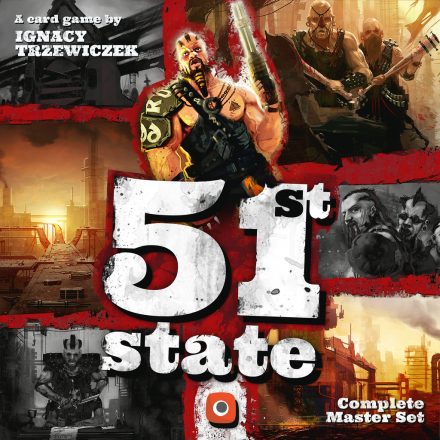
51st State: Master Set 🟠

The world you know no longer exists. There is no government. No army. No civilization. The United States has collapsed, and now thirty years after the war started, new powers finally try to take control over the ruined country, try to establish a new order, try to control others and create a new country, a new state: the 51st State.

51st State is a card game in which players control one of four powers trying to build a new country. Players put new locations into play, hire leaders, and send people to work in buildings to gain resources and new skills. To do this, every card in 51st State can be used in three different ways:

  • Raze a location to gain many resources once.
  • Deal with this location to gain one resource every turn.
  • Build the location so that you can use its skill each turn.

51st State: Master Set marks the rebirth of the 51st State line, with this set containing 88 cards from the original base game, and 50 cards each from both the New Era and Winter expansions; one of these expansions can be mixed with the cards of the base game, but not both at the same time. The entire set has been rebalanced to offer a cohesive experience no matter which expansion you choose to use.

Game Mechanics:

  • City Building
  • Economic
  • Hand Management
  • Open Drafting
  • Tableau Building
  • Worker Placement

Game Specifications:

  • 1 – 4 Players
  • 60 – 90 Minutes
  • Difficulty Weight 3.90

1848: Australia 🟠

1848 Australia, is a semi-historical railroad game from the 18xx set, and to which the designers credit some of this games’ systems to the originator of the series – Francis Tresham.

The game consists of two separate series of actions repeated until the game ends, these are stock rounds and operating rounds. During stock rounds, shares in the various railroading companies are bought & sold by players and are tracked on the stock market mat. During operating rounds, the player/directors of those railroading companies are allowed to build track & place station markers on the map, and then may buy trains from which to earn capital from running those trains along routes on the map. The capital earned may be paid out as dividends to shareholders or retained by the company for future expansion.

The game ends at a pre-determined point, whereupon the player with the most worth,(cash on hand & share certificate value) wins.

As with many games in this series, there are similarities within the rules, but many feature slight differences, and it is these that give each individual 18xx game its character.

1848 features an interesting array of differences described above. These include how private companies are purchased, the inclusion of The Bank Of England as a public company that extends loans and administers railroads that are in receivership, dealing with different track gauges between states and ‘The Ghan’ special train.

Game Mechanics:

  • Auction/Bidding
  • Economic
  • Network Building
  • Stock Holding
  • Tile Placement

Game Specifications:

  • 3 – 6 Players
  • 180 – 240 Minutes
  • Difficulty Weight 3.82

Zona: The Secret of Chernobyl

Zona: The Secret of Chernobyl

Zona: The Secret of Chernobyl

Zona is an adventure board game designed for 1-4 players. To win the game, player must reach the sarcophagus of Chernobyl Nuclear Power Plant before other players. The sarcophagus opens only when player had previously collected 2 Secrets from underground facilities known as Secret Locations. Players must hurry because there is a time limit to the game. When the Final Emission strikes, everything is lost…

GAMEPLAY
Each turn players take 2 Actions (move, explore, combat etc.) and then everyone read an Event Card which contains text for short adventure. At the end of turn, a News Card is drawn by the first player and resolved by him.

MOOD
This board game emphasizes the aspect of survival. Zone depicted on the playing board is an extremely hazardous and isolated area with very limited access to functional equipment and supplies. Players must remember to frequently repair their Items and buy new ones. It is also crucial to rest to reduce Fatigue and heal Damage.

STALKERS
Each player takes role of 1 Scavenger from the 10 included in the game. Each Scavenger has their own Special Skill, set of basic Skills and starting equipment. Values of stats such as AwarenessAgility or Intellect determine how good they are in avoiding dangers and traps, fighting mutants or gathering Artifacts from anomalies. The story of Scavenger explains his/herPersonal Goal – the reason for arriving to the Zone. Differences between Scavengers makes playing each one of them completely unique.

Game Mechanics:

  • Action Points
  • Dice Rolling
  • Push Your Luck

Game Specifications:

  • 1 – 4 Players
  • 120 – 180 Minutes
  • Difficulty Weight 2.76

Zombicide: Horde Box

Zombicide: Horde Box

Zombicide: Horde Box

The Zombicide: Horde Box contains all the extras added during the Kickstarter campaign for Zombicide: Green Horde and features an exclusive artwork by Jeremy Masson. The following items are included in the box:

  • 15 extra figures from the base game (1 Orc Necromancer, 1 Orc Abomination, 5 Orc Walkers, 4 Orc Runners, and 4 Orc Fatties);
  • 10 Kickstarter Exclusive Abominations with cards ((Werezombie, Siege Breaker, Vault Warden, Horde Brother, Swamp Lurker, The Magenta Covfefe of Aargh, Abominabunny, Gorgomination, Zombie Giant, Chromatiz);
  • 2 Kickstarter Exclusive Necromancers with cards ((Queen Severa, Count Temeraire);
  • 1 Kickstarter Exclusive Feral Dragon with cards;
  • 4 Kickstarter Exclusive Fatty Bursters with cards;
  • 1 Ballista;
  • 12 Kickstarter Exclusive New Equipment and Vault Cards;
  • 1 Kickstarter Exclusive Horde Tile;
  • 31 Kickstarter Exclusive Survivors with cards

Game Mechanics:

  • Cooperative
  • Dice Rolling

Game Specifications:

  • 1 – 6 Players
  • ~60 Minutes
  • Difficulty Weight 3.00

Yukon Airways

Yukon Airways

Yukon Airways

In Yukon Airways, you will be at the controls of your very own seaplane with the mission of transporting travelers to the different points of the Yukon. Embark your passengers (dice) using a draft system and use your ticket cards to take them to the different locations on the map. For each passenger, you get money and the possibility of improving your plane if the passenger finds a point of interest that satisfies their tastes at the destination (when the color of the die matches the color of one of the cubes at that destination). At the end of the game, you will earn extra money according to the different locations you have visited. The player who has earned the most money at the end of the week wins.

Game Mechanics:

  • Action Drafting
  • Dice Drafting
  • Hand Management
  • Open Drafting
  • Pick-Up and Deliver

Game Specifications:

  • 1 – 4 Players
  • 60 – 90 Minutes
  • Difficulty Weight 2.83

Yokohama

Yokohama

Yokohama

Once Yokohama was just a fishing village, but now at the beginning of the Meiji era it’s becoming a harbor open to foreign countries and one of the leading trade cities of Japan. As a result, many Japanese products such as copper and raw silk are collected in Yokohama for export to other countries. At the same time, the city is starting to incorporate foreign technology and culture, with even the streets becoming more modernized. In the shadow of this development was the presence of many Yokohama merchants.

In YOKOHAMA, each player is a merchant in the Meiji period, trying to gain fame from a successful business, and to do so they need to build a store, broaden their sales channels, learn a variety of techniques, and (of course) respond to trade orders from abroad.

Game Mechanics:

  • Economic
  • Grid Movement
  • Network Building
  • Set Collection
  • Worker Placement

Game Specifications:

  • 2 – 4 Players
  • ~90 Minutes
  • Difficulty Weight 3.29