Tag: Closed Drafting

Closed Drafting is a mechanic in which a player receives a private pool of resources to select from. This pool of resources is often then passed to the next player.

NEOM

NEOM

NEOM

NEOM is a modern city-building game featuring simultaneous drafting and tile placement that takes inspiration from games such as 7 WondersCarcassonne, and Sim City. Players compete to build the most impressive city utilizing a tree of 17 different goods (from three different tiers) that can each be unlocked, allowing the placement of increasingly powerful tiles as the game progresses. Tiles also feature roads which must be connected without being rotated, meaning that players must always plan their city layout with an eye to the future.

At the start of each game, players draft cornerstones — powerful, unique tiles that heavily change what is most valuable from game to game.

NEOM has been in development for seven years and the rules and tile set have been iterated on over the course of more than 3,500 games logged in a custom online prototype, leading to an exceptionally well balanced game with a wide variety of viable strategies.

Game Mechanics:

  • City Building
  • Closed Drafting
  • Take That
  • Tile Placement

Game Specifications:

  • 1 – 5 Players
  • ~45 Minutes
  • Difficulty Weight 2.60

Mille Fiori

Mille Fiori

Mille Fiori

In Reiner Knizia’s Mille Fiori (millefiori is a glasswork technique for decorative patterns, the name means Thousand Flowers), you take the role of glass manufacturers and traders who want to profit as much as they can from their role in the production of fine glass art.

The game board features different aspects of the glass production cycle: workshops where the glass is created, houses where it’s installed, people who support your work, trade shops where it’s sold, and the harbor where ships take the glass to faraway locations. You want to be present in all of these areas, preferably at just the right time to maximize your earnings. The gameboard features 109 spaces, with one card in the deck for each of those spaces.

At the start of a round, each player receives a hand of five cards. Each player chooses a card from hand, then passes the remaining cards to the next player, then each player plays their card in turn, beginning with the round’s start player and typically placing a diamond-shaped token of their color in the location depicted on that card:

  • In the Workshops, you score 1 point for each of your tokens in a connected group with the newly placed token, doubling that score if you played on a pigment field.
  • In the Residences, you score the listed number of points, and if your token is preceded in the line by one or more tokens of your color, you score those previously played tokens again.
  • In the Townspeople area, you score 1, 3 or 6 points based on the height of your token in the pyramids, but you can only place at higher levels if the lower spaces are filled. Double your points if the card symbol matches the space your filled. Supporting tokens score again as higher tokens are placed.
  • In the Trade shops, four types of goods are present, and when you place a token, each token on that goods type scores for its owner points equal to the number of goods of that type now covered.
  • In the Harbor, you move your ship equal to the number on the played card, scoring points based on the space where you land, then place a token in one of the five rows. When that row is filled with three ships, each token in that row scores for its owner 1/3/6/10 points depending on the number of trade goods in that row.

Alternatively, you can play a card for ship movement points and not place a token on the game board.

Each player plays four cards in a round (in a 3 or 4 player game), then adds the last card in hand to those displayed beside the game board, then the start player marker rotates and you begin a new round.

For each of the five areas, you can meet a certain condition that allows you to play a bonus card from those beside the game board, e.g., in the Workshops when you place the third card that surrounds a bonus card symbol, or in the Trade shops when you score a goods type that gives someone else more points than you. When you play a bonus card, you might trigger another bonus card… and then another!

Additionally, there are five different ways to score substantial bonus points for the areas, e.g., in the Residences you need to place tokens on houses of four different values, and in the Townspeople area you need to place tokens on all three types in a pyramid. You can only score each area’s bonus once, and importantly each time a bonus is claimed then the value available for later players is reduced.

When someone has placed their final diamond token or when you can’t deal a new hand of five cards to each player, then the game ends and the player with the most successful glass dynasty (most points) is declared the winner.

Game Mechanics:

  • Area Control
  • Closed Drafting
  • Pattern Building

Game Specifications:

  • 2 – 4 Players
  • 60 – 90 Minutes
  • Difficulty Weight 2.19

It’s a Wonderful World

It's a Wonderful World

It's a Wonderful World

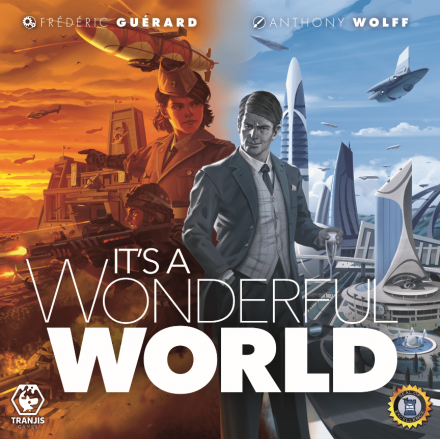
In It’s a Wonderful World, you are an expanding Empire and must choose your path to your future. You must develop faster and better than your competitors. You’ll carefully plan your expansion to develop your production power and rule over this new world.

It’s a Wonderful World is a cards drafting and engine building game from 1 to 5 players. Each round, players will draft 7 cards and then choose which ones will be recycled to immediately acquire Resources, and which ones will be kept for construction to produce Resources each round and/or gain victory points.

When a card is fully built, it’s added to the player’s Empire to increase the player’s production capacity for each round. The mechanical twist being that the production phase works in a specific order. You’ll have to plan your constructions carefully!

Game Mechanics:

  • Civilization
  • Closed Drafting
  • Economic
  • Hand Management
  • Set Collection

Game Specifications:

  • 1 – 5 Players
  • 30 – 60 Minutes
  • Difficulty Weight 2.30

The Isle of Cats

The Isle of Cats

The Isle of Cats

The Isle of Cats is a competitive, medium-weight, card-drafting, polyomino cat-placement board game for 1-4 players.

In the game, you are citizens of Squalls End on a rescue mission to The Isle of Cats and must rescue as many cats as possible before the evil Lord Vesh arrives. Each cat is represented by a unique tile and belongs to a family, you must find a way to make them all fit on your boat while keeping families together. You will also need to manage resources as you:

  • Explore the island (by drafting cards)
  • Rescue cats
  • Find treasures
  • Befriend Oshax
  • Study ancient lessons

Each lesson you collect gives you another personal way of scoring points, and 38 unique lessons are available. Complete lessons, fill your boat, and keep cat families together to score points, and the player with the most points after five rounds wins.

Game Mechanics:

  • Closed Drafting
  • Grid Coverage
  • Open Drafting
  • Pattern Building
  • Puzzle
  • Set Collection
  • Tile Placement

Game Specifications:

  • 1 – 4 Players
  • 60 – 90 Minutes
  • Difficulty Weight 2.31

The Great Split

The Great Split

The Great Split

In The Great Split, you draft cards to collect riches such as gems, gold, artwork, and tomes, adding them to your collection to make it the most prestigious of all!

You start each round by splitting your cards into two groups, then you pass your wallet to the player on your left — but only one group of cards will be given back to you. You split, they choose! Don’t despair, though, because while your opponent is looking at your split, you also receive a similar offer from the player on your right, so choose wisely. When your hand is complete, play your cards to add all those riches to your collection.

Each type of riches awards you prestige points in different ways, so maintain a balanced collection of gems, keep an eye on the value of the art market as it evolves, and pile up priceless tomes. Depending on how each player builds their collection, different riches will take on a different value for each of them. Show off your best haggling skills in crafting your split, and create the perfect offer to push your opponent to take what you want them to take…leaving you with the tastiest loot!

Be prepared for when the mid-game scorings are triggered. Manage your gold reserves sensibly to get additional riches, and make your collection just right!

Game Mechanics:

  • Closed Drafting

Game Specifications:

  • 2 – 7 Players
  • ~45 Minutes
  • Difficulty Weight 2.00

Bunny Kingdom

Peace has come at last to the great Bunny Kingdom! Lead your clan of rabbits to glory by gathering resources and building new cities across the land!

Draft cards and pick the right ones to position your warrens on the 100 squares of the board, provide resources to your colonies, build new cities to increase your influence, and plan your strategy to score big at the end of the game. Settle in lakesides or fields to collect water and grow carrots, gather mushrooms in the green forest, and climb the highest mountains to discover rare and precious resources… Secretly rally rabbit lords and recruit skillful masters to make your cities and resources even more valuable at the end of the game.

After each turn, your groups of contiguous warrens grant you points depending on the cities and different resources they include. The game ends after 4 rounds, and the player with the most points wins the game.

Game Mechanics:

  • Area Majority / Influence
  • Closed Drafting
  • Grid Coverage
  • Hand Management

Game Specifications:

  • 2 – 4 Players
  • 40 – 60 Minutes
  • Difficulty Weight 2.30

Brian Boru: High King of Ireland

In Brian Boru: High King of Ireland, you strive to unite Ireland under your domain, securing control through might, cunning, and matrimony. Join forces to fend off Viking invaders, build monasteries to extend your influence, and gather support in towns and villages throughout the land. To become High King of all Ireland, you need to navigate a web of shifting alliances, outmaneuver your enemies, and grab history by the reins.

The success of the historical Brian Boru rested on three pillars: his victories against the Vikings, the favor he managed to garner with the Church, and the alliances he forged through political marriages. This became the foundation of the game, with each pillar becoming a suit in the trick-taking that forms the core of the mechanisms. Win a trick and you gain influence in a town, which, in turn, gains you majorities in the regions; if you lose the trick, however (deliberately or otherwise), you instead take an action corresponding to the suit of the card.

Game Mechanics:

  • Area Majority / Influence
  • Closed Drafting
  • Hand Management
  • Trick-taking
  • Variable Phase Order

Game Specifications:

  • 3 – 5 Players
  • 60 – 90 Minutes
  • Difficulty Weight 2.54

Between Two Cities

It is the early 1800s, a time of immense construction and urbanization. You are a world-renowned master city planner who has been asked to redesign two different cities. Projects of such significance require the expertise of more than one person, so for each assignment you are paired with a partner with whom to discuss and execute your grandiose plans. Will your planning and collaborative skills be enough to design the most impressive city in the world?

Between Two Cities is a partnership-driven tile-drafting game in which each tile represents part of a city: factory, shop, park, landmarks, etc. You work with the player on your left to design the heart of one city, and with the player on your right to design the heart of another city. On each turn you select two tiles from hand, reveal them, then work with your partners separately to place one of those tiles into each of your two cities before passing the remaining hand of tiles around the table.

At the end of the game, each city is scored for its livability. Your final score is the lower of the livability scores of the two cities you helped design. To win, you have to share your attention and your devotion between two cities. The player with the highest final score wins the game.

Game Specifications:

  • 1 – 7 Players
  • ~25 Minutes
  • Difficulty Weight 1.82

Bargain Quest

Bargain Quest is a game of adventure and capitalism for 2-6 players. Players will take the role of shopkeepers in an adventuring town plagued by monsters. Players must draft items and then secretly choose which items to place in their windows to attract wealthy heroes to their shops.

Once all heroes have been equipped, they venture out to battle against monstrous threats, earning money and prestige for the shop they represent. Throughout the game players will encounter new heroes and monsters while upgrading their shops and hiring employees. Once the third monster is defeated the player who has earned the most gold and prestige is the winner.

Game Specifications:

  • 2 – 6 Players
  • 30 – 60 Minutes
  • Difficulty Weight 2.01

7 Wonders Duel 🟢

In many ways 7 Wonders Duel resembles its parent game 7 Wonders as over three ages players acquire cards that provide resources or advance their military or scientific development in order to develop a civilization and complete wonders.

What’s different about 7 Wonders Duel is that, as the title suggests, the game is solely for two players, with the players not drafting cards simultaneously from hands of cards, but from a display of face-down and face-up cards arranged at the start of a round. A player can take a card only if it’s not covered by any others, so timing comes into play as well as bonus moves that allow you to take a second card immediately. As in the original game, each card that you acquire can be built, discarded for coins, or used to construct a wonder.

Each player starts with four wonder cards, and the construction of a wonder provides its owner with a special ability. Only seven wonders can be built, though, so one player will end up short.

Players can purchase resources at any time from the bank, or they can gain cards during the game that provide them with resources for future building; as you acquire resources, the cost for those particular resources increases for your opponent, representing your dominance in this area.

A player can win 7 Wonders Duel in one of three ways: each time you acquire a military card, you advance the military marker toward your opponent’s capital, giving you a bonus at certain positions; if you reach the opponent’s capital, you win the game immediately; similarly, if you acquire any six of seven different scientific symbols, you achieve scientific dominance and win immediately; if none of these situations occurs, then the player with the most points at the end of the game wins.

Game Specifications:

  • 2 Players
  • ~30 Minutes
  • Difficulty Weight 2.22