Tag: Hand Management

Hand Management is a game mechanic in which players are rewarded for playing cards in a specific order. This mechanic often encourages players to hold cards for later turns.

Living Planet

Living Planet

Living Planet

In Living Planet, each player represents one major Galactic Corporation exploiting the distant planet MYC.14.250. Each one of them is eager to industrialize the planet and generate as much profit as possible before the planet self-destructs.

To do so, you’ll have to explore the planet to grow the map. You’ll manage your team to extract resources with factory buildings you’ve built, and trade resources at the stock market to make money. And above anything else, you’ll have to handle cataclysms generated by the planet. But cataclysms don’t happen randomly, players trigger them through their actions, using their card set. Confrontation between players will take place through the planet.

Players will alternately take the leader role for each turn. Each turn follows a specific game turn sequence. Every player will have some actions to accomplish at a turn, in the order the Leader chooses, resolving the sequence : Resources production – Action (Explore, Move, Construct, Trade…) – Cataclysms.

At the end of the game each player will earn victory points based on how much money they have and how many buildings and vehicles they control.

Game Mechanics:

  • Area Control
  • Economic
  • Grid Movement
  • Hand Management
  • Tile Placement
  • Worker Placement

Game Specifications:

  • 2 – 4 Players
  • 30 – 120 Minutes
  • Difficulty Weight 3.64

Legend of the Five Rings Card Game

Legend of the Five Rings Card Game

Legend of the Five Rings Card Game

Welcome to the realm of Rokugan: a land of samurai and mystics, mad dragons and divine beings — a land where honor is stronger than steel. Here, the clans serve the Emperor and engage in courtly deceptions and power plays, even as they wage war against each other and the evil forces that plague their realm. This is the world of Legend of the Five Rings!

Legend of the Five Rings: The Card Game is a Living Card Game set in the world of Rokugan, the original setting for the Legend of the Five Rings collectible card game. To play a Living Card Game, players create individual decks of cards from a base game with a fixed set of cards; they can then add supplemental card packs to this game world, with each pack also having a fixed set of cards, in order to vary their game experience.

While the connection of Legend of the Five Rings: The Card Game to Rokugan and the Colonies — as well as its pervasive themes of honor, nobility, magic, intrigue, duty, and warfare — should carry over from the original L5R CCG, Legend of the Five Rings: The Card Game is not compatible with that original game and will feature significant changes in the game mechanisms.

Game Mechanics:

  • Action Points
  • Deck Building
  • Hand Management

Game Specifications:

  • 2 Players
  • 45 – 90 Minutes
  • Difficulty Weight 4.01

In Too Deep

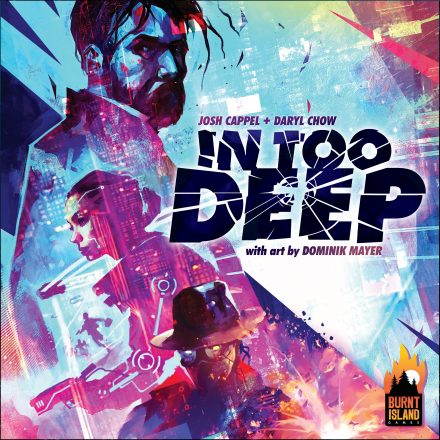
In Too Deep is a unique, narrative that thrusts you into the future in a tense, strategic board game for 1-5 players. Draft characters and spend actions to complete objectives and collect sets. What side of the law will you end up on?

In the year 2087, central governments have fallen. What remains are fragmented citystates like New Dawn City, struggling to keep chaos at bay. The sinister Syndicate targets these weakened cities for domination by usurping, organizing, and enhancing the existing criminal elements. In the world of In Too Deep, you are part of a secret agency dedicated to stopping the Syndicate at all costs.

Cybernetic implants give Syndicate operatives a technological advantage, but you have found a way to exploit that power. By infiltrating their cerebral upgrades, you can gain control of these criminals. Going deep undercover into the minds of your targets, you’ll coordinate crimes of escalating seriousness to get your hands on the critical evidence needed to foil the Syndicate’s looming plot.

Each turn, you can hook into a new criminal and manipulate their activities throughout the city, accessing powerful skills and increased stamina as you grow familiar with their minds. Your physical body is in a secret lab far from the actual action, but you are by no means safe. Entering the mind of criminals takes its toll on your morality.

Orchestrate crimes, strive to put the information you gather to the best use, wrestle with dangerously corrupting dilemmas, and try to hold yourself together. It will take everything you’ve got to avoid going In Too Deep.

Game Specifications:

  • 1 – 5 Players
  • 60 – 90 Minutes
  • Difficulty Weight 3.43

Great Western Trail: Argentina

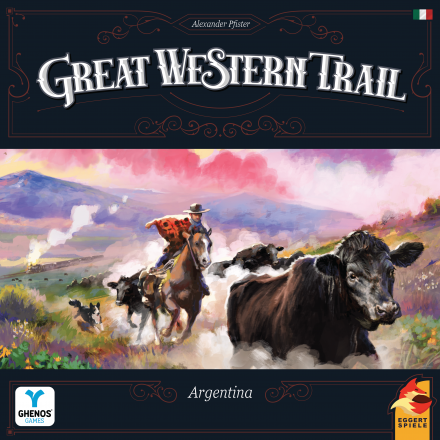
In Great Western Trail: Argentina, you own a vast estancia in Argentina at the end of the 19th century, and you will need to travel the plains of the Pampas with your cattle to deliver them to the main train station in Buenos Aires.

Great Western Trail: Argentina features gameplay elements similar to Great Western Trail such as deck management, the rondel mechanism, and the ability to upgrade your player board, along with twists on these elements and new features.

The player board features a new type of worker — farmers — and different paths await on the game board to confront you with more choices. Will you take the road with buildings or a path past farmers? Maybe you’ll have the chance to use your cows — well, the strength on your cow cards — to help farmers, getting them on your side and adding grain, a new type of resource, to your income, with grain being used for boat and city tiles.

Perhaps you can unlock shortcuts that allow you to deliver your herd to Buenos Aires more quickly. Sure, you’ll forfeit the use of action buildings, but maybe you can catch others unaware, with the ships leaving before they deliver. The timing of reaching the central train station to deliver your herd has never been so crucial, and valuable bonuses await on the city’s port tiles.

Money is easier to get in Great Western Trail: Argentina, but you have more to manage in terms of action options, shortcuts, and cards (including the new exhaustion cards), so the challenges won’t let up.

Great Western Trail: Argentina also includes a solitaire challenge in which Pedro is waiting for you to try to beat his score.

Game Specifications:

  • 1 – 4 Players
  • 75 – 120 Minutes
  • Difficulty Weight 3.83

Great Western Trail

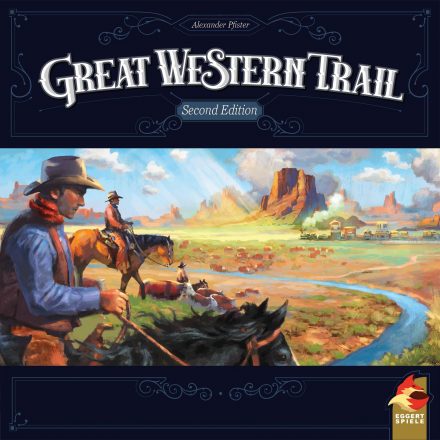
America in the 19th century: You are a rancher and repeatedly herd your cattle from Texas to Kansas City, where you send them off by train. This earns you money and victory points. Needless to say, each time you arrive in Kansas City, you want to have your most valuable cattle in tow. However, the “Great Western Trail” not only requires that you keep your herd in good shape, but also that you wisely use the various buildings along the trail. Also, it might be a good idea to hire capable staff: cowboys to improve your herd, craftsmen to build your very own buildings, or engineers for the important railroad line.

If you cleverly manage your herd and navigate the opportunities and pitfalls of Great Western Trail, you surely will gain the most victory points and win the game.

Game Specifications:

  • 2 – 4 Players
  • 75 – 150 Minutes
  • Difficulty Weight 3.71

Flotilla

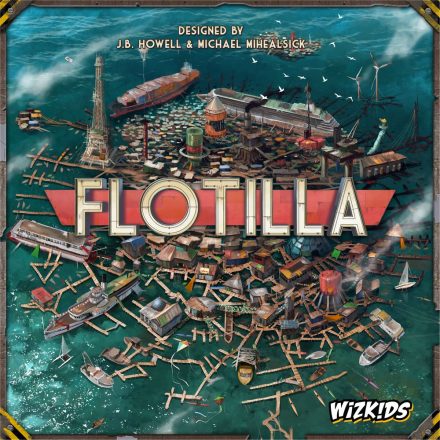
In 1954, with an explosion over a hundred thousand times more powerful than even the wildest estimates, the Castle Bravo nuclear test obliterated the Bikini Atoll, and ruptured the Earth down to its mantle.

As water levels rose in the aftermath, the remnants of humanity fled their homes and took to the sea. World leadership came together to build a massive Flotilla, mankind’s last bastion of civilization.

Now, ten years after the disaster, the Flotilla is home to the very last of us.

Flotilla features two distinct and interwoven modes of gameplay, as you try to outpace your opponents in bringing prosperity to humanity’s new home. You begin the game as a “Sinkside” Fleet Commander, commissioned by world leaders to explore the new face of the ocean, scour the depths for resources, and rescue any survivors you come across. At any point in the game, you may choose to turn “Skyside,” by selling your skiffs, and leaving your seafaring life behind to now grow the Flotilla itself.

The choice of if or when to switch from a “Sinkside” explorer to a “Skyside” settler defines the very core experience of Flotilla. They represent two similar but distinct game experiences, utilizing the same game components, seamlessly intertwined among all players. If you switch, you’ll flip over all of your accumulated game components, watching your crew grow into new roles with new art for the same characters, while finding entirely new uses for your ocean tiles and resources, and beginning to trade with the “Sinkside” players as you go after new objectives. As players turn “Skyside,” different niches are filled, forever changing the game’s economy. Mastering this ebb and flow will be critical if you’re to shape the new face of humanity!

As a “Sinksider,” you will explore the ocean with your skiffs, pulling some of the 92 hexagon-shaped ocean tiles out of a bag, and arranging them to help you effectively collect resources, discover valuable artifacts from the sunken civilization, all while trying to avoid toxic radiation left from the disaster. You’ll dive for supplies, rolling a pool of custom dive dice that vary based on the depth level of your skiffs. You’ll also carefully manage your resources, trading them on the open market for the currency you can use to buy more skiffs and outposts, or stockpiling them for when you turn “Skyside.”

As a “Skysider,” you will use your resources to build an expansive network of watercraft and docks, using the “Skyside” of your ocean tiles. Your divers will also have new jobs as researchers, rolling custom, multicolor Research dice, to discover new technologies that allow the Flotilla to manage a growing population. You’ll also build Sonar stations, making life a little easier for the “Sinksiders” still out exploring the unknown, while earning quite a few points for yourself.

On both sides, you’ll also grow your relationships with the four different governing guilds, each giving you unique bonuses and more powerful crew. The players with the strongest relationships will also earn valuable points at the end of the game!

The components in Flotilla are unique, immersive, and interconnected. Your skiffs will be able to actually carry up to four resource barrels, and come in a unique shape for each player color. Artifact tokens slot into matching spaces in a double-layered hub board and art on the ocean tiles lines up to create a unique layout for your growing Flotilla each time you play.

In Flotilla, you’ll find significant strategic depth and variety, while giving players the freedom to tell their own story. Will you build the Flotilla by being the first to go Skyside, or stay Sinkside for the whole game, becoming the most powerful seafarer of them all?

Game Specifications:

  • 3 – 5 Players
  • 90 – 150 Minutes
  • Difficulty Weight 3.82

The Colonists

The Colonists

The Colonists

In The Colonists, a.k.a. Die Kolonisten, each player is a mayor of a village and must develop their environment to gain room for new farmers, craftsmen, and citizens. The main goal of the game is full employment, so players must create new jobs, educate the people, and build new houses to increase their population. But resources are limited, and their storage leads to problems that players must deal with, while also not forgetting to upgrade their buildings. Players select actions by moving their mayor on a central board.

The Colonists is designed in different levels and scenarios, and even includes something akin to a tutorial, with the playing time varying between 30 minutes (for beginners) and 180 minutes (experts).

Game Mechanics:

  • Area Movement
  • Civilization
  • Hand Management
  • Open Drafting
  • Tile Placement
  • Worker Placement

Game Specifications:

  • 1 – 4 Players
  • 30 – 300 Minutes
  • Difficulty Weight 4.08

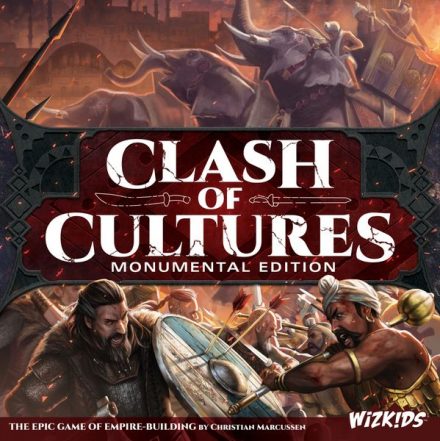
Clash of Cultures: Monumental Edition

Clash of Cultures: Monumental Edition brings back the classic game of exploration, expansion, and development with the Clash of Cultures base game and the Civilizations and Aztecs expansions in one box! Grow your civilization, advance your culture and tech, and leave your mark by building wonders, with this edition of the game including fully-sculpted miniatures of the Seven Wonders.

In Clash of Cultures, each player leads a civilization from a single settlement to a mighty empire. Players must explore their surroundings, build large cities, research advances and conquer those who stand in the way. The game features a modular board for players to explore, 48 distinct advances, seven mighty wonders, and loads of miniatures and cards. The winner will create a culture that will be remembered and admired for millennia.

Game Mechanics:

  • City Building
  • Hand Management
  • Modular Board
  • Tech Trees / Tech Tracks
  • Trading
  • Variable Player Powers

Game Specifications:

  • 2 – 4 Players
  • 180 – 240 Minutes
  • Difficulty Weight 3.72

Circadians: Chaos Order

The initial quakes were only minor tremors, but as the land began to unravel, so did our sense of security. We watched the cliffs of Hytazch fall into the sea. Mighty trees of old, swallowed up by the caverns below. As the waters rose, a great roar was heard across the plains. This was no cry of disbelief or heartache, but of jubilance. Songs began to fill the air as our once peaceful hosts, now readied themselves for war. Suddenly on the horizon, what appeared as huge bolts of energy shoot out into the depths of space, before disappearing again. Despite the inevitable shock wave heading our way, the clans continued to cheer as they made haste towards the origin of the blaze. What could cause such elation? Why abandon caution in favour of chaos? Had we missed something – some crucial misunderstanding of this planet and its inhabitants? Upon reaching the site, we were immediately plunged into combat. Across the landscape lay six massive structures, towering over the forces fighting below. They seemed to pulse and flicker with a golden haze. Could these be the ancient relics the Oxataya spoke of? There is so much we still do not understand, but we cannot concede to indecision. Will we stay and fight, or retreat back to Moontide?

In Circadians: Chaos Order, players take on the role of 1 of 6 asymmetric factions. Each faction has their own means of winning the game, unique leaders, attribute cards and other abilities.

Game Mechanics:

  • Action Drafting
  • Area Majority / Influence
  • Hand Management
  • Variable Player Powers
  • Wargame

Game Specifications:

  • 2 – 5 Players
  • 120 – 240 Minutes
  • Difficulty Weight 3.84

Brass: Lancashire

Brass: Lancashire — first published as Brass — is an economic strategy game that tells the story of competing cotton entrepreneurs in Lancashire during the industrial revolution. You must develop, build, and establish your industries and network so that you can capitalize demand for iron, coal and cotton. The game is played over two halves: the canal phase and the rail phase. To win the game, score the most victory points (VPs), which are counted at the end of each half. VPs are gained from your canals, rails, and established (flipped) industry tiles. Each round, players take turns according to the turn order track, receiving two actions to perform any of the following:

  1. Build an industry tile
  2. Build a rail or canal
  3. Develop an industry
  4. Sell cotton
  5. Take a loan

At the end of a player’s turn, they replace the two cards they played with two more from the deck. Turn order is determined by how much money a player spent on the previous turn, from lowest spent first to highest spent. This turn order mechanism opens some strategic options for players going later in the turn order, allowing for the possibility of back-to-back turns.

After all the cards have been played the first time (with the deck size being adjusted for the number of players), the canal phase ends and a scoring round commences. After scoring, all canals and all of the lowest level industries are removed for the game, after which new cards are dealt and the rail phase begins. During this phase, players may now occupy more than one location in a city and a double-connection build (though expensive) is possible. At the end of the rail phase, another scoring round takes place, then a winner is crowned.

The cards limit where you can build your industries, but any card can be used for the develop, sell cotton or build connections actions. This leads to a strategic timing/storing of cards. Resources are common so that if one player builds a rail line (which requires coal) they have to use the coal from the nearest source, which may be an opponent’s coal mine, which in turn gets that coal mine closer to scoring (i.e., being utilized).

Brass: Lancashire, the 2018 edition from Roxley Games, reboots the original Warfrog Games edition of Brass with new artwork and components, as well as a few rules changes:

  • The virtual link rules between Birkenhead have been made optional.
  • The three-player experience has been brought closer to the ideal experience of four players by shortening each half of the game by one round and tuning the deck and distant market tiles slightly to ensure a consistent experience.
  • Two-player rules have been created and are playable without the need for an alternate board.
  • The level 1 cotton mill is now worth 5 VP to make it slightly less terrible.

Game Mechanics:

  • Economic
  • Hand Management

Game Specifications:

  • 2 – 4 Players
  • 60 – 120 Minutes
  • Difficulty Weight 3.85