Tag: Limited Communication

Limited Communication is a game mechanic in which players are not allowed to openly communicate about their game strategy with each other.

So Clover!

So Clover!

So Clover!

So Clover! is a cooperative word-association game. Play as a team to get the highest score. Get Keywords and secretly write their common features on your Clover board; these are your Clues. Then work together to try to figure out each player’s Keywords. At the end of the game, add up your score according to how many Keywords you found and write it in the Record of Legends. Try to beat your high score each game!

Game Mechanics:

  • Cooperative
  • Limited Communication
  • Party Game
  • Word Game

Game Specifications:

  • 3 – 6 Players
  • ~30 Minutes
  • Difficulty Weight 1.09

Phantom Ink

Phantom Ink

Phantom Ink

Renowned mediums are competing to figure out a secret object and prove they can connect with the “World Beyond”. The first team to figure out the secret object wins!

To set up Phantom Ink, divide players so that the Sun team and the Moon team each have one Spirit and up to three Mediums. The mediums on a team share a hand of seven question cards, and the spirits begin the game by choosing one of the five objects on a card as the secret object. On a turn, the mediums pass two question cards to their spirit, with sample questions like “What color is it most commonly?”, “What fictional character has it or uses it?”, and “If it were a musical instrument, what would it be?”

The spirit discards one question card face up, then returns the question card it’s going to answer to their mediums, then slowly writes the answer one letter at a time for all to see. As soon as the mediums think they know what this clue word is, they yell “Silencio”, and the spirit stops writing. The other team of mediums might see only the letter “Y”, but if you know the question is “What color is it?”, then you know the clue must be “yellow”. To end your turn, draw two new question cards.

On a turn, instead of handing over question cards, you can attempt to guess the answer — and to do so you write like the spirits, one letter at a time. If you write an incorrect letter, the spirits will stop you, marking out your error, with your partial guess giving the other team more information. If you guess the entire word correctly, you win!

Game Mechanics:

  • Deduction
  • Limited Communication
  • Party Game
  • Puzzle
  • Targeted Clues
  • Team Based
  • Word Game

Game Specifications:

  • 4 – 8 Players
  • 10 – 15 Minutes
  • Difficulty Weight 1.33

Mystic Paths

Mystic Paths

Mystic Paths

In the deduction game Mystic Paths, players are challenged to navigate paths through a labyrinth called the Eternal Forest. Each player’s path is unique — and only you know the way. However, you cannot traverse the forest alone. Your teammates are needed to open the sealed portals along each step. Give clever clues, hope your teammates can read your mind, and complete your journey!

To complete the journey, each player takes a turn providing clues about which portal is their next step. Each step can have up to five different portals, but only one is the correct one, so players give clues that relate (hopefully) to the correct next step.

The challenge is that the only clues available are cards that have been dealt, so sometimes the clues may not relate to the next portal of a journey, which means you have to get creative. This is where you need to try to read the minds of your teammates. For example, the next portal on your journey could be the word “anteater”, and your clues are limited to cards you are dealt, like scary, or tall, or handsome. Which would you choose as your clue?

The game takes place in five rounds. Beat the game by having everyone complete their own journey before the five rounds are over.

Game Mechanics:

  • Cooperative
  • Deduction
  • Limited Communication
  • Party Game
  • Targeted Clues
  • Team Based
  • Word Game

Game Specifications:

  • 2 – 6 Players
  • 45 – 60 Minutes
  • Difficulty Weight 1.70

Mysterium Kids

Mysterium Kids

Mysterium Kids

Legend has it that the old mansion on the outskirts of the city is home to a fabulous treasure! Hoping to find it, you decide to spend the night there. You are about to give up when the ghost of Captain Echo appears to help you find his treasure. He isn’t much of a talker, but he plays a mean tambourine, and he’s going to use it to tell you which rooms to search in!

Players cooperate to find Captain’s treasure before the moon has traveled across the sky and the night is over. Each round, one player becomes the Ghost of Captain Echo. The Ghost must use a tambourine to give clues that help the other players guess the correct Noise card. If they do, they get to reveal a piece of the Captain’s treasure.

Game Mechanics:

  • Cooperative
  • Limited Communication

Game Specifications:

  • 2 – 6 Players
  • 21 Minutes
  • Difficulty Weight 1.50

Hues and Cues

Hues and Cues

Hues and Cues

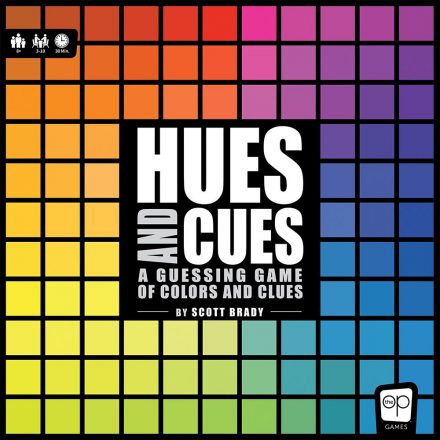
What hue do you think of when we say “apple”? Hues and Cues is a vibrant game of colorful communication where players are challenged to make connections to colors with words. Using only one and two-word cues, players try to get others to guess a specific hue from the 480 colors on the game board. The closer the guesses are to the target, the more points you earn. Since everyone imagines colors differently, connecting colors and clues has never been this much fun!

Gather around with three to ten people to play a quick and simple game with a prism of possibilities! First, a “cue giver” hides a specific color they’ve chosen out of a deck of cards. There are 480 shades on the board in front of you! After getting one- and two-word cues, everyone places their marker on which color they think is being described. “Coffee.” Is it dark brown, as in freshly brewed? “Au lait.” With milk. That means I should pick a lighter shade!

Use examples from everyday life, from nature to pop culture, or materials and moods. Everyone around the table gets a turn to give cues and guess. The better your hints or guesses, the more points you earn. Play off others’ experiences to narrow down what they have in mind!

Game Mechanics:

  • Deduction
  • Limited Communication
  • Party Game
  • Targeted Clues

Game Specifications:

  • 3 – 10 Players
  • ~30 Minutes
  • Difficulty Weight 1.17

Concept

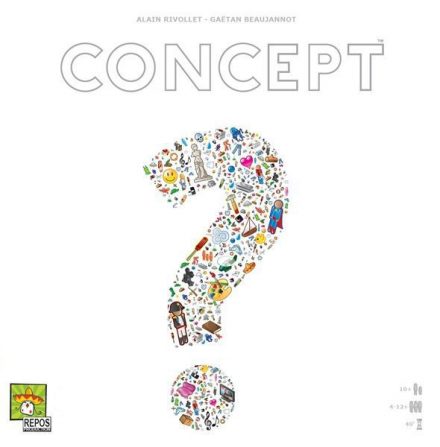
In Concept, your goal is to guess words through the association of icons. A team of two players – neighbors at the table – choose a word or phrase that the other players need to guess. Acting together, this team places pieces judiciously on the available icons on the game board.

To get others to guess “milk”, for example, the team might place the question mark icon (which signifies the main concept) on the liquid icon, then cubes of this color on the icons for “food/drink” and “white”. For a more complicated concept, such as “Leonardo DiCaprio”, the team can use the main concept and its matching cubes to clue players into the hidden phrase being an actor or director, while then using sub-concept icons and their matching cubes to gives clues to particular movies in which DiCaprio starred, such as Titanic or Inception.

The first player to discover the word or phrase receives 2 victory points, the team receives points as well, and the player who ends up with the most points wins.

Game Mechanics:

  • Deduction
  • Limited Communication
  • Party Game
  • Race
  • Team-Based Game

Game Specifications:

  • 4 – 12 Players
  • ~40 Minutes
  • Difficulty Weight 1.38

Codenames: Marvel

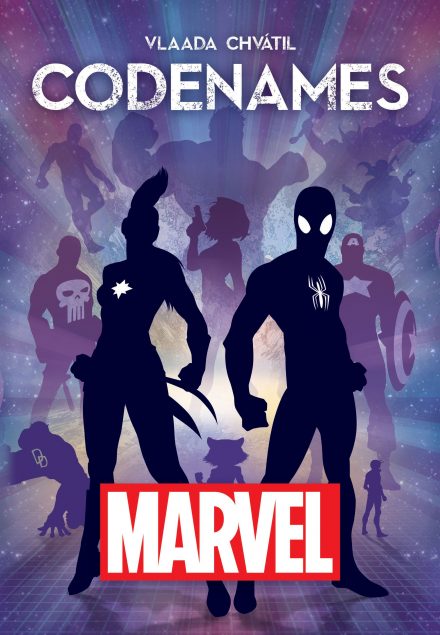
Codenames: Marvel combines the hit social word game Codenames, while featuring characters and locations from the Marvel Universe including, Spider Man, Guardians of the Galaxy, The Avengers and Doctor Strange.

In Codenames, two teams — S.H.I.E.L.D. and Hydra in this case — compete to see who can guess all of their field agents (identified by either a word or picture) correctly first — but those field agents are hiding in plain sight in a 5×5 grid that includes the agents of the other team, neutral words, and an assassin that will cause you to lose the game immediately if you guess it. One person on each team is a spymaster and only these two know which agents belong to each team. Spymasters take turns giving one-word clues that can help their teammates identify multiple agents on the board. Their teammates try to guess agents of the right color while avoiding those that belong to the opposing team — and everyone wants to avoid the assassin.

Game Mechanics:

  • Deduction
  • Limited Communication
  • Memory
  • Party Game
  • Push Your Luck
  • Team-Based Game

Game Specifications:

  • 2 – 8 Players
  • ~15 Minutes
  • Difficulty Weight 1.17

Codenames: Duet

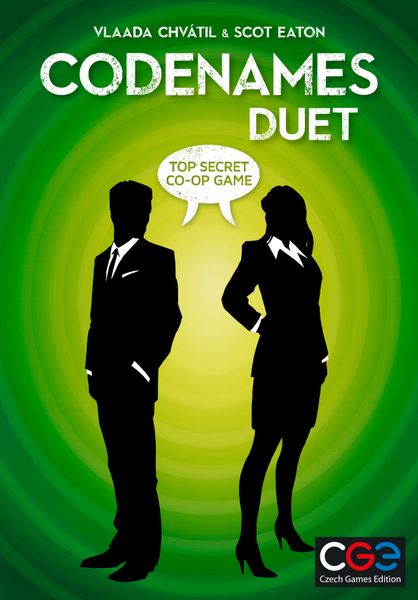
Codenames Duet keeps the basic elements of Codenames — give one-word clues to try to get someone to identify your agents among those on the table — but now you’re working together as a team to find all of your agents. (Why you don’t already know who your agents are is a question that Congressional investigators will get on your back about later!)

To set up play, lay out 25 word cards in a 5×5 grid. Place a key card in the holder so that each player sees one side of the card. Each player sees a 5×5 grid on the card, with nine of the squares colored green (representing your agents) and three squares colored black (representing assassins). Three of the nine squares on each side are also green on the other side, one assassin is black on both sides, one is green on the other side and the other is an innocent bystander on the other side.

Collectively, you need to reveal all fifteen agents — without revealing an assassin — before time runs out in order to win the game. Either player can decide to give the first one-word clue to the other player, along with a number. Whoever receives the clue places a finger on a card to identify that agent. If correct, they can attempt to identify another one. If they identify a bystander, then their guessing time ends. If they identify an assassin, you both lose! Unlike regular Codenames, they can keep guessing as long as they keep identifying an agent each time; this is useful for going back to previous clues and finding ones they missed earlier. After the first clue is given, players alternate giving clues.

Game Mechanics:

  • Cooperative
  • Deduction
  • Limited Communication
  • Memory
  • Push Your Luck
  • Word Game

Game Specifications:

  • 2 Players
  • 15 – 30 Minutes
  • Difficulty Weight 1.36

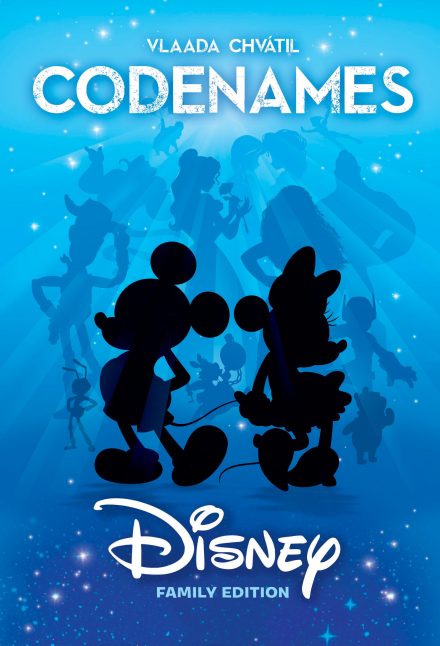
Codenames: Disney – Family Edition

In Codenames, two teams compete to see who can guess all of their words correctly first — but those words are hiding in plain sight in a 5×5 or grid that includes the words of the other team, neutral words, and an game over card that will cause you to lose the game immediately if you guess it. One person on each team is a spymaster and only these two know which words belong to each team. Spymasters take turns giving one-word clues that can point to multiple words on the board. Their teammates try to guess words of the right color while avoiding those that belong to the opposing team — and everyone wants to avoid the game over card. This version also comes with 4×4 grid cards with no game over spot to make it more accessible for families and children.

The Disney Family Edition of Codenames combines the hit social word game with some of Disney’s most beloved properties from the past 90 years. Including both pictures and words, it’s family fun for Disney fans of all ages.Codenames: Disney Family Edition keeps the Codenames gameplay, while featuring characters and locations from over 90 years of Disney and Pixar films..

Game Mechanics:

  • Deduction
  • Limited Communication
  • Memory
  • Party Game
  • Push Your Luck
  • Team-Based Game
  • Word Game

Game Specifications:

  • 2 – 8 Players
  • ~15 Minutes
  • Difficulty Weight 1.23